

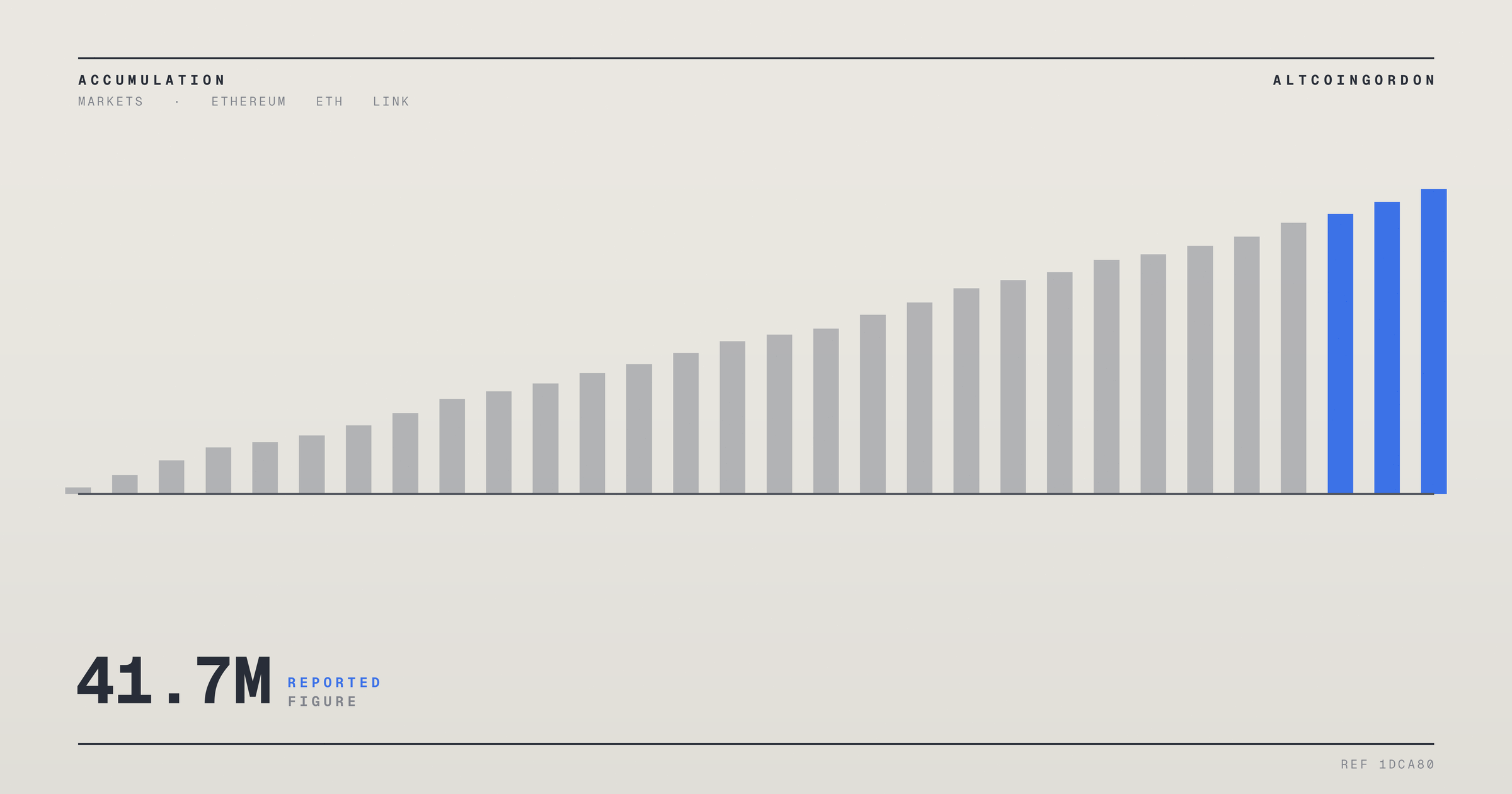
Ethereum's staked supply has climbed to a new record of 41.7 million ETH. That figure was reported by crypto.news and confirmed by TronWeekly. The record comes even as ETH's market price has faced pressure in recent trading.
Staking on Ethereum involves locking ETH to help secure the network under its proof-of-stake system. Validators who stake their tokens earn rewards for confirming transactions and producing blocks. The more ETH that gets locked into staking contracts, the smaller the portion of supply that remains freely tradable on exchanges.
A rising staked supply typically reduces the liquid float of ETH available for spot trading. Analysts often watch this metric as a signal of long-term investor conviction. Holders choosing to stake rather than sell suggest a willingness to commit capital for extended periods, regardless of near-term price swings.
The timing of this record is notable. Staking has grown even as ETH's price has struggled to gain traction. That combination points to a split between network-level fundamentals and short-term market sentiment. Investors adding to staked positions appear focused on yield and participation rather than immediate price momentum.
Ethereum's staking mechanism has expanded steadily since the network's shift to proof-of-stake. Validator counts and total staked ETH have generally trended upward over time. Periodic increases reflect both new capital entering the ecosystem and existing holders shifting from spot holdings into staking positions.
The 41.7 million ETH figure represents a meaningful share of Ethereum's total circulating supply. Locking that much ETH into staking contracts reduces the amount theoretically available to sell at any given moment. Market watchers often cite tightening liquid supply as a factor that can influence price behavior over longer time horizons, though it does not guarantee any particular short-term outcome.
Both crypto.news and TronWeekly framed the record staking figure alongside ETH's price weakness, without asserting a direct causal link between the two trends. The reports describe parallel developments rather than claiming one is driving the other.
Market Impact
A record staked supply reduces the pool of ETH readily available for trading on exchanges. That dynamic can, over time, contribute to tighter liquidity conditions in spot markets. However, the immediate price weakness reported alongside this record shows that reduced liquid supply does not automatically translate into upward price pressure in the short term.
Market participants often view rising staking participation as a sign of confidence in the network's long-term prospects. It signals that a growing share of holders prioritize yield and network security over immediate liquidity. Traders and analysts will likely continue monitoring the relationship between staking growth and price action as both trends develop.
Ethereum's staking milestone underscores growing long-term commitment to the network even amid short-term price softness. Whether that divergence narrows will depend on broader market conditions ahead.
Frequently Asked Questions
What does it mean that Ethereum staking hit 41.7 million ETH?
It means 41.7 million ETH is currently locked in staking contracts to secure Ethereum's proof-of-stake network, a new record high for that metric.
Why would staking rise while ETH's price falls?
Staking reflects long-term holder behavior, such as seeking yield, while price reflects short-term trading sentiment. The two can move independently of each other.
Does more staked ETH reduce the amount available to trade?
Yes, staked ETH is generally locked and not readily available for spot trading, which can reduce the liquid supply circulating on exchanges.
Is a record staking level a guarantee of future price gains?
No. The reports note staking hit a record while price struggled, showing reduced liquid supply does not guarantee any particular price outcome.