

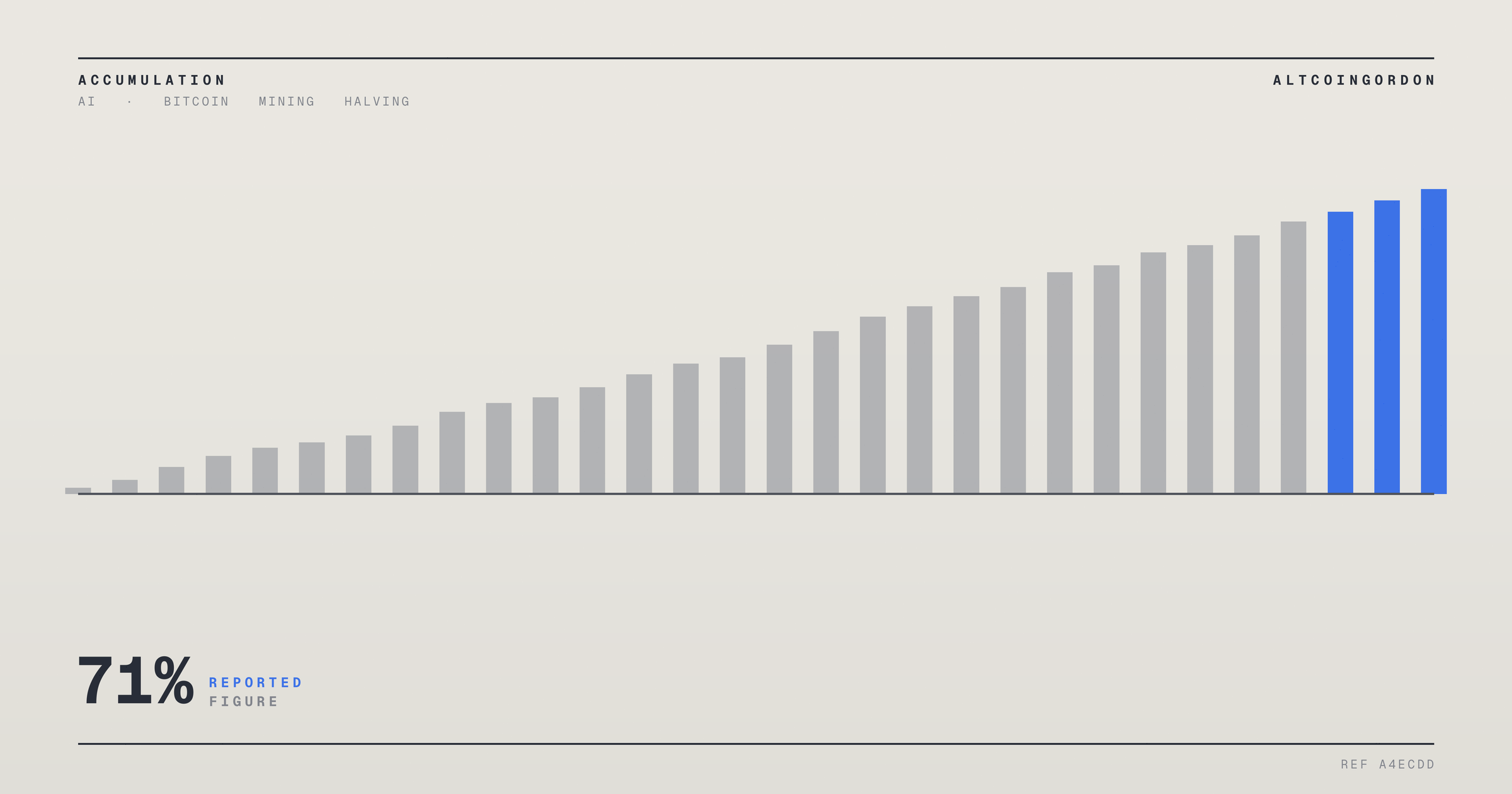
Bernstein has reiterated its Outperform rating on TeraWulf, a company that began as a bitcoin mining operator but has increasingly positioned itself as an infrastructure provider for high-performance computing and artificial intelligence workloads. The reaffirmation follows disclosure that HPC-related revenue made up 71% of the company's total revenue in the second quarter, a figure that signals how far the company's business mix has moved away from its original bitcoin mining focus.
TeraWulf's evolution mirrors a broader trend among publicly traded bitcoin miners, many of which have sought to diversify revenue streams as mining economics have become more volatile following the 2024 halving and amid rising energy costs. Several miners have repurposed existing data center capacity, power contracts, and cooling infrastructure originally built for mining rigs to instead host GPU clusters and other hardware used for AI training and inference, a shift often described in the industry as a pivot toward HPC hosting.
Bernstein's continued Outperform rating suggests the bank views this transition favorably, at least based on the revenue mix disclosed for the quarter. An Outperform rating generally indicates that analysts expect a stock to perform better than the broader market or its sector peers over a defined period, though it does not constitute a price target or guarantee of future performance.
The fact that HPC revenue now represents the majority of TeraWulf's quarterly top line is notable because it marks a departure from the company's original identity as a bitcoin miner. For much of the sector's recent history, miners' revenues were tied almost entirely to the price of bitcoin and the network's mining difficulty. A shift toward HPC and AI infrastructure revenue introduces a different set of demand drivers, tied more closely to enterprise and cloud computing spending than to cryptocurrency markets.
This kind of diversification has drawn increased attention from equity analysts and institutional investors who have historically been cautious about the volatility inherent in pure-play bitcoin mining stocks. By demonstrating a growing, non-crypto revenue base, companies like TeraWulf may be seeking to appeal to a broader investor base less focused on bitcoin price cycles.
As of this report, the underlying figures behind the 71% HPC revenue share and the specifics of Bernstein's rationale for maintaining its rating have been reported by a single source, The Block. Readers should treat the precise revenue breakdown and analyst commentary as reported pending further corroboration from additional outlets or from TeraWulf's own quarterly filings.
Market Impact
A reaffirmed Outperform rating from a research house like Bernstein can influence short-term investor sentiment toward TeraWulf's stock, particularly among institutional investors who weigh analyst coverage when evaluating mining-adjacent equities. If HPC revenue continues to make up the majority of the company's top line, it could also reinforce a broader narrative that some bitcoin miners are becoming hybrid infrastructure companies rather than pure crypto plays, a distinction that may affect how these stocks are valued relative to bitcoin price movements.
More broadly, continued disclosures of rising HPC revenue share across the mining sector could accelerate comparisons between crypto-mining infrastructure firms and traditional data center or cloud computing companies, potentially altering how analysts and investors benchmark these stocks going forward.
The reaffirmed Bernstein rating highlights TeraWulf's ongoing transition toward HPC infrastructure, a shift that reflects wider changes across the bitcoin mining industry, though further reporting will be needed to confirm the full scope of the underlying financial details.
Frequently Asked Questions
What does an Outperform rating mean?
An Outperform rating indicates that an analyst expects a stock to perform better than the broader market or comparable companies in its sector over a given time frame; it does not represent a specific price target or a guarantee of returns.
Why is TeraWulf's HPC revenue share significant?
TeraWulf originated as a bitcoin mining company, so HPC revenue accounting for 71% of its second-quarter total reflects a substantial shift toward high-performance computing and AI-related infrastructure services, diversifying its business beyond bitcoin mining economics.
Is this shift common among bitcoin mining companies?
Several publicly traded bitcoin miners have explored diversifying into HPC and AI infrastructure hosting in recent years, often by repurposing data center capacity and power contracts, though the extent of this shift varies by company.
How reliable is the reported 71% HPC revenue figure?
The figure and Bernstein's rating reaffirmation have been reported by a single source at this time; readers should look for confirmation through TeraWulf's official financial disclosures or additional media coverage.