

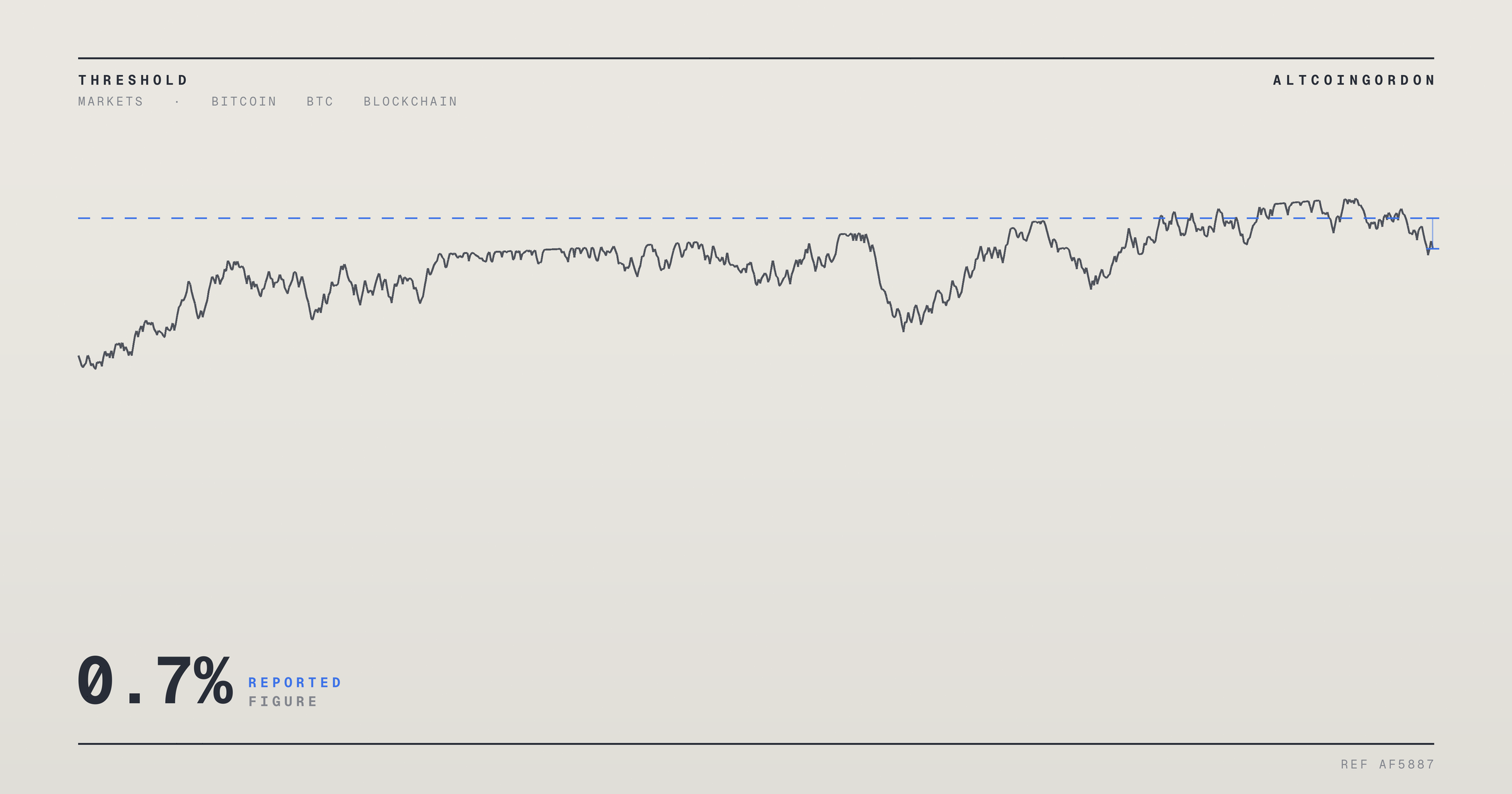
Bitcoin miners are collecting less than 0.7% of their total revenue from transaction fees, according to data reported by Cointelegraph. The reading marks the lowest fee share recorded in a decade, underscoring a long-running shift in how mining operations generate income.
Miner revenue comes from two sources. The first is the block subsidy, the fixed amount of new bitcoin awarded for adding a block to the chain. The second is transaction fees, paid by users to have their transfers included and confirmed. For most of Bitcoin’s history, fees have made up a small but meaningful slice of total earnings, occasionally spiking during periods of network congestion.
The drop below 0.7% suggests that fee income has become almost negligible in comparison with subsidy payments. Miners are still being rewarded for confirming blocks, but the reward now comes almost entirely from newly issued bitcoin rather than from demand to use the network itself. That distinction matters because subsidies shrink over time by design.
Bitcoin’s protocol cuts the block subsidy in half roughly every four years through an event known as the halving. The most recent halving in 2024 reduced the per-block reward to 3.125 BTC. Each halving mechanically lowers the baseline income miners can expect, making any additional fee revenue more important to their overall economics, not less.
A thin fee market can reflect several conditions at once. It may point to reduced congestion on the base Bitcoin blockchain, fewer large transfers competing for limited block space, or a pullback in speculative activity that previously drove fee spikes, such as inscription-based token trends seen in prior years. Cointelegraph’s reporting did not specify which factor, or combination of factors, is behind the current low reading.
The milestone arrives at a moment when miners are already contending with rising operational costs, tighter margins, and continued scrutiny over energy use. A lower fee contribution means that block rewards, and by extension the price of bitcoin itself, carry even more weight in determining whether mining remains profitable. Analysts have long debated what is often called Bitcoin’s long-term security budget, the total value paid to miners to keep the network defended against attack. A shrinking fee share adds to that conversation, since it suggests the network is currently more reliant on subsidy issuance than on organic transactional demand to fund its own security.
Sources disagree on this story
This article was published before the reports below were compared. The reporting above stands; what follows is where the published accounts do not agree.
Cointelegraph and CryptoBriefing both cite a 0.52% miner fee-revenue share as a decade low, but place it in different time periods.
What all sources agree on
- Bitcoin transaction fees make up a historically low share of miner revenue.
- Miners are increasingly pivoting to AI/HPC business lines amid the fee squeeze.
- Miners are more dependent on the block subsidy than on fees.
- The current block subsidy is 3.125 BTC.
- Publicly listed miners including MARA, RIOT, CLSK, CIFR/Cipher Mining, and IREN are named in connection with the AI pivot.
Where the reports disagree
1When the 0.52% fee-share low occurred
Data from onchain analytics platform Glassnode shows that fees as a proportion of miner revenue remain near decade lows after falling to just 0.52% in April.
In the week ending December 29, 2025, transaction fees accounted for a mere 0.52% of total block rewards, translating to roughly 16 BTC (about $1.4 million) out of 3,166 BTC in total miner revenue.
What would settle it: The underlying Glassnode/on-chain dataset showing weekly miner fee-share by date.
2Current fee share cited in the headline (under 0.7% vs under 1%)
Bitcoin (BTC) transaction fees now account for just 0.69% of miner revenue as major players pivot to AI.
Bitcoin miners earn under 1% of revenue from fees, hitting 10-year low
What would settle it: The same on-chain dataset specifying the current (most recent) weekly or monthly fee-share figure.
3Network hash rate level and trend
Hash rate has declined from its October 2025 peak of 1.3 zettahashes per second (ZH/s) to 861 exahashes per second (EH/s), Checkonchain shows — a drop of 33%.
The network hashrate reached approximately 1,099 EH/s by late December 2025, meaning computational competition for blocks is near all-time highs.
What would settle it: Checkonchain or comparable on-chain hash rate time series.
What to make of it
Treat the broad narrative of fee decline and AI pivot as established, but do not treat the specific 0.52% figure or current fee-share percentage as pinned to a confirmed date until the two reports' underlying data periods are reconciled.
Market Impact
For miners, a smaller fee contribution tightens the link between profitability and the price of bitcoin, since subsidy payments dominate revenue and fees offer little cushion. Operations with higher energy costs or thinner margins may feel this pressure most acutely, particularly heading into future halvings that will further reduce subsidy payouts.
For the broader network, sustained low fee revenue raises longer-term questions about how mining security will be funded once block subsidies continue shrinking on their fixed schedule. The market will likely watch on-chain activity closely for any rebound in transaction volume or renewed demand for block space that could lift the fee share back toward historical norms.
The drop in Bitcoin's fee share to a ten-year low is a data point worth watching rather than an immediate crisis, but it does sharpen an existing debate over how the network will fund its own security as subsidies keep falling.
Frequently Asked Questions
What does it mean that miners earn under 0.7% of revenue from fees?
It means transaction fees now account for less than 0.7% of total mining income, with the vast majority coming from the fixed block subsidy paid for confirming new blocks.
Why do transaction fees make up such a small share of miner revenue?
Cointelegraph's report did not specify a single cause, but a low fee share typically reflects reduced congestion on the network or less competition for limited block space.
How does the halving affect this trend?
The Bitcoin protocol cuts the block subsidy in half roughly every four years, most recently in 2024, which reduces the guaranteed portion of miner revenue over time regardless of fee activity.
Why does a low fee share matter for network security?
Miner revenue funds the computing power that secures Bitcoin, so a heavy reliance on shrinking block subsidies, rather than fees, raises questions about how that security will be financed in the future.