

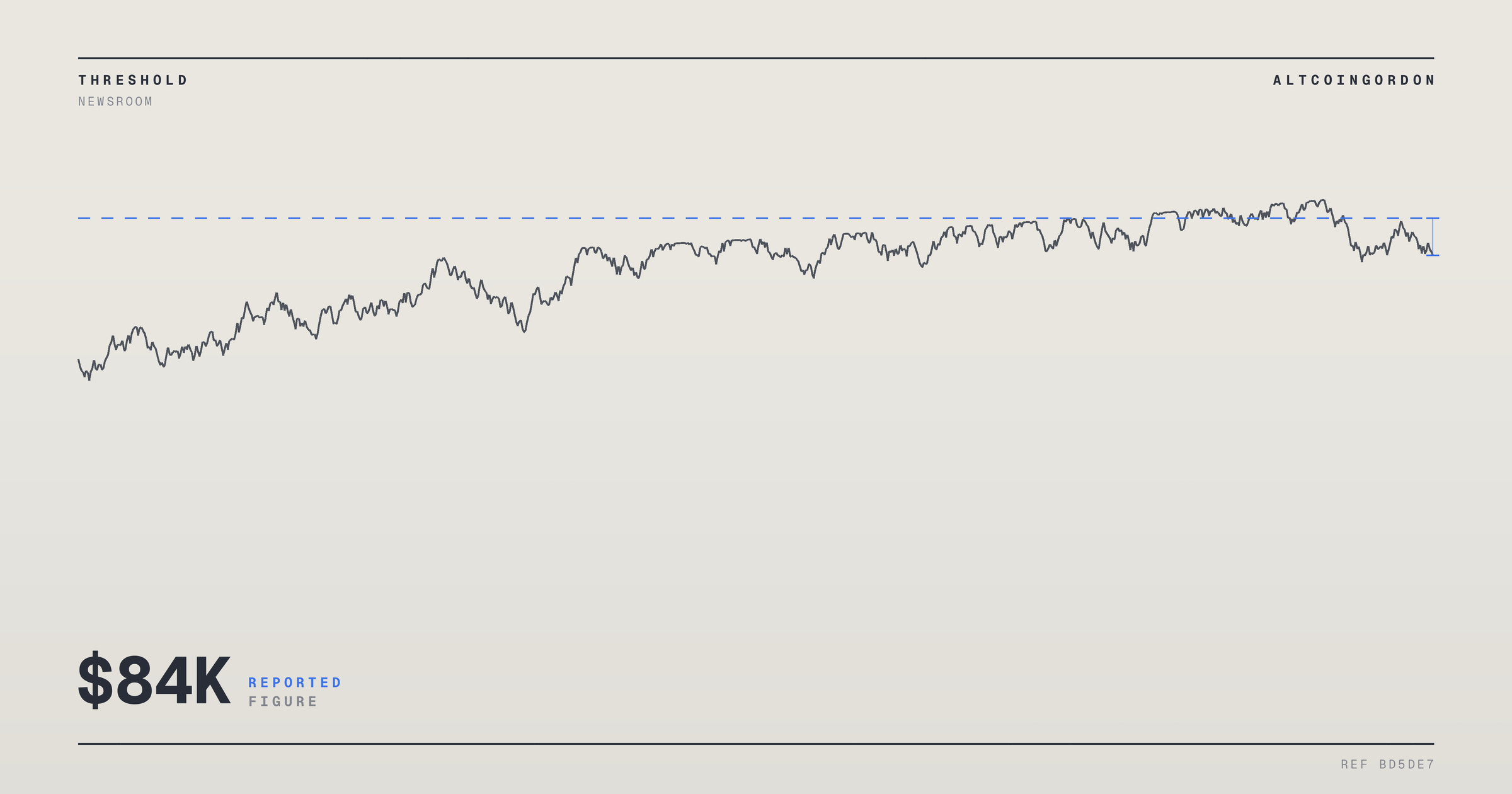
Bitcoin's price action stalled near the $84,000 mark this week, meeting resistance at a level traders have watched closely in recent sessions. The stall coincided with a deepening decline in South Korea's KOSPI index, driven by losses across the country's technology sector, according to Cointelegraph.
The KOSPI has historically served as a barometer for global risk appetite, given its heavy weighting toward semiconductor and electronics firms tied to global supply chains. A sustained drop in that index often signals broader caution among investors toward growth-sensitive and tech-adjacent assets. Bitcoin, frequently described as a risk asset correlated with equity market sentiment, has at times mirrored these swings.
Resistance levels like $84,000 matter to traders because they mark price points where selling pressure has previously overwhelmed buying interest. A failure to break through such a level can suggest hesitation among market participants, particularly when broader macro conditions remain uncertain. The coincidence of Bitcoin's stall with the Korean tech selloff has prompted some observers to question whether equity weakness in Asia is spilling into crypto markets.
South Korea's technology sector carries outsized influence on the KOSPI because of the presence of major semiconductor and electronics exporters. When these companies face pressure, whether from demand concerns, supply chain disruptions, or shifts in global chip markets, the effects can ripple through the broader index. Investors watching for signs of contagion into other asset classes, including cryptocurrencies, often look to such sector-specific routs as early indicators.
Crypto markets have in recent years shown periods of correlation with equity indices, particularly during episodes of macro stress or liquidity tightening. This relationship is not constant, and Bitcoin has also demonstrated periods of decoupling from traditional markets. The current episode, with Bitcoin meeting resistance as KOSPI losses deepen, adds another data point to an ongoing debate about how closely digital assets track global risk sentiment.
Market participants will likely continue monitoring both the KOSPI's trajectory and Bitcoin's ability to clear the $84,000 resistance level. Whether the two move in tandem going forward, or whether the current overlap proves coincidental, remains to be seen based on available reporting.
Market Impact
If Bitcoin's resistance at $84,000 holds alongside continued weakness in Korean tech shares, traders may interpret this as a sign that risk-off sentiment is spreading beyond equities into crypto. A clear break above the resistance level, by contrast, could suggest Bitcoin is decoupling from the Asian equity selloff and trading on its own momentum.
Broader market watchers will likely parse incoming KOSPI data and Bitcoin price charts for confirmation of any sustained correlation. Given that only one source has reported this specific overlap so far, the durability of any connection between the two markets remains to be established through further price action and additional reporting.
The simultaneous stall in Bitcoin near $84,000 and the deepening Korean tech rout highlight how closely watched asset classes can intersect during periods of market uncertainty, though the strength of that link remains to be confirmed.
Frequently Asked Questions
Why does the KOSPI's performance matter for Bitcoin traders?
The KOSPI is heavily weighted toward technology and semiconductor firms, making it a gauge of global risk appetite that some traders watch alongside crypto markets.
What does it mean that Bitcoin hit resistance at $84,000?
Resistance refers to a price level where selling pressure has previously stalled upward momentum, and a failure to break through can signal trader hesitation.
Is Bitcoin directly caused by the Korean tech stock selloff?
Cointelegraph reported the two events occurring together, but no causal relationship has been confirmed, and correlation between crypto and equities varies over time.
Should investors expect this pattern to continue?
It is not yet clear whether Bitcoin will keep tracking Korean equity weakness or trade independently, and further price data will be needed to assess this.