

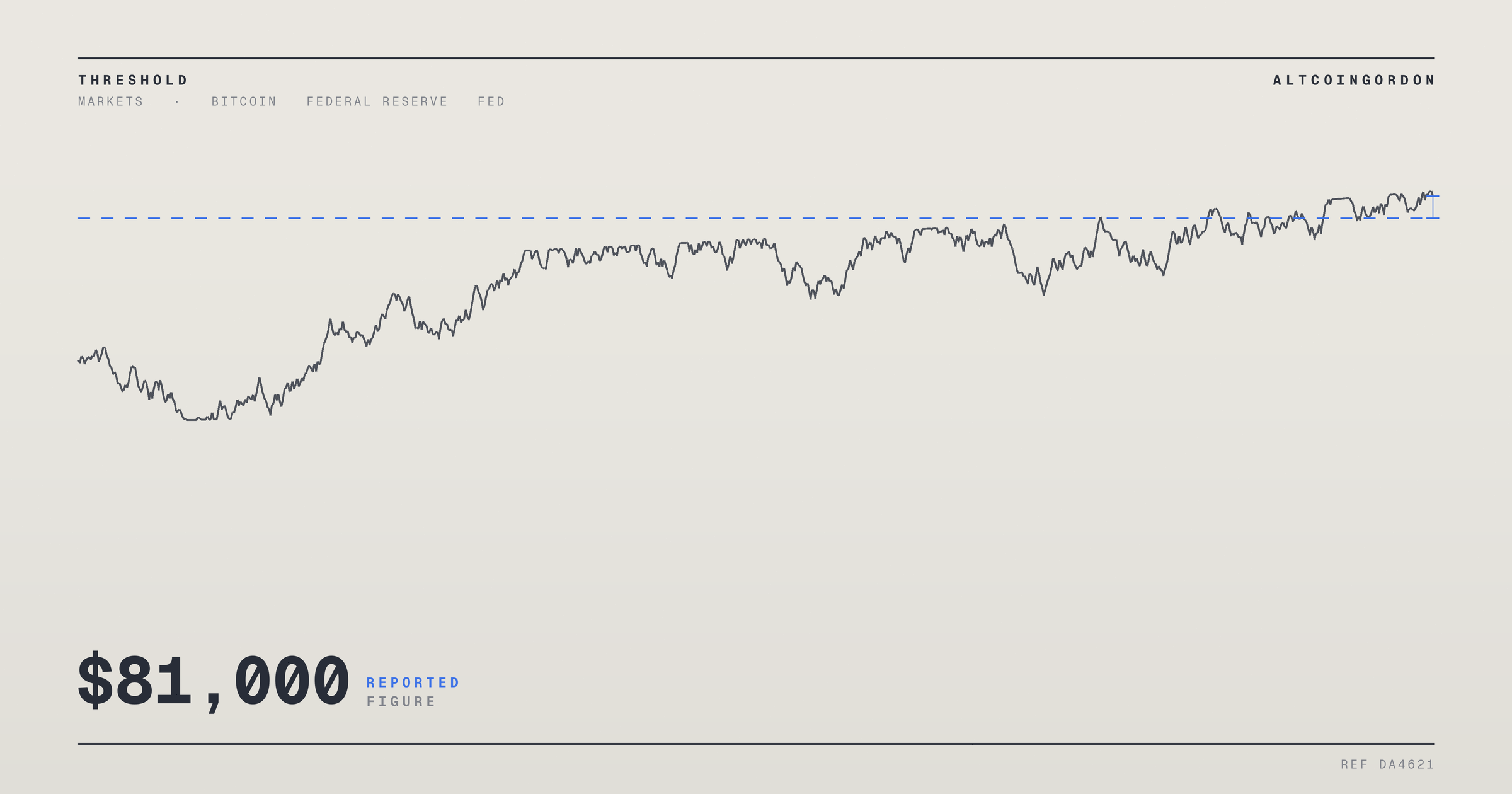
Bitcoin's latest attempt to push past $81,000 stalled, according to reporting from Cryptonews.com and Yahoo Finance. The rejection has left traders watching the calendar for the Federal Reserve's September meeting as the next major catalyst.
The failed breakout comes at a sensitive moment for crypto markets. Investors have spent much of this year recalibrating expectations around monetary policy, with interest rate decisions carrying outsized weight for risk assets like bitcoin. A rejection at a key psychological level tends to reinforce caution among traders positioning ahead of a Fed announcement.
The $81,000 mark has functioned as a point of resistance in recent sessions. When bitcoin approaches such levels and fails to hold above them, it often signals hesitation among buyers or profit-taking among short-term holders. That dynamic can compound uncertainty already present around macroeconomic policy.
The September Fed meeting has drawn heightened attention across both traditional and digital asset markets. Interest rate decisions influence the cost of capital and the appetite for speculative investments. Bitcoin, often described as a risk-on asset, tends to react sharply to shifts in rate expectations, whether through actual policy moves or shifts in forward guidance.
This price action also unfolds against the backdrop of the Trump administration's continued engagement with cryptocurrency policy. The administration has pursued a broadly favorable posture toward digital assets since taking office, a stance that has shaped market sentiment throughout the year. Traders have been parsing statements and policy signals from Washington alongside traditional economic data when assessing bitcoin's near-term trajectory.
The interplay between political signals and monetary policy adds a layer of complexity for market participants. Bitcoin's price behavior in the run-up to Fed meetings has historically reflected broader risk sentiment rather than crypto-specific news alone. This pattern appears to be repeating as the September decision approaches.
Market watchers note that resistance levels like $81,000 are not fixed barriers but reflect where buying and selling pressure have recently balanced. A rejection at this level does not necessarily indicate a trend reversal. It does, however, suggest that conviction among buyers may be limited until there is more clarity from the Fed.
Market Impact
A stalled breakout near $81,000 suggests traders remain cautious ahead of the Federal Reserve's September meeting. Rate decisions and accompanying commentary from the Fed could act as the next major catalyst for bitcoin's direction, either reinforcing the recent resistance or providing momentum to retest higher levels.
Broader crypto markets often take cues from bitcoin's price action at key thresholds. Continued uncertainty around monetary policy, combined with ongoing developments in Trump administration crypto policy, could keep volatility elevated across digital assets in the near term.
As the September Fed meeting approaches, bitcoin's failure to clear $81,000 underscores how closely crypto markets remain tied to broader monetary policy signals and political developments in Washington.
Frequently Asked Questions
Why did bitcoin's move above $81,000 matter?
The $81,000 level had acted as a resistance point, and bitcoin's failure to break above it signals hesitation among buyers at that price.
Why is the September Fed meeting significant for bitcoin traders?
Federal Reserve rate decisions influence risk appetite across markets, and bitcoin has historically reacted strongly to shifts in interest rate expectations.
How does the Trump administration's crypto policy relate to this price action?
The administration's broadly supportive stance on digital assets has shaped market sentiment throughout the year, forming part of the backdrop against which traders are assessing bitcoin's next move.
Does a rejection at $81,000 mean bitcoin's trend has reversed?
Not necessarily. A rejection at a resistance level reflects a temporary balance between buyers and sellers rather than confirming a broader reversal in trend.