

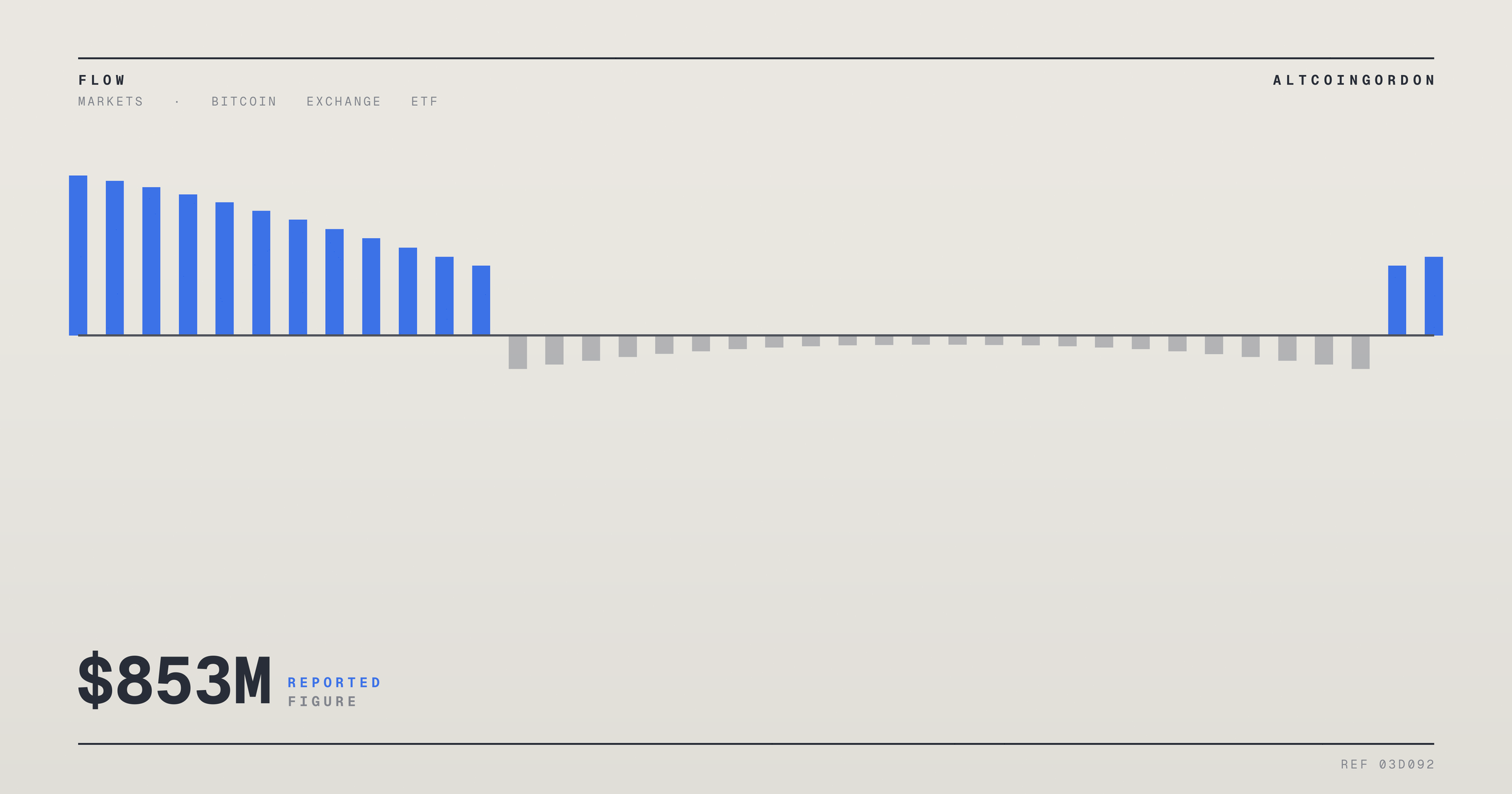
U.S. spot Bitcoin exchange-traded funds attracted $853 million in net inflows on the day, marking their largest single-day haul since April. The figure signals renewed investor appetite for regulated Bitcoin exposure after a stretch of more muted flows.
BlackRock’s iShares Bitcoin Trust, known by its ticker IBIT, led the pack by a wide margin. The fund reportedly captured around 81% of the total inflow, reaffirming its status as the preferred vehicle for institutional and retail investors seeking spot Bitcoin exposure through a traditional brokerage account.
Spot Bitcoin ETFs have become a central gauge of institutional sentiment toward the asset since their U.S. launch in early 2024. Daily flow data is closely watched by traders and analysts as a proxy for broader demand, since these funds allow exposure to Bitcoin’s price without requiring direct custody of the asset.
A single day’s inflow reaching this scale suggests a meaningful shift in positioning among fund allocators. It follows periods where flows had cooled compared to the surges seen earlier in the products’ history. The concentration of demand in IBIT specifically points to continued investor preference for BlackRock’s brand recognition and the fund’s liquidity profile relative to competitors.
Other issuers in the spot Bitcoin ETF category, including funds from Fidelity, Ark Invest, and Bitwise, also participate in this market, though their combined share of the day’s inflow was comparatively small next to IBIT’s take. The lopsided distribution highlights how consolidated the spot Bitcoin ETF landscape has become around a handful of large issuers, with BlackRock consistently at the top.
The timing of this inflow surge arrives amid broader questions about how institutional capital is rotating across asset classes. Bitcoin ETF flows are often interpreted alongside movements in equities, bond yields, and macroeconomic data, since large allocators frequently adjust crypto exposure in response to shifting risk appetite. Analysts tracking these products note that sustained inflows over multiple sessions, rather than a single strong day, tend to carry more weight when assessing longer-term institutional commitment to Bitcoin as an asset class.
Sources disagree on this story
This article was published before the reports below were compared. The reporting above stands; what follows is where the published accounts do not agree.
Three outlets cite a $853.54 million weekly Bitcoin ETF inflow figure while CryptoBriefing reports a range of $865 million to $1 billion for the same week.
What all sources agree on
- BlackRock's iShares Bitcoin Trust (IBIT) led the week's inflows with roughly $693 million.
- The week marked the strongest showing for U.S. spot Bitcoin ETFs since April.
- Bitcoin traded in a range of roughly $64,000 to $65,100 during the period.
- Fidelity's FBTC brought in approximately $116 million, the second-largest contribution.
Where the reports disagree
1Total weekly net inflow figure for U.S. spot Bitcoin ETFs
U.S. spot bitcoin ETFs posted gains across all five sessions, attracting $853.54 million in their strongest week since April 17.
US spot Bitcoin ETFs pulled in somewhere between $865 million and $1 billion in a single week, their strongest showing since April.
Between August 3 and August 7, U.S. spot Bitcoin ETFs pulled in $853.54 million in net inflows, the largest weekly total since mid-April, according to data from SoSoValue.
Bitcoin exchange-traded funds (ETFs) in the United States generated $853.54 million in net inflows during the week ending August 7, marking the strongest week for new investments since mid-April, according to data from SoSoValue.
What would settle it: SoSoValue's published daily and weekly Bitcoin ETF flow dataset for the week of August 3-7.
2Historical ranking of the week's inflow strength
The inflows represent the third-strongest weekly performance since the notable market disruption in October 2024
Blackrock's IBIT drove bitcoin ETFs to $853.54M, their best week since April 17.
What would settle it: SoSoValue's or Farside Investors' historical weekly flow rankings for U.S. spot Bitcoin ETFs since October 2024.
What to make of it
Treat BlackRock's roughly $693 million IBIT contribution and the 'strongest week since April' characterization as established across sources; the precise total weekly inflow figure ($853.54 million versus a $865 million-$1 billion range) remains unresolved and should not be cited as a single settled number until the underlying SoSoValue data is checked directly.
Market Impact
A daily inflow of this size can influence short-term Bitcoin price dynamics, since ETF issuers typically purchase underlying Bitcoin to match new share creation. Large, concentrated inflows into a single fund like IBIT can also affect market structure by increasing the share of Bitcoin held through custodial arrangements tied to major asset managers.
For the broader ETF industry, sustained demand at this level would reinforce BlackRock's position as the dominant gatekeeper for institutional Bitcoin access. It may also pressure competing issuers to adjust fee structures or marketing strategies to recapture market share. Investors and analysts will likely watch subsequent days' flow data to determine whether this inflow reflects a durable trend or a one-off event tied to specific market conditions.
The $853 million inflow marks a notable moment for spot Bitcoin ETFs, with BlackRock's IBIT once again at the center of institutional demand. Whether this pace of inflows continues will depend on broader market conditions and investor sentiment toward Bitcoin in the weeks ahead.
Frequently Asked Questions
What caused the $853 million Bitcoin ETF inflow?
The reported figure reflects net inflows into U.S. spot Bitcoin ETFs on a single day, with BlackRock's IBIT accounting for the largest share. Specific catalysts were not detailed in available reporting, though such surges often follow shifts in broader investor sentiment toward risk assets.
Why did BlackRock's IBIT capture most of the inflow?
IBIT has consistently been the largest and most liquid spot Bitcoin ETF since launch, making it a common choice for institutional allocators. Reports indicate it took in roughly 81% of the day's total inflow.
How does this inflow compare to previous periods?
According to the reports, this was the highest single-day inflow for spot Bitcoin ETFs since April, suggesting a notable pickup in demand compared to recent months.
Do ETF inflows directly affect Bitcoin's price?
ETF issuers generally buy underlying Bitcoin to back new shares, so large inflows can add buying pressure. However, price movements also depend on broader market conditions beyond ETF activity alone.