

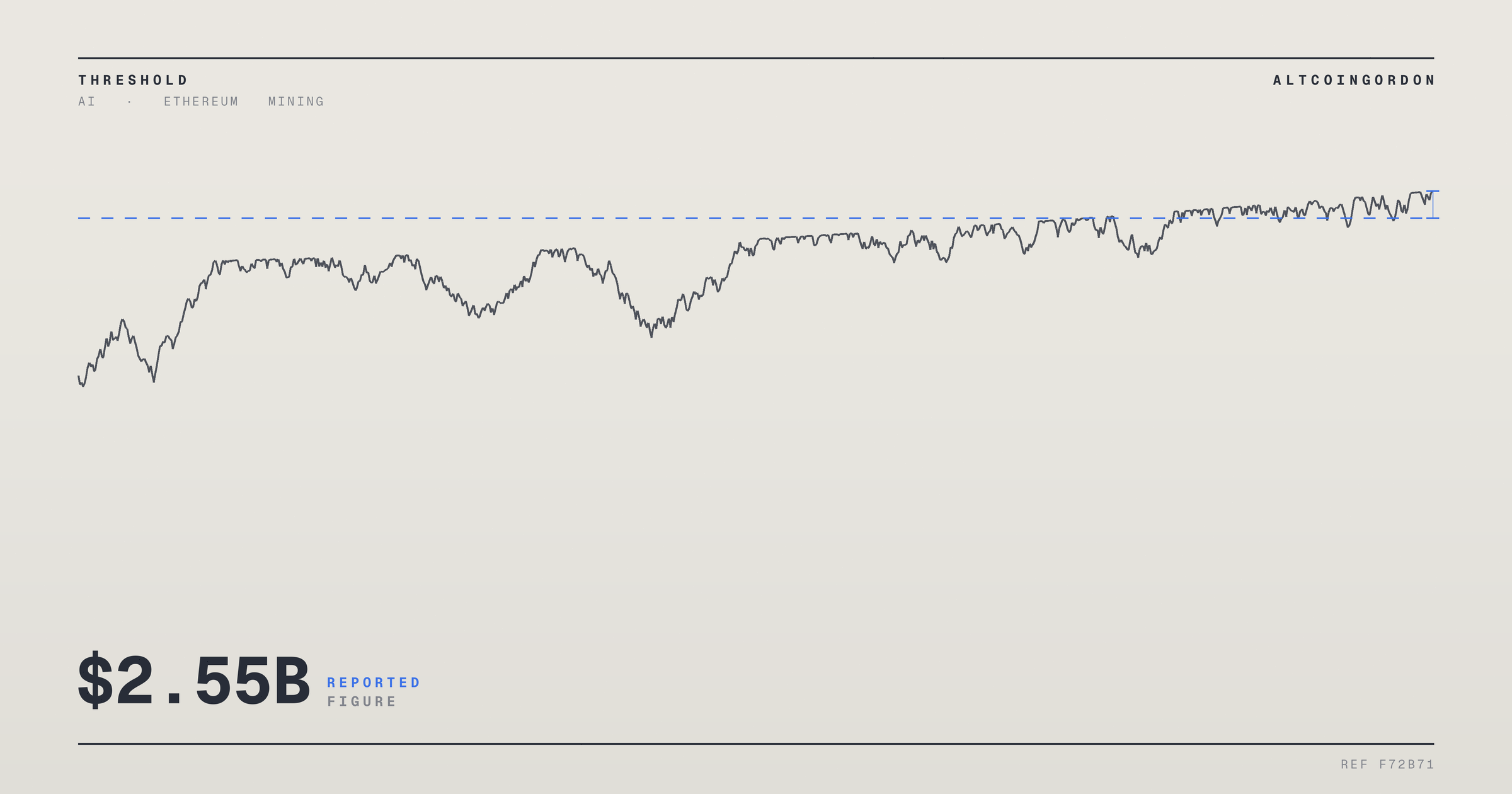
CoreWeave expects second-quarter revenue to land near $2.55 billion, CryptoBriefing reported. That figure would mark a near doubling of the company's revenue from the same quarter a year earlier, if realized as guided.
CoreWeave operates a cloud computing platform built around graphics processing units, or GPUs, the specialized chips that power much of today's artificial intelligence workloads. The company has positioned itself as an infrastructure provider for firms training and deploying large AI models, renting out access to Nvidia chips and related data center capacity.
The company's roots trace back to cryptocurrency mining. CoreWeave initially built its GPU infrastructure to support Ethereum mining operations before Ethereum's shift to a proof-of-stake consensus mechanism removed the need for GPU-based mining. That transition pushed the company to repurpose its hardware for AI computing, a pivot that has since become central to its business model.
Guidance of roughly $2.55 billion in quarterly revenue would place CoreWeave among the faster-growing infrastructure providers tied to the current AI buildout. Doubling revenue year over year is a substantial pace of growth for a company operating at this scale, and it reflects the broader surge in enterprise and research spending on AI compute capacity.
The report did not detail the specific drivers behind the projected growth, such as new contract signings, expanded data center capacity, or pricing changes. Companies in the GPU cloud sector have generally cited rising demand from AI developers, alongside continued investment in expanding physical infrastructure, as key factors behind revenue growth over the past two years.
CoreWeave's trajectory is being watched closely by investors tracking the intersection of crypto-adjacent infrastructure and the broader AI computing market. Firms that originally built hardware for digital asset mining have increasingly redirected that capacity toward AI workloads, and CoreWeave is often cited as one of the more prominent examples of that shift.
Market Impact
If CoreWeave's guidance holds, it would reinforce the narrative that demand for GPU-based cloud computing remains strong heading into the second half of the year. Investors in AI infrastructure names, as well as chipmakers supplying the underlying hardware, are likely to view sustained revenue growth at this scale as a signal of continued capital spending across the sector.
For the crypto industry specifically, CoreWeave's evolution from a mining operation into an AI cloud provider illustrates how infrastructure originally built for blockchain networks can be redeployed elsewhere. That dynamic may continue to shape how other mining-derived infrastructure firms position themselves as AI compute demand evolves.
The reported guidance points to continued momentum in CoreWeave's AI-focused business, though final results will confirm whether the company meets its projected revenue figure.
Frequently Asked Questions
What is CoreWeave's projected Q2 revenue?
CoreWeave expects second-quarter revenue of approximately $2.55 billion, according to a report from CryptoBriefing.
How does this compare to last year?
The projected figure would represent close to a doubling of CoreWeave's revenue from the same quarter a year earlier.
What does CoreWeave do?
CoreWeave provides cloud computing infrastructure built around GPUs, primarily serving companies training and running AI models.
Why is CoreWeave connected to cryptocurrency?
CoreWeave originally built GPU infrastructure for Ethereum mining before pivoting to AI computing after Ethereum moved away from GPU-based mining.