

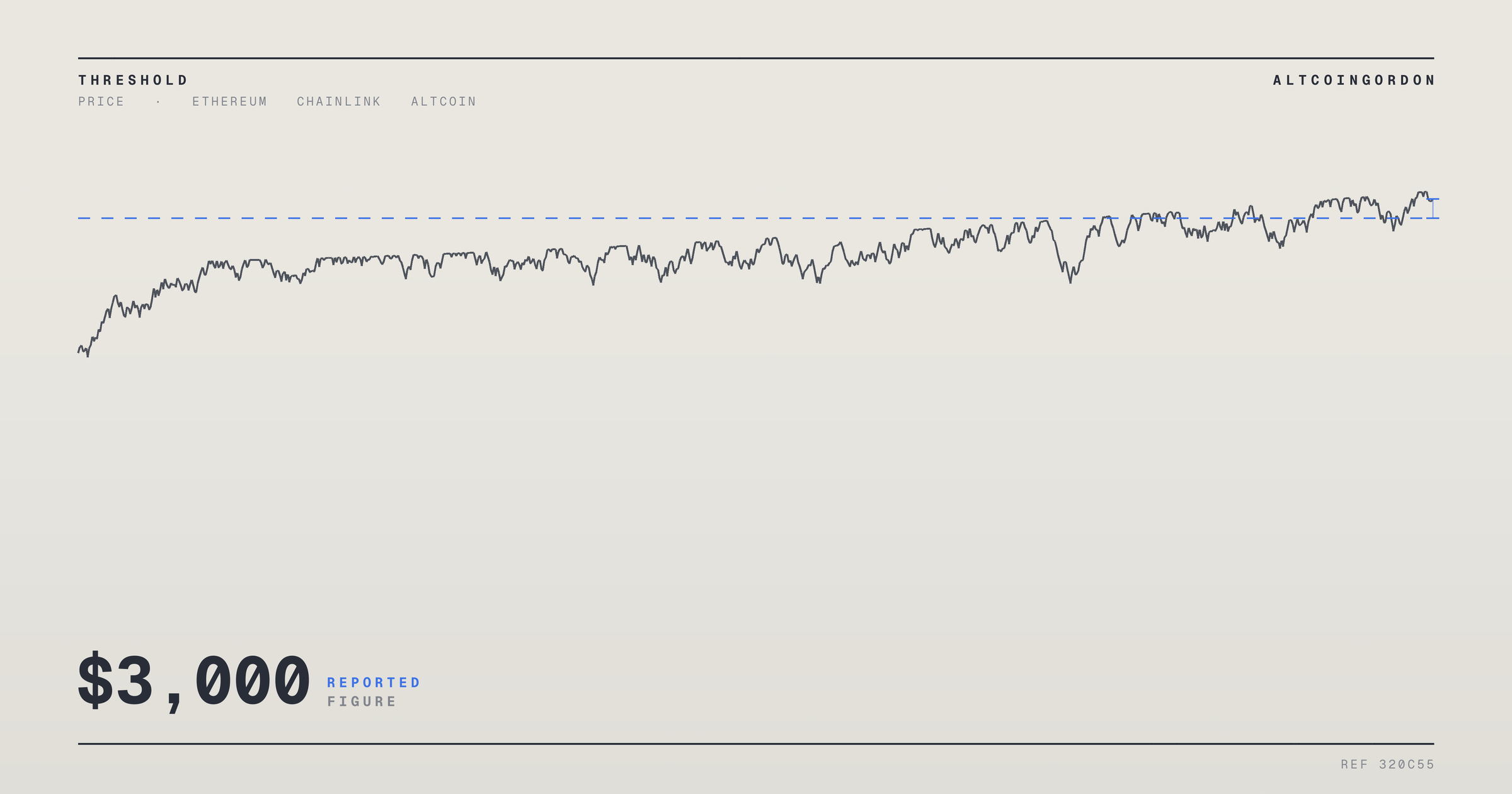
Ethereum's price is closing in on the $3,000 mark, according to a report from TronWeekly published on August 13. The move follows the formation of a golden cross in Ethereum's Market Value to Realized Value, or MVRV, ratio. Analysts cited in the report see the pattern as a supportive signal for renewed upside.
MVRV compares an asset's current market value against the average price at which coins last moved on-chain, known as realized value. The ratio is widely used to gauge whether an asset is statistically overvalued or undervalued relative to its holder cost basis. A golden cross in this context occurs when a shorter-term moving average of the ratio crosses above a longer-term average, a pattern traders often read as an early sign of strengthening momentum.
The Ethereum signal did not appear in isolation. A separate report from CoinGape, published on August 14, described an analyst applying the same MVRV golden cross framework to Chainlink. That analysis pointed to the possibility of a 30% surge in the token's price. The near-simultaneous appearance of the pattern on two different assets suggests the indicator is being watched closely across the altcoin market, not just for Ethereum alone.
On-chain metrics like MVRV have become a standard part of the crypto analyst toolkit. Traders use them alongside traditional technical analysis to assess whether a rally has fundamental support from the underlying holder base. A golden cross does not guarantee a specific outcome, but it is often treated as a confirming signal when combined with price action already trending higher.
For Ethereum specifically, the $3,000 level carries psychological weight. It has served as both a resistance and support zone during previous market cycles. A sustained move above that threshold, if it materializes, would likely draw additional attention from traders monitoring broader market structure and liquidity conditions.
The timing of these two reports, within roughly eleven hours of each other, reflects a broader pattern in crypto markets where on-chain signals are tracked in near real time. Analysts frequently compare indicators across multiple large-cap tokens to identify whether a shift in sentiment is asset-specific or part of a wider market trend.
Market Impact
If the MVRV golden cross signal on Ethereum holds, it could reinforce trader confidence heading into the $3,000 level, potentially encouraging further inflows into the asset. The parallel signal reported for Chainlink suggests some altcoins may be exhibiting similar on-chain characteristics, which traders sometimes interpret as a sign of broader market strength rather than an isolated move.
However, on-chain indicators like MVRV are descriptive tools based on historical holder behavior, not guarantees of future price direction. Market participants should weigh these signals alongside broader factors, including liquidity conditions, macroeconomic developments, and overall risk appetite in crypto markets, before drawing conclusions about near-term price movement.
As Ethereum tests the $3,000 level and similar on-chain signals emerge for Chainlink, traders will be watching whether the MVRV golden cross translates into sustained price momentum across the broader altcoin market.
Frequently Asked Questions
What is an MVRV golden cross?
It refers to a shorter-term moving average of the Market Value to Realized Value ratio crossing above a longer-term average. Analysts often treat this pattern as an early signal of strengthening market momentum.
Why is the $3,000 level significant for Ethereum?
The $3,000 mark has previously acted as both support and resistance for Ethereum's price. A sustained break above it is often viewed by traders as a meaningful shift in market structure.
Does the MVRV golden cross also apply to other tokens?
Yes. A separate analysis reported that Chainlink showed a comparable MVRV golden cross pattern, with one analyst pointing to potential upside of around 30 percent for the token.
Does an MVRV golden cross guarantee a price rally?
No. It is an on-chain indicator based on historical holder cost basis and market value, not a certainty. Traders typically use it alongside other data points rather than as a standalone forecast.