

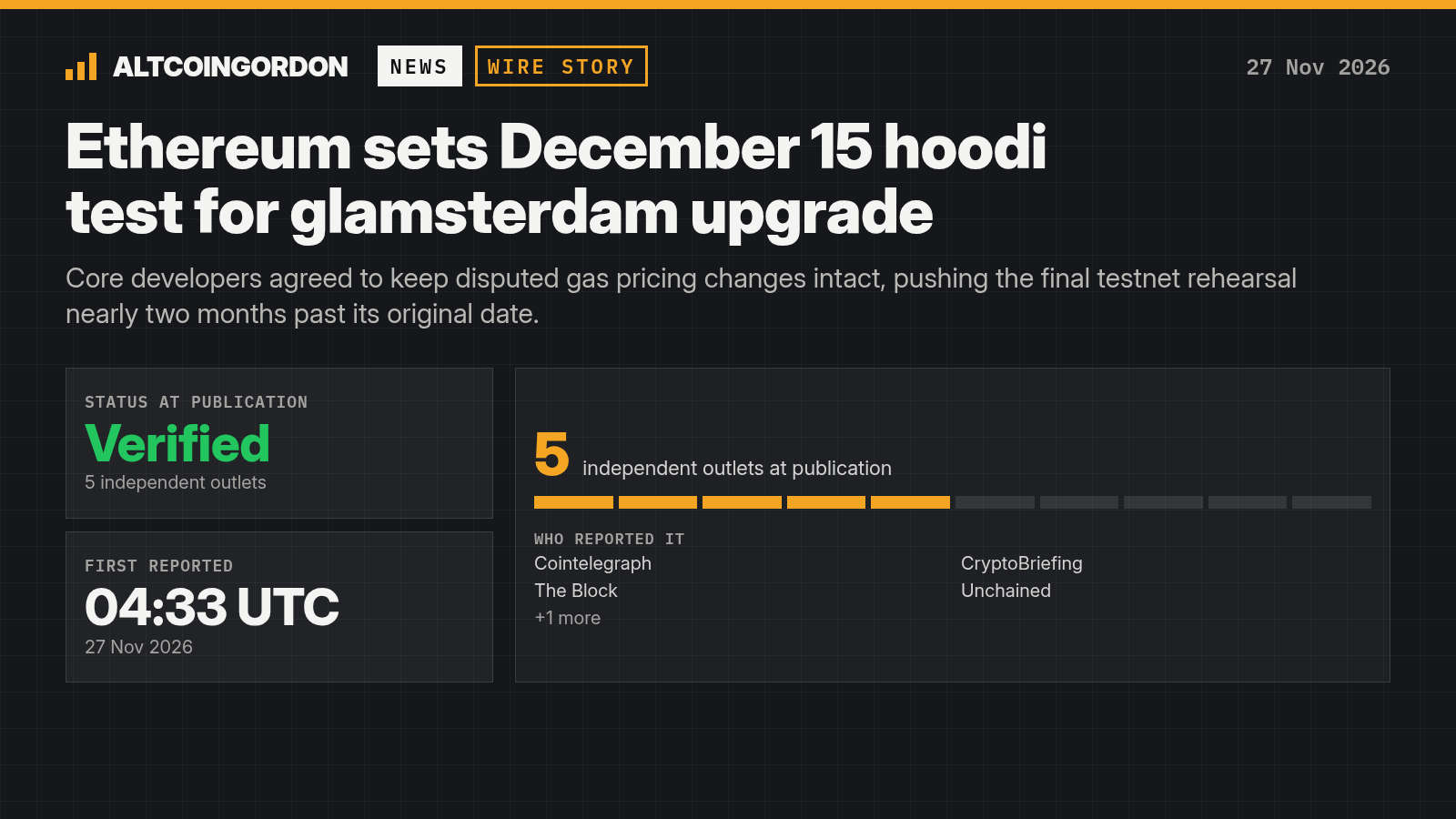
Ethereum's next major network upgrade now has a firm date for its last testnet run before mainnet. Developers confirmed during the All Core Developers Consensus call on November 26 that Glamsterdam will activate on the Hoodi testnet on December 15, at 19:12 UTC, corresponding to epoch 143616.
The date marks a return to schedule after the rollout slipped from its original October 26 target. Cointelegraph and CoinTurk News both described the delay as stretching nearly two months, while crypto.news put the gap closer to seven weeks. The holdup traced back to two proposals bundled into Glamsterdam, EIP-8037 and EIP-8038, which change how Ethereum charges gas for certain operations, including the creation of permanent data on the network.
Testing after the original rollout date revealed that the new gas rules could cause some smart contracts to run out of gas unexpectedly, leading to failed transactions. Security audits flagged roughly 200 compatibility issues spread across the smart contract ecosystem, with the changes carrying potential implications for as many as 15,000 contracts. Of those flagged, 24 were found to require upgrades or migration before the new rules take effect.
- Oct. 6Glamsterdam goes live on the Sepolia testnet
- Oct. 22Unscheduling pull request merged, removing the original fork timestamp
- Oct. 26Original target date for Hoodi activation, now missed
- Nov. 26Core developers agree during ACDC meeting to keep EIP-8037 as written
- Dec. 15Glamsterdam scheduled to activate on the Hoodi testnet
Faced with that risk, execution-layer teams debated whether to revise EIP-8037 before moving forward. They ultimately agreed to retain the proposal as originally written, judging that further changes risked breaking other contracts and delaying the mainnet rollout even longer. Ethereum researcher and core developer Ansgar Dietrichs summed up the reasoning behind pressing ahead. "Indecision is also just a decision in itself; it would just mean we delay into the next year," he said.
Glamsterdam first reached the Sepolia testnet on October 6, giving developers an early look at the upgrade before the more consequential Hoodi deployment. Hoodi serves as the final testnet checkpoint before Ethereum moves the changes to mainnet. Beyond the gas pricing adjustments, Glamsterdam is built to advance Ethereum's layer-1 scaling roadmap, introducing enshrined proposer-builder separation and block-level access lists alongside the fee changes.
Projects judged to carry the highest risk from the gas rule changes have largely completed fixes already, with the remaining remediation work expected to wrap up around the time of the Hoodi activation. ETH holders and stakers face no action during the testnet phase. Wallets, bridges and exchanges are being urged to review the changes and prepare for any updates the new rules require before mainnet activation follows.
Attention is already turning to what comes after Glamsterdam. Researchers are weighing whether Ethereum's next major upgrade, referred to as Hegota, should prioritize quantum-resistant cryptographic defenses ahead of a separate measure aimed at preventing transaction censorship, known as FOCIL.
- 23 Oct13 Security Risks Push Back Ethereum's Glamsterdam Upgrade Timeline
- 8 NovEthereum's EIP-8037 State-Gas Rules Push Developers to Rework dApp Billing
Describes the delay as nearly two months
Also describes the delay as nearly two months
Ether around this story
What Ether futures prices on Hyperliquid showed between the first report and our publication. It shows timing, not cause: prices move for many reasons at once.
Market Impact
Ether's price rose 3% over 24 hours to $1,740 on November 27, outperforming Bitcoin during a broader market recovery, with the MACD indicator registering a bullish crossover. The timing coincided with developers confirming the December 15 Hoodi date, though the excerpts do not establish a direct causal link between the technical announcement and the price move.
For wallets, bridge operators and exchanges, the confirmed date sets a concrete deadline to finish reviewing the gas pricing changes before they reach mainnet. With up to 15,000 contracts potentially affected and 24 already flagged as requiring upgrades or migration, infrastructure providers have roughly three weeks to complete remaining compatibility work ahead of the Hoodi activation.
Ethereum's developer community has settled on a path forward after weeks of uncertainty over Glamsterdam's gas pricing changes. The Hoodi testnet activation on December 15 will serve as the last major checkpoint before the upgrade moves toward Ethereum's mainnet.
Frequently Asked Questions
What is the Glamsterdam upgrade?
Glamsterdam is Ethereum's next major network upgrade, introducing changes including enshrined proposer-builder separation, block-level access lists, and new gas pricing rules under EIP-8037 and EIP-8038.
Why was the Hoodi testnet rollout delayed?
Testing revealed that Glamsterdam's revised gas pricing rules could cause some smart contracts to run out of gas and fail, prompting developers to postpone the original October 26 Hoodi date while audits assessed the risk.
When will Glamsterdam activate on the Hoodi testnet?
Developers set the activation for December 15, 2026, at 19:12 UTC, corresponding to epoch 143616, following agreement during the November 26 All Core Developers Consensus call.
How many smart contracts could be affected by the changes?
Security audits identified around 200 compatibility issues with potential implications for up to 15,000 smart contracts, though only 24 were found to require upgrades or migration.
What happens after Glamsterdam reaches mainnet?
Researchers are already discussing Ethereum's following upgrade, referred to as Hegota, and debating whether to prioritize quantum-resistant cryptography ahead of a separate proposal targeting transaction censorship resistance.