

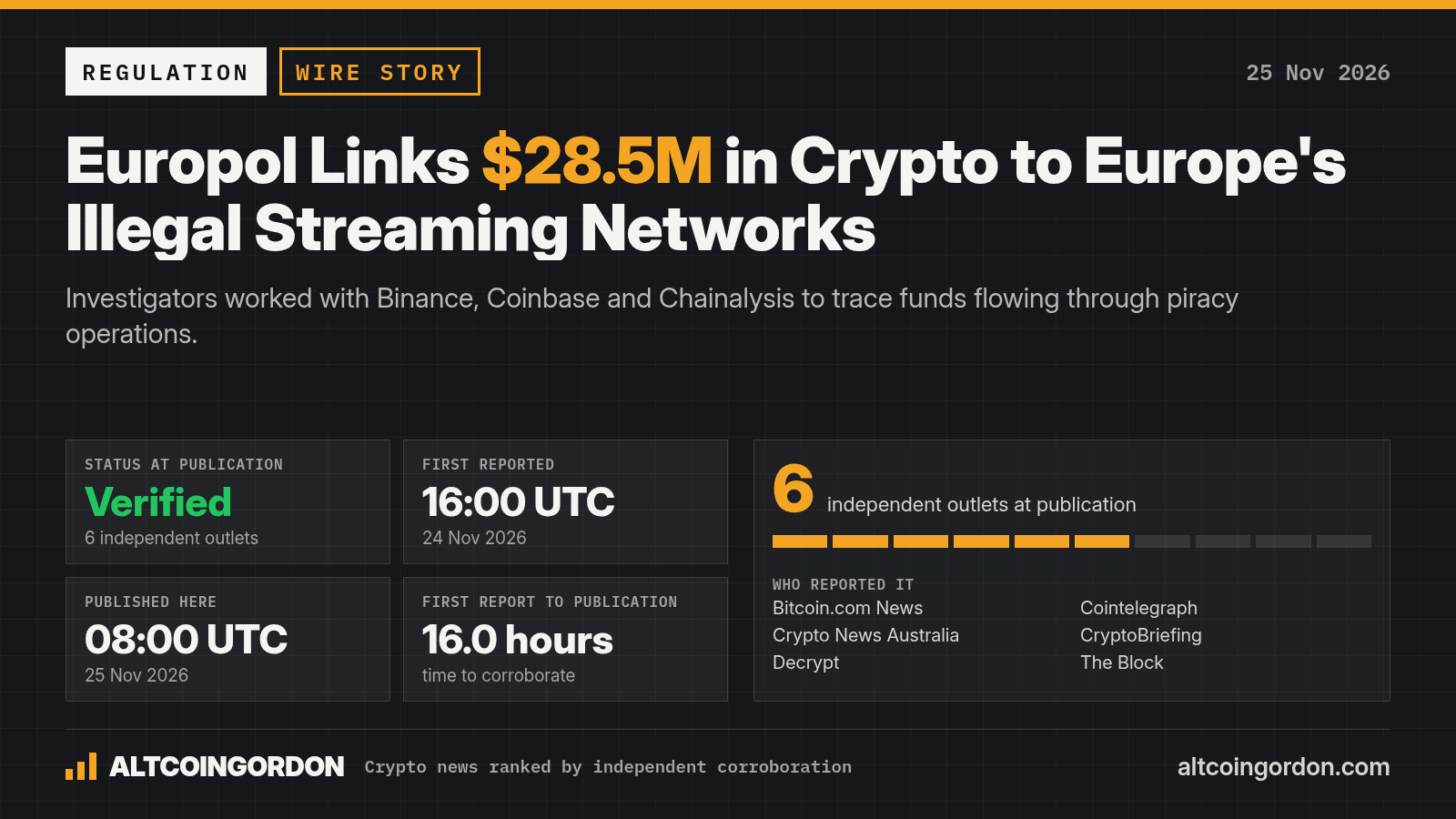
Europol has identified more than $28 million in cryptocurrency connected to illegal streaming operations across Europe. The figure, reported at $28.5 million by some outlets, represents funds the agency says flowed through a network of unauthorized services distributing pirated television and film content.
The investigation relied on cooperation between Europol, cryptocurrency exchanges Binance and Coinbase, and blockchain analytics firm Chainalysis. That combination of law enforcement, exchange compliance teams and tracing software reflects a pattern now common in crypto-related financial crime cases. Investigators increasingly pair on-chain analysis with data held by regulated exchanges to follow money that would otherwise be difficult to track.
Illegal streaming has long generated substantial revenue through subscription fees, advertising and donations, much of it collected outside traditional banking channels. Cryptocurrency offers operators a way to receive payments with less friction and, historically, with less scrutiny than card networks or bank transfers. Europol's findings suggest that assumption is eroding as tracing tools mature.
Chainalysis has built a business around supplying exactly this kind of forensic capability to governments and exchanges. Its involvement signals that the piracy investigation used established blockchain-tracing methodology rather than ad hoc techniques. Binance and Coinbase, both of which operate extensive compliance and law enforcement liaison teams, appear to have supplied account or transaction data that helped investigators connect wallets to specific services.
The case adds to a broader body of enforcement actions in which crypto exchanges assist European authorities. Regulators across the European Union have pushed exchanges toward tighter know-your-customer and anti-money-laundering standards in recent years. Cooperation on cases like this one is often cited as evidence that those frameworks are functioning as intended.
Details on individual suspects, the specific streaming platforms involved, or any arrests tied to the $28 million figure were not included in the available reporting. It remains unclear how the funds were ultimately used or whether further enforcement actions are planned. Europol has not indicated whether additional jurisdictions outside Europe were involved in the financial trail.
- 24 Nov 16:00Decrypt · first report
- 24 Nov 16:06CryptoBriefing
- 24 Nov 16:45The Block
- 24 Nov 17:09Coin Edition
- 24 Nov 17:56Crypto Economy
- 24 Nov 21:50Cointelegraph
- 25 Nov 00:37Blockchain.News
Market Impact
The disclosure is unlikely to move cryptocurrency prices directly, since it concerns law enforcement tracing rather than market activity. It does reinforce a trend relevant to exchanges and compliance teams: regulators and investigators are treating blockchain data as a routine investigative tool rather than a specialized exception.
For exchanges like Binance and Coinbase, continued cooperation with European law enforcement may support their efforts to demonstrate regulatory good standing in a region tightening oversight under frameworks such as MiCA. For blockchain analytics firms, cases like this serve as evidence of their tools' effectiveness, which can support continued government and institutional demand for tracing services.
The $28 million figure underscores how closely crypto transactions can now be linked to real-world criminal enterprises when exchanges and analytics firms cooperate with investigators. Further details from Europol may clarify the scope of the streaming network and any resulting legal action.
Frequently Asked Questions
How much cryptocurrency did Europol trace in this investigation?
Europol traced more than $28 million in cryptocurrency, with one report putting the figure at $28.5 million, tied to illegal streaming services in Europe.
Which companies assisted Europol in the investigation?
Europol worked with cryptocurrency exchanges Binance and Coinbase, along with blockchain analytics firm Chainalysis, to trace the funds.
Were any individuals or platforms named in connection with the illegal streaming network?
The available reporting did not identify specific suspects or streaming platforms tied to the traced funds.
Does this case indicate crypto is commonly used to fund illegal streaming services?
The findings show cryptocurrency has been used to move proceeds from illegal streaming operations in this case, reflecting a broader pattern of digital assets appearing in piracy-related financial flows.