

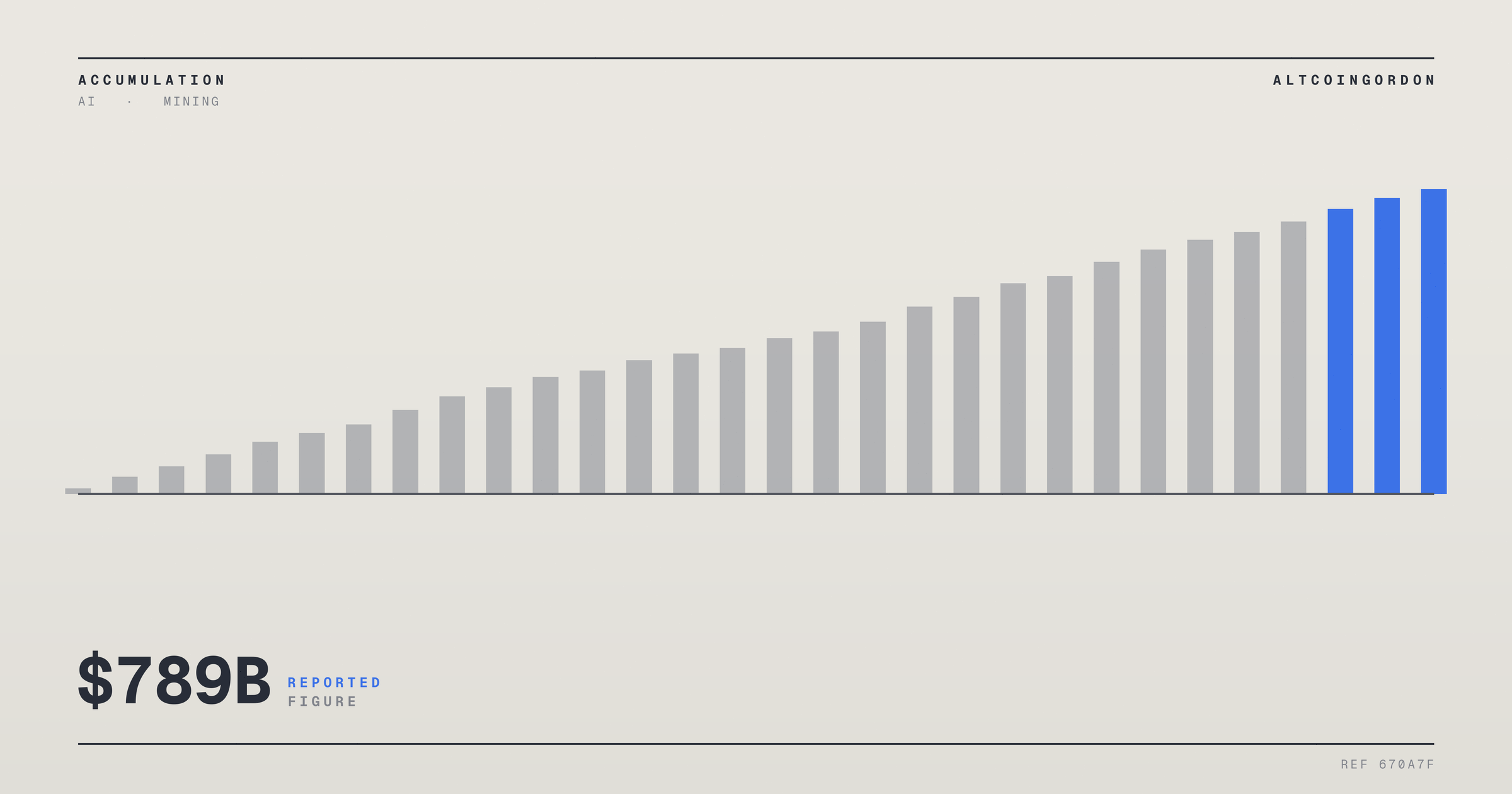
CryptoBriefing reported on August 10 that expectations for hyperscaler capital expenditure in 2026 have surged to approximately $789 billion. The term hyperscaler generally refers to the largest cloud and internet infrastructure operators, companies that build and run massive data center networks. These firms have historically included the likes of Amazon, Microsoft, Google, and Meta, though the report did not break down spending by individual company.
Capital expenditure, or capex, covers the money these firms put into physical infrastructure. That includes servers, networking equipment, semiconductors, and the buildings and power systems that house them. A rising capex forecast typically signals that operators expect demand for computing capacity to keep growing. In recent years, that demand has been driven heavily by artificial intelligence workloads, which require far more processing power than traditional cloud services.
The scale of the $789 billion figure, if it holds, would represent a substantial jump from prior spending cycles. Hyperscaler capex has already been rising for several years as companies race to build out AI training and inference capacity. Higher spending expectations suggest that firms anticipate sustained or growing demand for AI services well into 2026, rather than a plateau.
This kind of infrastructure buildout matters beyond the technology sector alone. Data centers require enormous amounts of electricity, chips, and physical real estate, creating knock-on demand across semiconductor supply chains, energy markets, and construction. Companies that supply components or services to hyperscalers often see their own revenue expectations shift in response to these capex signals.
The crypto industry has developed increasingly close ties to this infrastructure buildout. Some cryptocurrency mining operations have converted or expanded facilities to host AI computing hardware instead of, or alongside, mining rigs. Power capacity and data center space that were once built for proof-of-work mining are now being marketed to AI customers, given overlapping infrastructure needs.
Market watchers frequently treat hyperscaler capex figures as a proxy for broader confidence in the AI investment cycle. When large operators signal higher spending, it is often interpreted as a vote of confidence in continued AI demand. When forecasts are trimmed, it can raise questions about whether the pace of AI adoption is slowing. The $789 billion figure reported by CryptoBriefing falls into the former camp, pointing toward continued expansion rather than retrenchment.
Market Impact
A higher hyperscaler capex outlook tends to reverberate through markets tied to AI infrastructure, including semiconductor companies, data center real estate, and energy suppliers. Within crypto, firms that have pivoted mining facilities toward AI hosting or high-performance computing could see renewed investor interest if the spending trend materializes. Tokens and equities linked to decentralized compute, GPU marketplaces, or energy infrastructure may also draw attention as investors look for exposure to the broader AI buildout.
At the same time, large capex commitments carry execution risk. Spending forecasts can shift if hyperscalers adjust plans in response to chip supply constraints, financing costs, or changes in AI demand. Investors should treat the $789 billion figure as an expectation rather than a guaranteed outcome, and watch for updates as hyperscalers report their own guidance in coming quarters.
The reported jump in hyperscaler capex expectations to $789 billion for 2026 highlights how central AI infrastructure spending has become to technology and adjacent markets. Whether that figure holds will depend on how demand, supply chains, and financing conditions evolve over the coming year.
Frequently Asked Questions
What is a hyperscaler?
A hyperscaler is a large cloud computing or internet infrastructure company that operates data centers at massive scale, such as those run by major cloud providers.
Why did hyperscaler capex expectations rise to $789 billion?
CryptoBriefing reported the figure reflects growing anticipated spending on data centers, chips, and power infrastructure, largely driven by demand for AI computing capacity.
How does hyperscaler spending relate to crypto markets?
Some crypto mining operators have repurposed facilities and power capacity for AI hosting, tying their business outlook to broader trends in AI infrastructure investment.
Is the $789 billion figure guaranteed to be spent?
No. It represents an expectation reported by CryptoBriefing, and actual spending could change based on demand, supply chains, or financing conditions.