

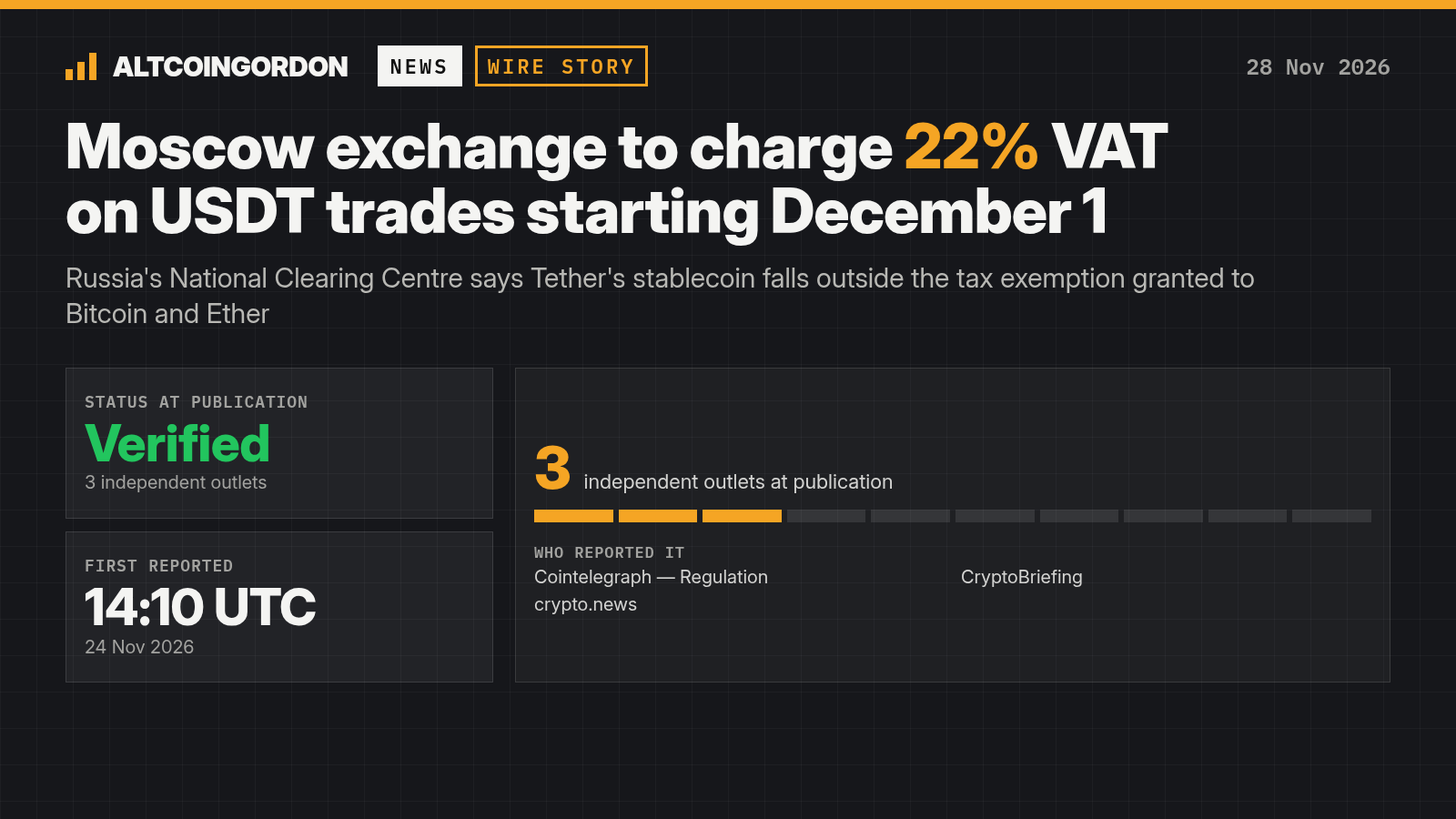
Moscow Exchange, Russia's largest bourse, will launch organized trading in Bitcoin, Ether and Tether's USDT on December 1, 2026. The exchange's clearinghouse, the National Clearing Centre, has confirmed that USDT purchases will carry a 22% value-added tax that Bitcoin and Ether trades will not.
The NCC said the VAT will apply to USDT purchases, sales and swaps made between December 1 and December 31. The tax is added on top of the trade price. A buyer seeking 100,000 rubles worth of USDT would pay an extra 22,000 rubles in VAT, bringing the total cost to 122,000 rubles before broker fees.
The discrepancy in treatment stems from how Russian law categorizes digital assets. Bitcoin and Ether are classified as digital currencies, a category the tax code exempts from VAT. USDT instead falls under a separate designation known as a foreign digital instrument, which the NCC says carries no explicit VAT exemption. The clearinghouse is basing the charge on Articles 153 and 164 of the tax code, which govern how the tax base and applicable rates are calculated. Article 146 of the tax code is what excludes digital currency sales from VAT, drawing the legal line that leaves USDT outside that protection. The Federal Tax Service lists 22% as Russia's standard VAT rate for 2026.
- September 1Main provisions of Federal Law No. 282-FZ took effect
- November 6Bank of Russia approved the list of coins for non-qualified investors
- November 22Bank of Russia approved Bitcoin, Ether and USDT for organized trading
- November 24NCC decided to charge VAT on Tether trades for December
The NCC has asked the Federal Tax Service and the Finance Ministry for formal guidance on the matter. It said it would notify market participants if regulators clarify the rules or if lawmakers decide to exempt trades executed before January 1, 2027. For now, the clearinghouse's notice covers only the month of December.
The new crypto market operates under Federal Law No. 282-FZ, whose main provisions took effect September 1, 2026, combined with a Bank of Russia directive permitting organized digital asset trading from November 22. Separate Bank of Russia rules taking effect November 17 let non-qualified investors buy Bitcoin, Ether and USDT through licensed intermediaries, with annual purchases capped at 300,000 rubles, or roughly $3,650, per intermediary.
Rather than building a separate crypto venue, Moscow Exchange is routing digital asset trades through its existing stock-market infrastructure, clearing through the NCC while licensed digital depositories record ownership. Investors will trade through brokerage accounts and apps they already use rather than personal crypto wallets. Trading hours will mirror the stock market, running from 06:50 to 23:50 Moscow time, with same-day or next-day settlement and swap functionality for liquidity management. Short selling will be banned when trading begins, and brokers will connect to the new market in stages during an initial pilot period.
Retail investors will need to pass a mandatory knowledge test before gaining access. U.S. sanctions on Moscow Exchange leave unresolved questions about how Tether would treat pooled USDT holdings tied to the platform.
- 2 NovBitcoin, Ethereum and USDT Trading to Begin December 1 on Moscow Exchange
- 21 NovRussia Clears Crypto Exchanges to Launch Bitcoin Trading, Moscow Exchange Targets December
- 24 Nov 14:10Cointelegraph — Regulation · first report
- 24 Nov 14:25CryptoBriefing
- 24 Nov 16:11Bitcoinist
- 24 Nov 19:10crypto.news
- 25 Nov 14:43Crypto News Flash
Bitcoin around this story
What Bitcoin futures prices on Hyperliquid showed between the first report and our publication. It shows timing, not cause: prices move for many reasons at once.
Market Impact
The VAT creates an immediate cost gap between USDT and Russia's two other approved digital assets, which could push retail activity toward Bitcoin and Ether in the near term. Traders who move repeatedly in and out of USDT would face the 22% charge on every purchase, making frequent trading in the stablecoin markedly more expensive than simply holding it or trading Bitcoin and Ether instead.
Because the NCC has flagged the tax treatment as provisional and tied to pending guidance from Russian tax authorities, the rules could shift once officials respond or lawmakers act on exemptions for trades completed before 2027. Market participants and brokers connecting to the pilot phase will likely watch for that clarification closely, given its direct effect on the relative cost of trading USDT versus Bitcoin and Ether on the new venue.
Moscow Exchange's launch marks a notable step in formalizing Russian crypto trading, but the uneven tax treatment of USDT highlights how quickly new rules can create friction for specific assets. Further guidance from Russian tax authorities could reshape the economics of stablecoin trading on the platform before the pilot period concludes.
Frequently Asked Questions
Why does USDT face a VAT that Bitcoin and Ether avoid?
Russian law classifies Bitcoin and Ether as digital currencies, which are exempt from VAT, while USDT is categorized as a foreign digital instrument with no explicit exemption, the National Clearing Centre said.
How much extra would a trader pay under the new VAT?
A buyer purchasing 100,000 rubles worth of USDT would pay an additional 22,000 rubles in VAT, for a total of 122,000 rubles before broker fees.
Is the 22% VAT permanent?
The NCC's notice currently covers only trades from December 1 through December 31, 2026, and the clearinghouse has asked Russian tax authorities for further guidance that could change the treatment.
How much crypto can ordinary Russian investors buy?
Non-qualified investors can buy up to 300,000 rubles, about $3,650, worth of crypto per year through each licensed intermediary.
Do investors need a crypto wallet to trade on Moscow Exchange?
No. Trades run through existing brokerage accounts and apps, with ownership recorded by licensed digital depositories instead of personal wallets.