

Scott Aaronson, a well-known figure in quantum computing and computational complexity, has said he is hearing multiple rumors that OpenAI, Anthropic, or both companies may have found an efficient method to factor large numbers. Factoring large numbers quickly is the problem RSA encryption is built to prevent. If that assumption breaks, a huge share of the encryption securing banks, governments, and online communications would be at risk.
Aaronson has gone further than simply repeating chatter. He described himself as 'virtually certain' one of the two labs is sitting on cryptography 'bombshells' that have not yet been made public. No evidence has been released to confirm any such breakthrough, and the claim remains speculative rather than demonstrated.
The rumors arrived alongside a genuine wave of published mathematical research from AI labs. On November 24, OpenAI added nine manuscripts to its public mathematics repository. One claimed to resolve the exponent of square matrix multiplication at exactly 9/4, a problem mathematicians have worked on for decades. Matrix multiplication underpins a wide range of fields, including scientific computing, engineering, artificial intelligence, and some cryptographic applications.
A day later, on November 25, Google released six AI-generated research papers of its own. The near-simultaneous timing of these releases, combined with Aaronson's comments, has been enough to reignite long-running debate about whether AI systems are quietly closing in on problems once thought to require decades more progress.
The discussion inevitably turned to Bitcoin, given how often cryptocurrency security gets tied to broader conversations about cryptographic risk. Bitcoin does not rely on RSA. It uses elliptic-curve cryptography to secure wallets and transactions, a mathematically distinct system from the integer factorization problem RSA depends on. That distinction matters: even if the rumored OpenAI or Anthropic breakthrough is real, and even if it solves factorization efficiently, it would not automatically break the elliptic-curve math that protects Bitcoin private keys.
Still, the episode has renewed attention on a longer-term concern shared across both traditional and crypto-native security circles: the eventual arrival of computing power, whether quantum or AI-assisted, capable of undermining cryptographic assumptions that have held for decades. Aaronson's position as a leading voice in the field gives his remarks weight even without public proof, since his career has been built on evaluating exactly these kinds of computational claims.
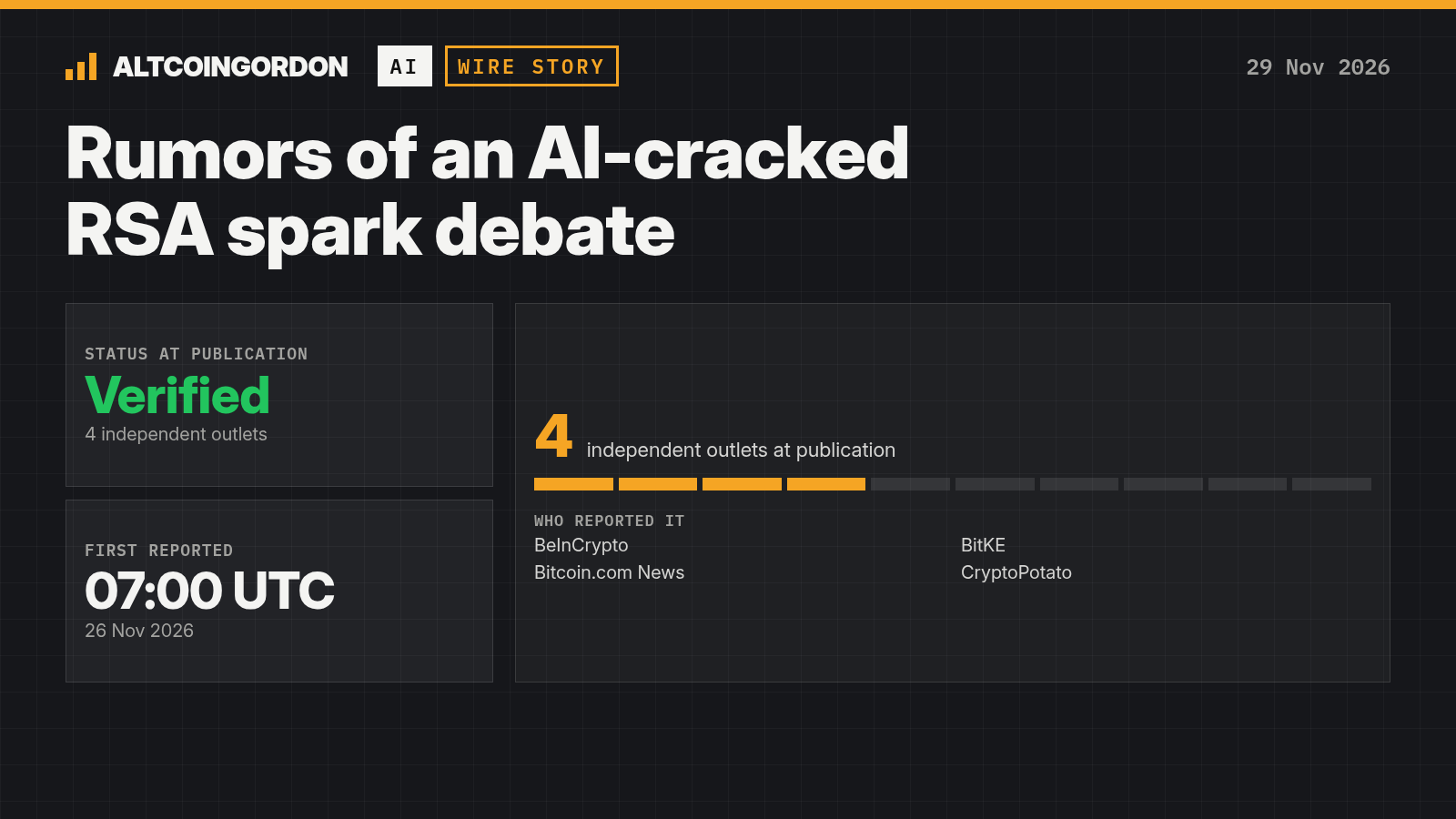
- 26 Nov 07:00BeInCrypto · first report
- 26 Nov 14:54CryptoPotato
- 26 Nov 15:30Bitcoin.com News
- 27 Nov 08:00BitKE
Bitcoin around this story
What Bitcoin futures prices on Hyperliquid showed between the first report and our publication. It shows timing, not cause: prices move for many reasons at once.
Market Impact
No confirmed breakthrough has been published, so there is no direct, verifiable impact on Bitcoin's price or network security at this stage. The rumors highlight how closely crypto markets track developments in unrelated fields, since any credible threat to cryptographic assumptions tends to generate anxiety across digital asset markets even when the underlying math does not apply to blockchain systems.
Because Bitcoin's security rests on elliptic-curve cryptography rather than RSA, an integer factorization breakthrough, if it materializes, would not by itself compromise Bitcoin wallets or transactions. The broader signal, that AI labs may be accelerating progress on hard mathematical problems, could still shape longer-term conversations about cryptographic standards used across both traditional finance and crypto infrastructure.
Until OpenAI or Anthropic confirms or denies the rumors, the claim remains unverified speculation built on Aaronson's remarks and a wave of unrelated but genuine mathematical publications from OpenAI and Google.
Frequently Asked Questions
Did OpenAI or Anthropic confirm breaking RSA encryption?
No. Scott Aaronson said he has heard rumors of such a breakthrough, but no evidence has been made public by either company.
Would an RSA break affect Bitcoin directly?
Not automatically. Bitcoin relies on elliptic-curve cryptography rather than RSA, so a factorization breakthrough would not by itself compromise Bitcoin wallets.
What mathematical research did OpenAI actually publish?
On November 24, OpenAI released nine manuscripts, including a claimed solution setting the exponent of square matrix multiplication at exactly 9/4.
What did Google release around the same time?
Google published six AI-generated research papers on November 25, a day after OpenAI's manuscript release.
Who is Scott Aaronson?
He is a complexity theorist known for work in quantum computing, whose comments on factorization rumors have driven the renewed debate.