

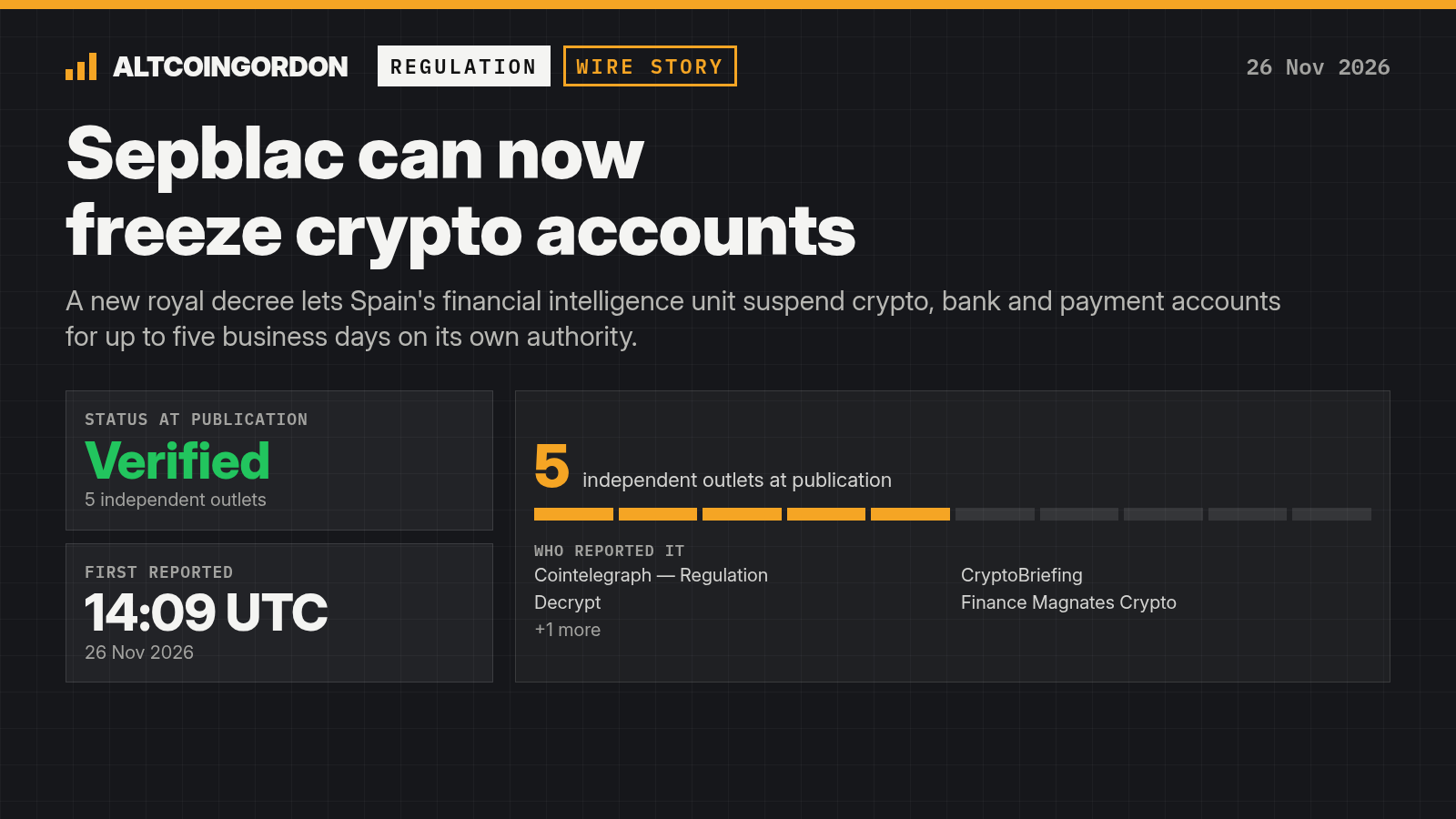
Spain's government has handed its financial intelligence unit a tool it previously lacked: the ability to freeze crypto accounts on its own, without a judge signing off first. The change comes through Real Decreto-ley 44/2026, published in Spain's Official State Gazette on November 25, 2026.
The decree inserts a new provision, Article 46 bis, into Ley 10/2010, Spain's core anti-money-laundering statute. It gives Sepblac, formally the Executive Service of the Commission for the Prevention of Money Laundering and Monetary Offenses, the authority to suspend bank, payment and crypto-asset accounts when it detects signs of money laundering or terrorist financing. An account or business relationship can be frozen for up to five business days. A transaction already in progress can be held for up to ten business days.
The most significant shift is procedural. Until now, Sepblac could only suspend a transaction if a foreign financial intelligence unit asked it to. Under the new rule, the agency can act purely on its own internal analysis, without waiting for an external trigger. Spanish authorities say this closes a gap that slowed down domestic investigations and left suspected illicit funds free to move while paperwork from abroad was pending.
- November 24, 2026Royal Decree-Law 44/2026 is dated
- November 25, 2026Decree is published in Spain's Official State Gazette
- January 25, 2027New freeze powers are scheduled to take effect
The freeze is meant to be temporary by design. Once a suspension is no longer needed, it must end. If Sepblac wants to keep an account or transaction locked beyond the five- or ten-day limits, a public prosecutor has to request a court ruling to extend it. That keeps a judge in the process, just later than before, and only for cases the agency wants to pursue further.
The measure did not arrive as a standalone crypto bill. It is folded into a broader decree on consumer credit that also caps interest rates on consumer loans and sets rules for buyers of bad debt, Decrypt reported. Spanish officials have pointed to the speed of digital-asset transfers and to standards set by the Financial Action Task Force as reasons for giving Sepblac a faster trigger. crypto.news reported that the decree partially implements an EU anti-money-laundering directive requiring member states to grant their financial intelligence units comparable powers.
The new authority is scheduled to take effect on January 25, 2027, giving crypto firms operating in Spain roughly two months to adjust their compliance procedures before direct freeze orders become possible. CryptoBriefing reported that the decree still requires validation from Spain's parliament before the effective date arrives.
Market Impact
Crypto exchanges, custodians and payment firms with Spanish users now have a concrete deadline to prepare for faster-moving freeze orders that bypass the usual wait for a judge. Compliance teams are likely to tighten transaction-monitoring and reporting workflows ahead of January 25, 2027, since Sepblac will be able to act on domestic analysis alone rather than waiting on requests from foreign counterparts.
The move also signals how EU member states are converging on stronger, faster-acting financial-intelligence powers for digital assets, a trend that firms operating across multiple European jurisdictions will need to track as similar directives take hold elsewhere.
Spain's decree gives its financial watchdog a quicker, judge-free first move against suspected illicit crypto flows, while preserving court oversight for anything that runs longer than five or ten business days. The rule takes effect January 25, 2027, pending parliamentary validation.
Frequently Asked Questions
What is Sepblac?
Sepblac is Spain's financial intelligence unit, formally the Executive Service of the Commission for the Prevention of Money Laundering and Monetary Offenses.
How long can Sepblac freeze a crypto account under the new rule?
Sepblac can suspend a crypto, bank or payment account for up to five business days, and can hold a transaction already in progress for up to ten business days.
Does a judge still get involved?
Yes, but later in the process. If Sepblac wants to extend a freeze beyond the initial limits, a public prosecutor must request a court ruling.
When do the new powers take effect?
The measure is scheduled to take effect on January 25, 2027. The decree still needs validation from Spain's parliament.
Why did Spain make this change?
Sepblac previously needed a request from a foreign financial intelligence unit before it could suspend a transaction. The government cited the speed of digital transfers and FATF standards, and the decree partially implements an EU anti-money-laundering directive.