

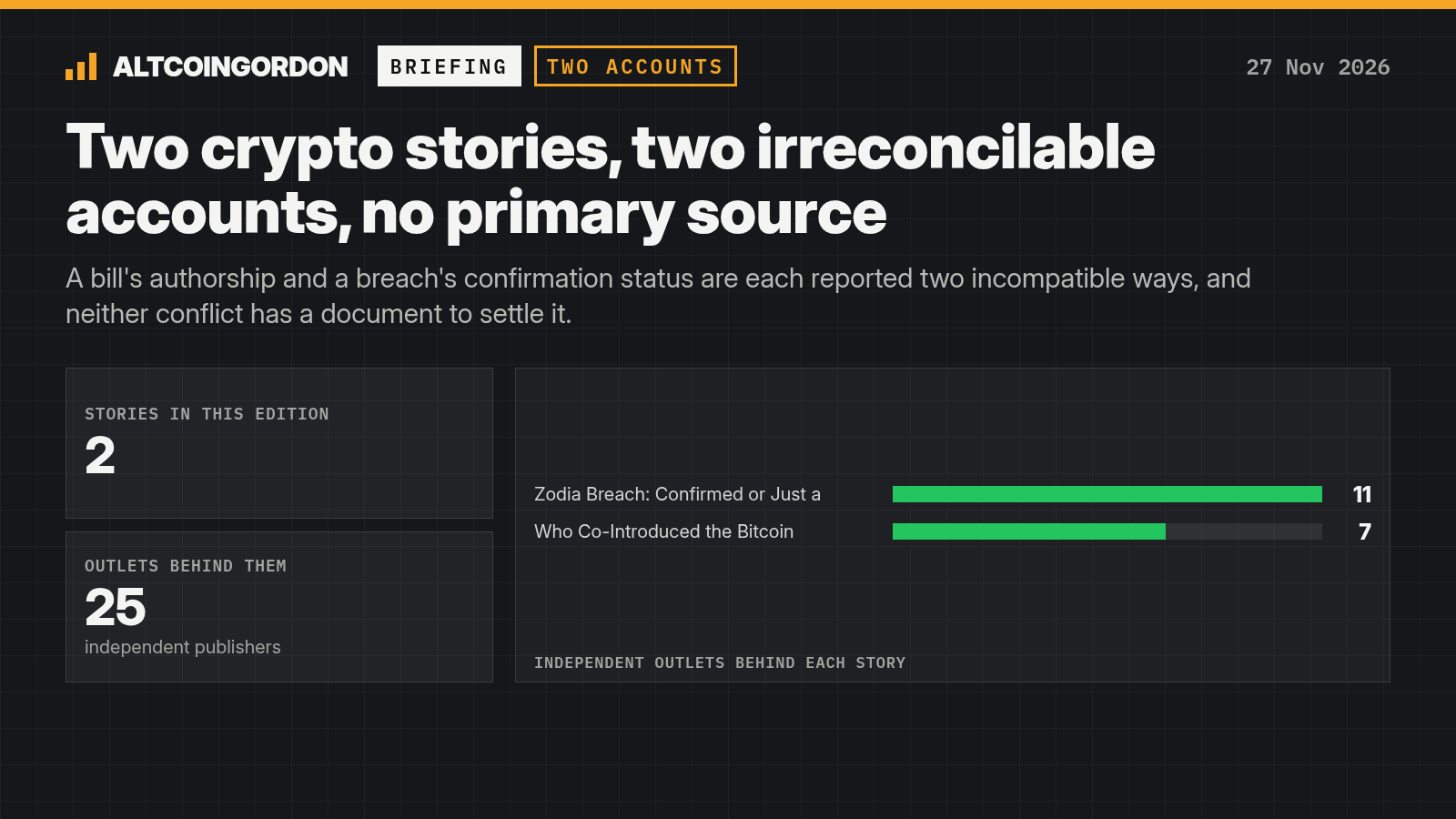
A bill's authorship and a breach's confirmation status are each reported two incompatible ways, and neither conflict has a document to settle it.
Neither conflict is resolved by what has been published so far, the bill's authorship and the breach's confirmation status both wait on a document neither claim has produced, and the wide publisher counts attached to each story describe how far they travelled, not which version is correct.
Who Actually Put Their Name on H.R. 8957 Is Disputed
Carried by seven independent publishers including AMBCrypto, Bitcoin Magazine and CoinGape, the reporting on the Bitcoin reserve bill splits cleanly down the middle on a question that should have one answer: who introduced it. Two accounts describe the bill as introduced by Begich alone with Golden listed only as a cosponsor, which makes Golden a supporting name rather than an author. A third account describes Begich and Golden as joint introducers, which is a different legislative fact, not a rounding error, because cosponsorship and joint introduction carry different procedural weight in how a bill is recorded. Seven publishers repeating a story does not multiply the number of original sources behind it, and here it does not even multiply agreement, since the publishers themselves disagree on the detail that matters most. Nothing in the material resolves which framing the bill's own text or the congressional record would support, so the honest position is that the attribution is unsettled, not that one version is wrong.
That matters beyond the trivia of a byline. A reader using this story to gauge how much institutional backing a bitcoin reserve bill has in Congress needs to know whether it has one sponsor and one cosponsor, which is a narrower coalition, or two co-introducers, which reads as broader. The coverage volume looks like corroboration from the outside, but on this specific fact it is actually two camps of reporting talking past each other.
Was the Zodia Breach Confirmed or Just Claimed
The Zodia story carries more weight on paper, reaching eleven independent publishers including BeInCrypto, Cointelegraph and Coinpedia, which puts it among the better-supported items of the period purely by publisher count. But the count conceals a split in what is actually being reported. One account treats the breach as an unconfirmed claim circulating on social media, careful to flag it as unverified. Two other accounts go further and state that Zodia's chief executive confirmed the breach directly, which is a materially stronger claim because it moves the story from rumour to acknowledged incident. A CEO statement, if it exists, would be the kind of primary document that settles this outright, but nothing in the material shows that statement itself, only reports asserting it was made. Until that statement surfaces, the eleven-publisher count tells you the story travelled widely, not that the strongest version of it is confirmed.
This is the trap of corroboration counts treated as a single number. Eleven publishers sounds like consensus, but consensus on what. If the underlying claim is "a breach happened and the CEO confirmed it," that is supported by a subset. If the claim is "something happened and is being discussed," that is supported by all eleven. Collapsing those into one figure overstates certainty on the exact point a reader most needs to be careful about.
Volume of Coverage Is Not the Same as Agreement on Facts
Read together, the bill story and the Zodia story describe the same structural problem from opposite directions. In the bill case, wide syndication (thirteen feeds carrying the authorship story) sits on top of a genuine factual fork about Begich and Golden's roles. In the Zodia case, an even wider spread, sixteen feeds, sits on top of a fork about whether confirmation happened at all or merely a claim did. Neither fork is an error one side is making and the other is not; nothing here is a primary document from Congress or from Zodia itself, so neither edition can declare a winner. What both stories show is that a high publisher count measures reach, not precision, and a reader should weight the headline number of outlets against whether those outlets are actually saying the same thing.
Stories in this edition
Neither conflict is resolved by what has been published so far, the bill's authorship and the breach's confirmation status both wait on a document neither claim has produced, and the wide publisher counts attached to each story describe how far they travelled, not which version is correct.