

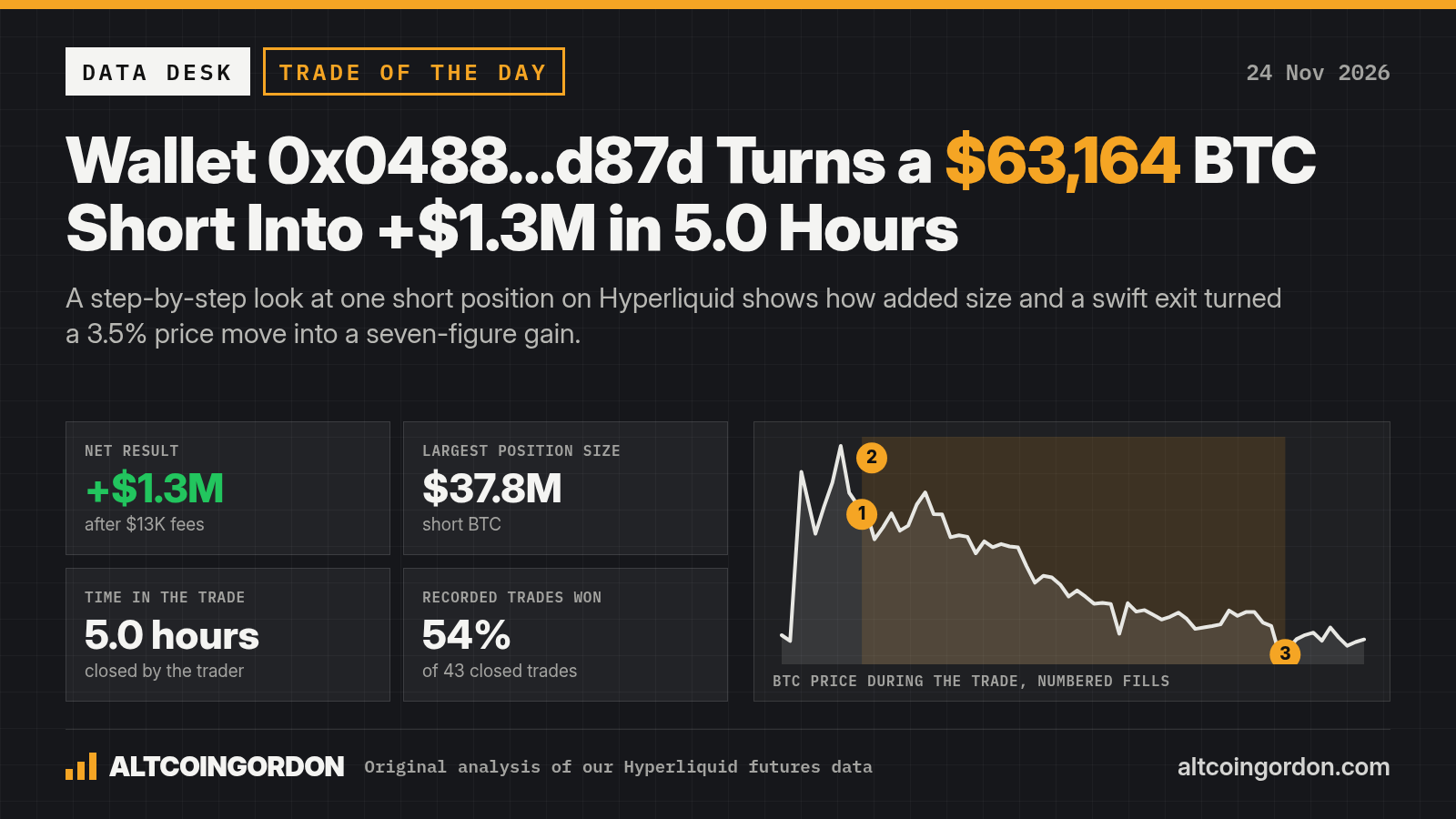
- Wallet 0x0488…d87d opened a BTC short at $63,164, added to it, and closed the whole position at $60,930 for a net profit of $1.3M after $13K in fees.
- The position reached a largest size of $37.8M and was open for 5.0 hours before the trader closed it themselves.
- Across 43 recorded closed trades this wallet wins 54% of the time, but its net result of +$2.0M shows size and timing matter as much as win rate.
A short position profits when price falls, and that is what played out here. Wallet 0x0488…d87d opened a BTC short at 14:42 UTC on 23 November at $63,164, added to the position 7 minutes later, and closed the entire trade at 19:43 UTC at $60,930. The price change from entry to exit was -3.5%, and on a position that reached $37.8M in size, that move produced a profit before fees of +$1.3M. After $13K in fees, the net result was +$1.3M.
Following the trade fill by fill
The step-by-step record shows three fills. The trader opened with $28.4M at $63,164, added $9.4M at $62,962 to bring the position up to its largest size of $37.8M, then closed the full $36.6M at $60,930 for a realized gain of $1.3M. The add came in while price was already below the entry level, meaning the trader increased exposure to a short that was already moving in their favor rather than waiting for a retracement.
- 1
Opened $28.4M at $63,16423 Nov 14:42 UTC
- 2
Added $9.4M at $62,96223 Nov 14:50 UTC
- 3
Closed $36.6M at $60,93023 Nov 19:43 UTC · realized +$1.3M
The close came 5.0 hours after the position was opened, which lines up with how the trader described the trade ending: closed by the trader, not by a stop or a liquidation. That distinction matters. A position that is closed on the trader’s own terms means the exit price was chosen, not forced, which is why the fees here were $13K against a profit before fees of +$1.3M rather than a liquidation wiping out the position.
What the wallet’s record shows
This was not an isolated result. The wallet’s scorecard lists Hyperliquid P&L of +$1.7M over the past day, +$1.1M over the past 7 days, +$1.8M over the past 30 days, and +$1.8M all time. Those figures are Hyperliquid’s own account numbers, not a sum of every trade we have recorded.
Looking only at the closed trades our tracker has captured since 11 November 2026, the wallet has 43 closed trades, of which 54% made money. The net result of those trades after fees is +$2.0M, and the typical holding time is 3.2 hours — close to the 5.0 hours this particular trade ran. The wallet has not been liquidated in any of those 43 trades. A 54% win rate paired with a net result well above zero tells a specific story: this trader is not winning on frequency alone. The scale of wins and losses matters more than how often each occurs.
That point is reinforced by comparing this trade with the wallet’s worst recorded trade: a short BTC position opened 21 Nov 06:36 UTC that moved from $56,521 to $60,471 and closed for a net -$2.6M. Both trades were BTC shorts closed by the trader, but one ended in a gain of $1.3M and the other in a loss of $2.6M. The record does not say why price moved against the position on 21 November, only that it did, and that the trader absorbed a loss larger in absolute terms than the gain on 23 November.
The cumulative picture
Over the past 30 days, cumulative P&L for this wallet started at $0, reached a high of +$3.5M, dropped to a low of -$14K, and stands at +$1.8M as of the latest reading.
That path — a high well above the current total, a low close to zero, and a result in between — is consistent with a trader who takes on sized directional risk, as reflected in our Directional trader classification, and whose account value stands at $4.5M.
What to watch
The trade itself is closed, so there is nothing live to track in this position. For context on how this trader operates going forward, the scorecard’s typical holding time of 3.2 hours and the 0 liquidations recorded across 43 trades are the two figures worth keeping in view against any new positions that appear in the wallet.
Beginner’s guide: the terms in this report
How much do fees matter?
Every fill on Hyperliquid pays a fee, and active traders pay it many times over. A strategy built on many small trades needs a real edge just to break even, which is why we show fees separately from the gross result.
What do long and short mean?
A long position makes money when the price rises; a short position makes money when it falls. On a futures exchange such as Hyperliquid you can open either with borrowed buying power, which is what leverage means.
Follow it live
How this was made: every figure above comes from AltcoinGordon’s own tracking of BTC positions on Hyperliquid, captured at 00:15 UTC. It covers the accounts we track, not the whole market. The text was written by our automated data desk and checked by software against the captured data before publishing. Not investment advice.