

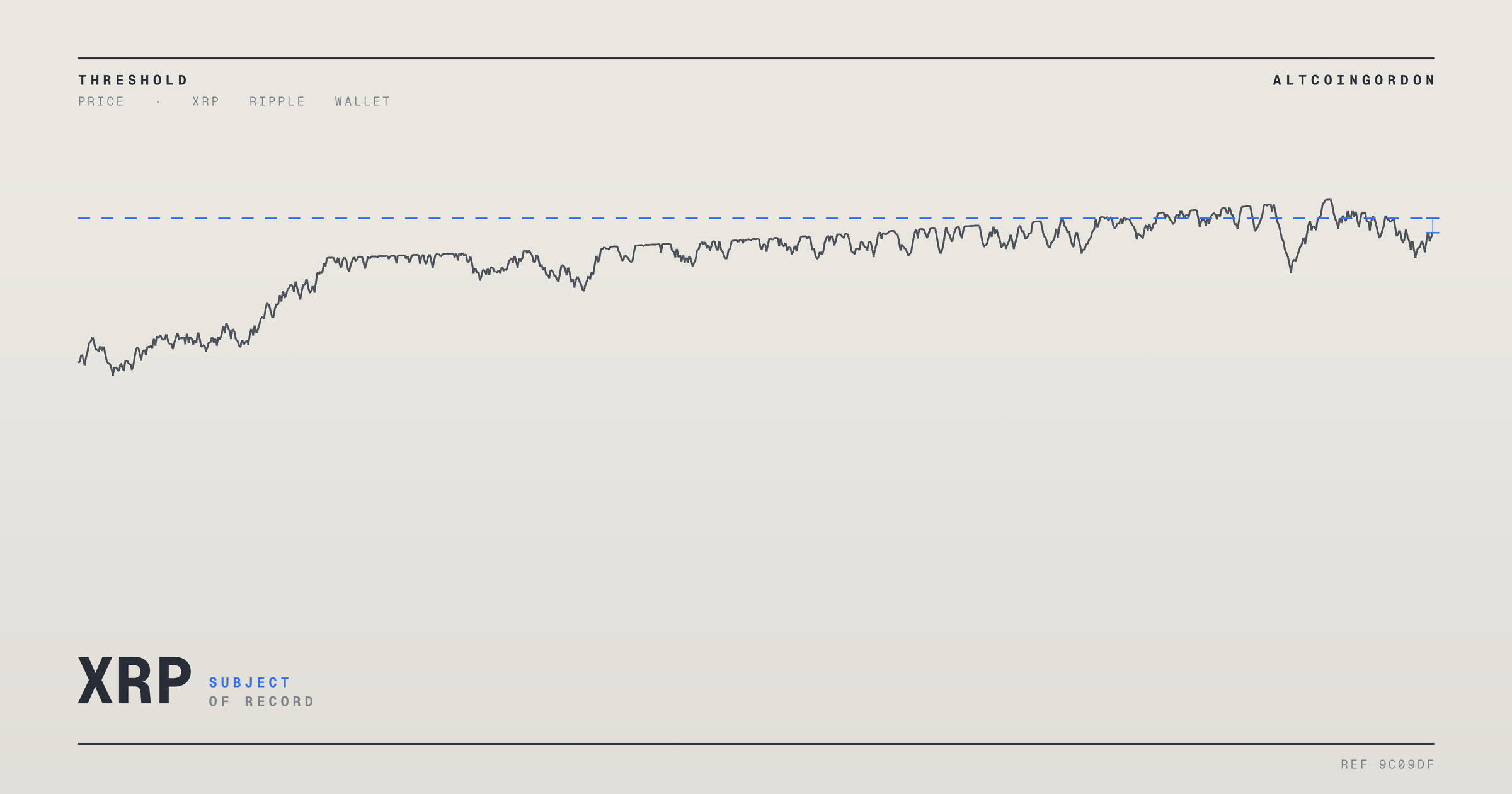
XRP has drawn fresh attention after reports flagged an uptick in whale accumulation, a pattern traders often watch for signs of a shift in market sentiment. Whale accumulation refers to large holders adding to their positions, typically interpreted as a vote of confidence from participants with outsized market influence.
One report estimated the recent buying at roughly $4.25 million, tying the activity to a resistance level near $1.20. Clearing that level, according to that account, would be a necessary step before any larger move higher. A separate report framed the same underlying trend as evidence of a bullish reversal, with attention on $1.80 as a longer-range target.
The two figures are not necessarily contradictory. Resistance levels such as $1.20 often function as near-term checkpoints, while targets like $1.80 represent a further destination if momentum continues to build. Traders commonly use tiered price levels this way, treating each breakout as confirmation before eyeing the next.
Whale accumulation data is typically drawn from on-chain wallet analysis, which tracks large transfers and changes in holdings among addresses believed to belong to major investors. This kind of data can vary depending on the methodology and timeframe used, which may explain why separate reports arrived at different dollar figures and price levels.
XRP has spent much of the past year moving within a well-defined range, with traders closely watching how the token behaves around key psychological and technical price points. Renewed whale interest, if sustained, is often viewed as an early indicator that could precede broader shifts in trading volume and volatility.
Market participants tend to treat whale accumulation as one input among many, rather than a standalone signal. Broader factors, including overall crypto market sentiment, regulatory developments affecting Ripple and XRP specifically, and general liquidity conditions, continue to play a role in how the token trades in the near term.
Market Impact
If whale accumulation continues, it could add buying pressure that helps XRP test the resistance levels flagged in recent reports. A confirmed breakout above the $1.20 area, as described in one account, would likely draw additional attention from short-term traders looking for momentum trades.
At the same time, the differing figures across reports underscore the uncertainty inherent in whale-tracking data. Investors should treat accumulation signals as one data point among several, rather than a guaranteed precursor to a specific price outcome such as the $1.80 level mentioned in some coverage.
Whale accumulation in XRP appears to be building, though reports diverge on the exact scale and the price levels most likely to be tested next. Traders will likely watch resistance near $1.20 closely, treating any breakout as a signal for further moves.
Frequently Asked Questions
What does whale accumulation mean for XRP?
It refers to large holders increasing their XRP positions, which traders often view as a sign of growing confidence among major market participants.
Why do the two reports cite different price levels?
One report focuses on a near-term resistance level around $1.20, while the other points to $1.80 as a longer-range target, reflecting different timeframes and methodologies in tracking whale activity.
Is whale accumulation a guarantee of a price increase?
No. Accumulation is one signal among many that traders monitor, and it does not guarantee that a specific resistance level will break or that a target price will be reached.
How is whale accumulation data typically measured?
It is usually derived from on-chain analysis of large wallet transfers and holding changes, which can vary depending on the data source and time period examined.