

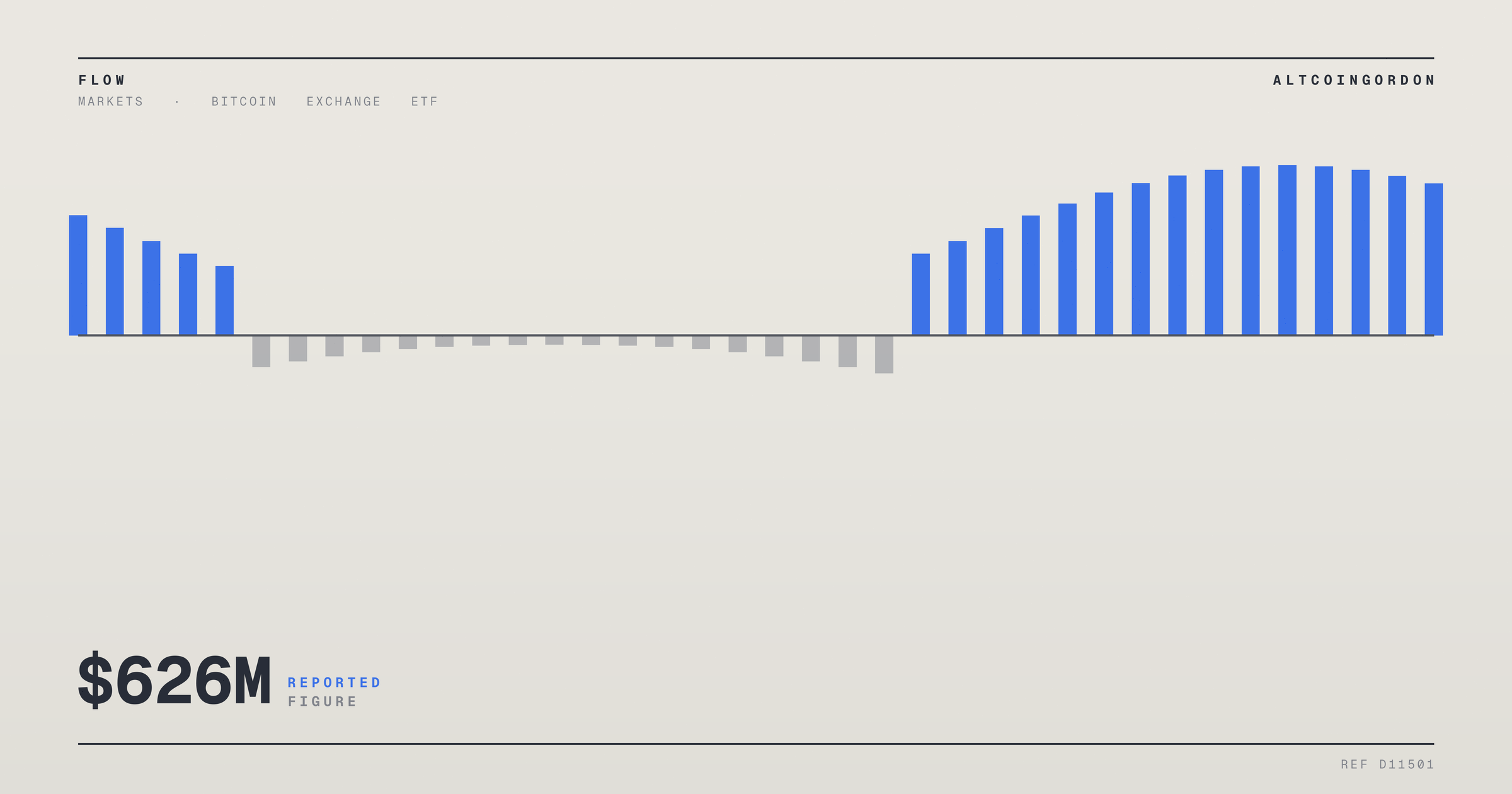
US spot Bitcoin exchange-traded funds recorded another day of net inflows, taking in $244 million and extending a winning streak that now spans three consecutive trading sessions. Combined, the three-day run has channeled more than $626 million into the group of funds, according to reporting from Cointelegraph.
Spot Bitcoin ETFs have become one of the primary conduits through which institutional and retail investors in the United States gain regulated exposure to Bitcoin without directly holding or custodying the asset themselves. Since their launch, these products have been closely watched as a barometer of broader market sentiment, with sustained inflows generally read as a signal of growing demand from allocators who prefer the familiarity and compliance framework of a listed fund over direct crypto ownership.
A multi-day inflow streak of this size is notable because ETF flows can be volatile, often swinging between net inflows and outflows within the same week depending on macroeconomic data, interest rate expectations, and broader risk appetite across financial markets. Three consecutive days of positive flows suggest a degree of consistency in buying interest, though it remains a relatively short window from which to draw firm conclusions about a longer-term trend.
The inflows arrive against a backdrop in which spot Bitcoin ETFs have accumulated substantial assets under management since their approval, with large asset managers competing for market share through fee structures and marketing. Daily flow data from these products is tracked closely by analysts and traders as a proxy for institutional positioning, given that the funds report holdings and flows with more transparency than many other segments of the crypto market.
Readers should treat the specific dollar amounts as reported pending additional independent verification, while recognizing that ETF flow data of this kind is typically sourced from fund administrators and exchange filings that are generally considered reliable.
The broader significance of continued ETF inflows lies in what they may indicate about the composition of Bitcoin’s investor base. As more capital moves through regulated fund structures rather than direct exchange purchases, the dynamics of Bitcoin’s price discovery and liquidity could increasingly reflect the behavior of institutional allocators, pension funds, and wealth managers who access the asset through traditional brokerage accounts.
Sources disagree on this story
This article was published before the reports below were compared. The reporting above stands; what follows is where the published accounts do not agree.
Cointelegraph and crypto.news give conflicting cumulative net-inflow figures for U.S. spot Bitcoin ETFs, with IBIT's reported cumulative total exceeding the market-wide cumulative total reported elsewhere.
What all sources agree on
- US-listed spot Bitcoin ETFs attracted $244.4 million in net inflows on the day in question (Cointelegraph, crypto.news).
- Spot Bitcoin ETFs recorded a three-day inflow total of approximately $626 million from August 3-5 (Cointelegraph, CryptoBriefing, Bitcoin.com News).
- BlackRock's IBIT captured roughly $478-479 million of that three-day total (CryptoBriefing, Bitcoin.com News, Cointelegraph).
- US-listed spot Bitcoin ETFs added $98.85 million on August 7 (Bitcoin.com News, crypto.news).
- Spot Ether ETFs added $49.60 million / $60.9 million figures on the respective dates cited (Bitcoin.com News, Cointelegraph, crypto.news).
Where the reports disagree
1Cumulative net inflow figures — IBIT's own cumulative total versus the entire market's cumulative total
BlackRock’s iShares Bitcoin Trust ETF (IBIT) led the gains, attracting $479 million over the three-session period and lifting its cumulative net inflows to nearly $61 billion, according to Farside Investors data.
Cumulative net inflows since launch stood at $52.18 billion, while the products generated $1.57 billion in daily trading value.
What would settle it: Farside Investors' published cumulative net-inflow dataset for IBIT alone, and SoSoValue's aggregate cumulative net-inflow figure for the entire U.S. spot Bitcoin ETF market, would need to be reconciled to determine which cumulative total is accurate.
What to make of it
Treat the daily and three-day/five-day flow figures as reliably reported across outlets, but do not cite either cumulative net-inflow total — IBIT's ~$61 billion or the market's $52.18 billion — as settled until the underlying Farside or SoSoValue datasets are checked directly.
Market Impact
Sustained net inflows into spot Bitcoin ETFs are typically interpreted by market participants as a sign of steady institutional demand, which can provide a supportive backdrop for Bitcoin's price by absorbing available supply through fund creation activity. However, a three-day streak, while notable, represents a short sample size, and flows have historically reversed quickly in response to shifts in macroeconomic conditions or risk sentiment.
For the broader crypto industry, continued ETF inflows reinforce the role these products play as a bridge between traditional finance and digital assets, potentially encouraging further product development, such as additional altcoin-based ETFs, and continued competition among issuers. Traders and analysts will likely continue monitoring daily flow figures as a real-time gauge of institutional sentiment toward Bitcoin.
The three-day inflow streak highlights continued institutional interest in spot Bitcoin ETFs, though market participants should watch subsequent flow data and additional corroborating reports to confirm whether this pattern reflects a durable trend or a short-term shift in positioning.
Frequently Asked Questions
What does a net inflow into a Bitcoin ETF mean?
A net inflow means that, on balance, investors bought more shares of the ETF than they sold or redeemed, requiring the fund to purchase additional Bitcoin to back the new shares, which reflects growing investor demand for that exposure.
Why are spot Bitcoin ETF flows closely watched?
Because spot Bitcoin ETFs report their holdings and flows with regulatory transparency, they serve as one of the clearest available indicators of institutional and retail demand for Bitcoin exposure through traditional brokerage accounts.
How reliable is this particular inflow figure?
This report is based on a single independent source at the time of writing, with a stated fact-check confidence of 0.43 and no additional cross-source corroboration found yet, so the specific dollar figures should be treated as reported pending further confirmation.
Does a multi-day inflow streak indicate a long-term trend?
Not necessarily. ETF flows can be volatile and are influenced by short-term factors such as macroeconomic data and shifts in risk appetite, so a three-day streak, while a positive signal, is not sufficient on its own to confirm a sustained long-term trend.