

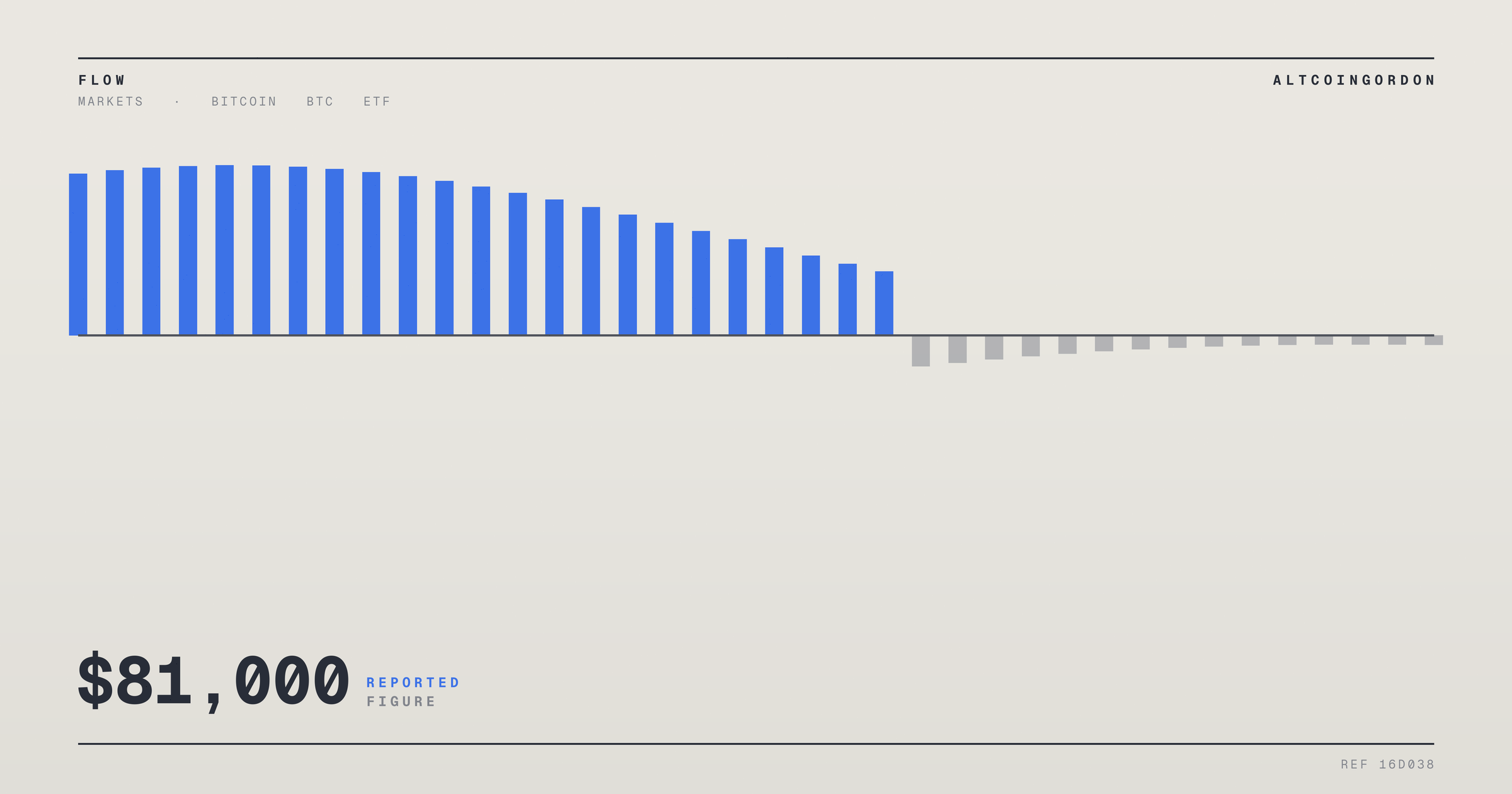
US spot Bitcoin ETFs pulled in fresh capital as Bitcoin's price climbed above $81,000. The rally came after a stretch of choppy trading that had pushed several funds into net outflow territory earlier in the week.
According to Crypto News Australia, a single-day inflow of $433 million on Friday was large enough to flip the week's overall flow figure from negative to positive. That inflow also helped the group of funds avoid a second consecutive week of net outflows, a pattern that had raised questions about waning institutional demand.
CryptoBriefing reported the broader trend of inflows returning to the spot Bitcoin ETF market as the price move above $81,000 took hold. The two developments, price strength and renewed ETF buying, appear closely linked, though the exact causal direction between price and flows is difficult to isolate from the data alone.
Spot Bitcoin ETFs have become one of the primary channels through which institutional and retail investors gain exposure to Bitcoin without holding the asset directly. Custody arrangements, regulatory approval, and daily flow data from these funds are now closely watched as a proxy for broader market sentiment.
Weekly flow swings of this size are not unusual for a market still adjusting to relatively young investment vehicles. Spot Bitcoin ETFs in the United States have only been trading for a bit over a year and a half, and their flow patterns remain sensitive to macroeconomic news, interest rate expectations, and shifts in risk appetite across broader financial markets.
The fact that a single day's inflow could reverse an entire week's trend also underscores how concentrated trading activity can be. A handful of large transactions, often tied to institutional allocation decisions, can move the aggregate figures substantially. This volatility in flow data makes single-week snapshots less reliable than longer trend lines when assessing investor sentiment toward Bitcoin.
Market participants have increasingly treated ETF flow data as a real-time signal of institutional appetite for Bitcoin exposure. Sustained inflows are often interpreted as a sign of confidence, while outflows can suggest profit-taking or a shift toward risk-off positioning. The reversal reported this week illustrates how quickly that signal can change direction.
Both reports frame the $433 million Friday inflow as a turning point after a difficult stretch for fund flows. Whether the momentum continues into the following week remains to be seen, and neither report offered forward guidance on future flow trends.
Market Impact
The reversal in ETF flows alongside Bitcoin's move past $81,000 may reinforce the perception that institutional demand remains a key driver of price action. Traders and analysts often use ETF flow data as a gauge of near-term sentiment, and a swing from net outflow to net inflow within a single week can influence short-term positioning across derivatives and spot markets.
Because the reported figures reflect aggregate flows across multiple funds, individual product performance may vary. Market watchers will likely look to subsequent weekly data to determine whether Friday's inflow marks a sustained shift or a temporary rebound tied to the price move above $81,000.
The Friday inflow highlights how quickly sentiment toward spot Bitcoin ETFs can shift, even within a single trading week. Continued monitoring of flow data alongside price action will help clarify whether this marks a durable trend or a short-term rebound.
Frequently Asked Questions
What caused the reversal in Bitcoin ETF flows?
Reports point to a $433 million inflow on Friday that offset earlier losses in the week, coinciding with Bitcoin's price rising above $81,000. The precise cause of the inflow was not detailed in available reporting.
Did all spot Bitcoin ETFs see inflows?
Available reporting describes aggregate flow figures across the group of US spot Bitcoin ETFs rather than performance for each individual fund.
Why do ETF flow figures matter to Bitcoin's price?
Spot Bitcoin ETF flows are widely watched as an indicator of institutional demand, and shifts between inflows and outflows can influence broader market sentiment and trading activity.
Does this end the risk of further weekly outflows?
No. The reports indicate this inflow avoided a second straight weekly outflow, but they do not provide guidance on future flow trends.