

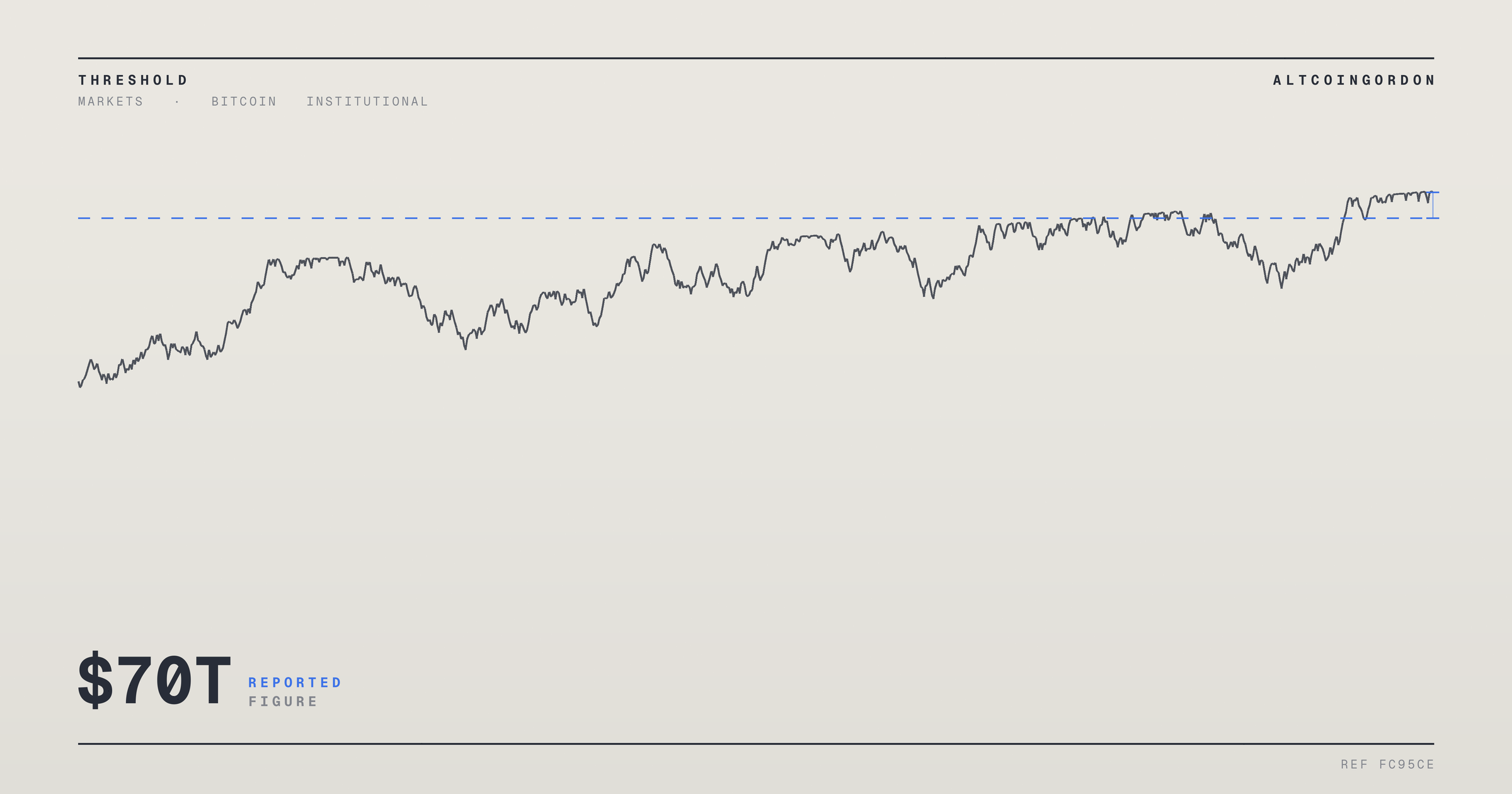
Bitcoin appeared to be consolidating in a tight range around the $64,000 mark on August 4, 2026. The coin's sideways price action stood in contrast to a notable move in traditional equities, where the S&P 500 was said to have climbed to a record $70 trillion in aggregate market capitalization, reportedly tied to optimism around a timeline for reopening the Strait of Hormuz.
The Strait of Hormuz is one of the world's most critical maritime chokepoints, handling a significant share of global seaborne oil and gas shipments. Any disruption to transit through the strait typically triggers volatility across energy markets and, by extension, broader risk assets, as investors price in the potential for higher energy costs and supply chain strain. Conversely, reports suggesting a path toward normalized shipping traffic tend to ease those fears, which appears to be the dynamic cited in connection with the equity market's advance.
Bitcoin's muted reaction, holding near $64,000 rather than rallying in tandem with stocks, illustrates a recurring pattern in which the asset can decouple from equity markets during macro-driven news cycles, even as it has at other times shown correlation with risk-on sentiment. Traders and analysts frequently watch for these divergences as a signal of where capital is rotating, though a single trading session's price action is not necessarily indicative of a broader trend.
It is worth noting that this report currently carries a moderate confidence rating and has not yet been corroborated by multiple independent sources, meaning some details—including the specific timeline referenced for the Strait of Hormuz reopening and the precise drivers behind the S&P 500's record valuation—should be treated as preliminary pending further confirmation.
Market participants often look to geopolitical developments in the Middle East as a proxy for global risk appetite, given the region's outsized influence on energy prices. A de-escalation narrative, even one based on a proposed timeline rather than a confirmed resolution, can be enough to shift sentiment among institutional investors who weight portfolios based on macro risk assessments.
For cryptocurrency markets specifically, the lack of a corresponding rally in Bitcoin despite bullish equity news raises questions about whether digital assets are currently being priced independently of broader macro catalysts, or whether the market is simply digesting the news at a slower pace than equities. Observers will likely look for confirmation from additional sources and subsequent price action to determine whether Bitcoin's consolidation near $64,000 represents a pause before a larger move or a more sustained period of range-bound trading.
Market Impact
If confirmed, a reopening timeline for the Strait of Hormuz would likely be viewed as broadly supportive for global risk assets, given the strait's role in global energy logistics and the market's sensitivity to supply disruption risk. The S&P 500 reaching a $70 trillion market capitalization milestone, as reported, would reflect renewed investor confidence in equities, potentially at the expense of near-term crypto inflows if capital continues favoring traditional markets during this period of easing geopolitical tension.
For Bitcoin, continued consolidation around $64,000 amid a rallying equity market could suggest that crypto-specific factors, such as liquidity conditions, regulatory developments, or on-chain dynamics, are currently outweighing macro tailwinds that might otherwise support a correlated move higher. Traders will likely monitor whether Bitcoin eventually follows equities upward or remains range-bound as the broader macro picture develops.
With only limited corroboration available at this stage, both the Hormuz reopening timeline and the S&P 500's reported $70 trillion valuation warrant continued monitoring as additional sources confirm the details, while Bitcoin's consolidation near $64,000 leaves open the question of whether crypto markets will eventually track the optimism seen in equities.
Frequently Asked Questions
Why does the Strait of Hormuz matter for financial markets?
The Strait of Hormuz is a major chokepoint for global oil and gas shipments, and disruptions or resolutions affecting its shipping traffic can significantly influence energy prices and broader investor risk sentiment worldwide.
Why did Bitcoin not rally alongside the S&P 500's reported record?
The report indicates Bitcoin remained in a tight consolidation range near $64,000 even as equities advanced, suggesting crypto markets may be responding to different or slower-moving catalysts than traditional stock markets at this time.
How reliable is this report given the single-source citation?
The information currently comes from one report with a moderate confidence rating and no independent corroboration, so key details such as the exact Hormuz reopening timeline should be treated as preliminary until confirmed by additional sources.
What would a $70 trillion S&P 500 market cap milestone represent?
A market capitalization of $70 trillion for the S&P 500 would mark a new record high for the index's combined company valuations, reflecting strong investor confidence, though the specific drivers behind this figure require further verification.