

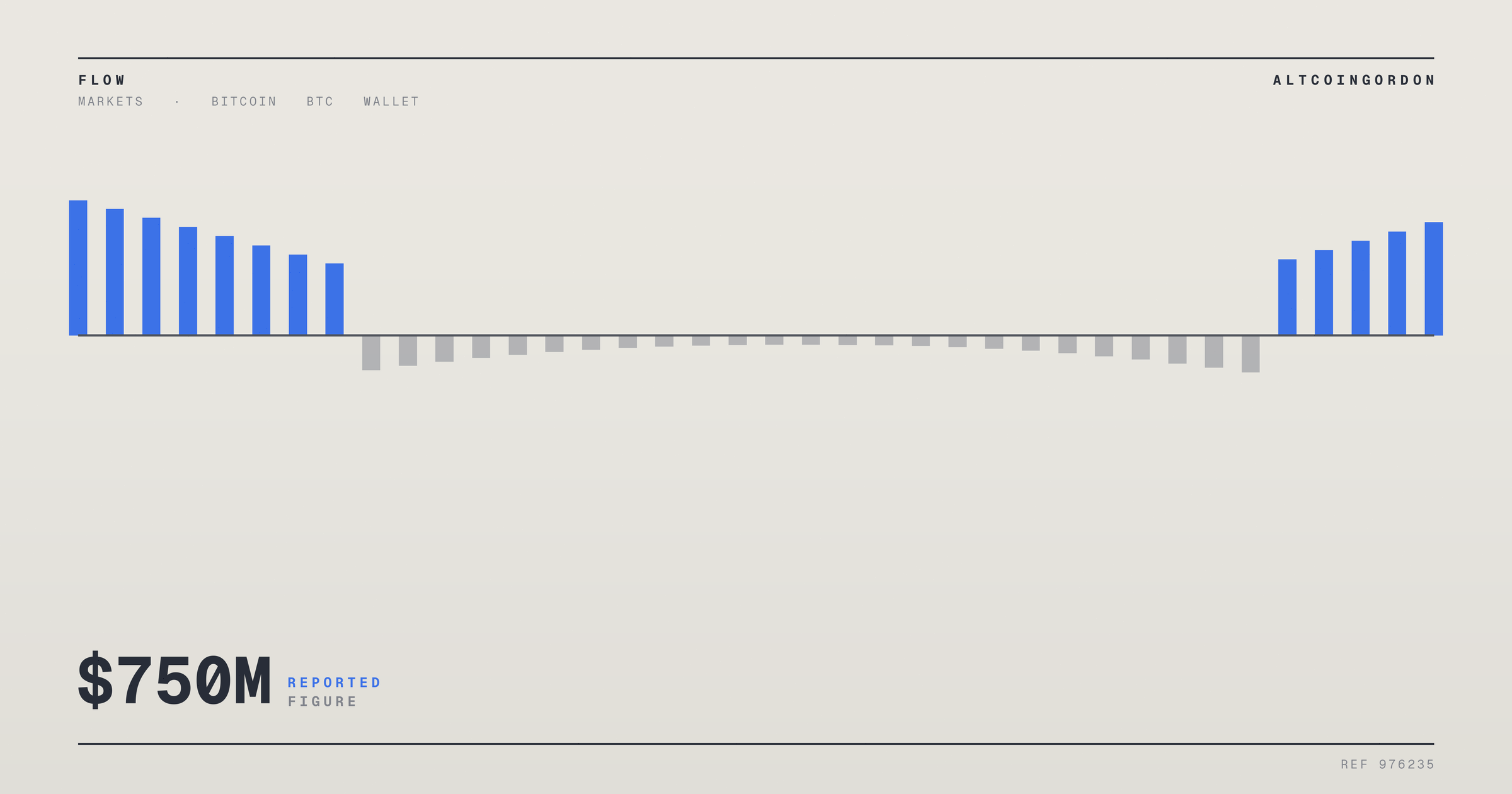
Bitcoin's largest holders have reportedly increased their exposure to the asset by approximately $1.2 billion, according to a report from CoinDesk dated August 7, 2026. The accumulation coincided with a separate wave of demand through regulated investment products, as U.S.-listed spot Bitcoin exchange-traded funds attracted around $750 million in net inflows over the same window.
Whale accumulation is typically tracked through on-chain analytics that monitor wallet addresses holding large quantities of BTC, distinguishing them from exchange wallets, custodial services, or smaller retail holders. When these addresses show a net increase in holdings over a defined period, analysts often interpret it as a signal of longer-term conviction, since large holders moving coins into cold storage or accumulation wallets tend to reduce the immediately available supply on exchanges.
The simultaneous inflow into spot ETFs adds another dimension to the picture. Since their U.S. launch, these funds have become a primary channel through which institutional and retail investors gain exposure to Bitcoin without directly holding or custodying the asset. Net inflows of the scale reported here suggest that demand through traditional brokerage and fund structures was also running positive during the same period, rather than being offset by redemptions.
Taken together, whale accumulation and ETF inflows moving in the same direction can be read as two distinct investor bases — direct holders transacting on-chain and fund investors operating through regulated markets — showing aligned appetite for Bitcoin exposure at roughly the same time. Historically, analysts have pointed to this kind of dual demand as one of several factors that can tighten available float, though the relationship between such flows and subsequent price action is not mechanical and depends on a range of other market conditions.
It is worth noting that this report currently traces back to a single published source, CoinDesk, with a stated fact-check confidence of 0.43 and no independent cross-source corroboration at the time of writing. Readers should treat the specific dollar figures — the $1.2 billion in whale accumulation and the $750 million in ETF inflows — as figures attributed to that single report rather than confirmed across multiple outlets. As is standard practice in crypto markets reporting, additional verification from other data providers or exchanges would strengthen confidence in the precise scale of these flows.
The broader context remains that Bitcoin ETF flow data and on-chain whale metrics have both become widely referenced indicators within the industry since the products' approval, giving market watchers more granular visibility into who is buying and through what channel than was available in earlier market cycles.
Market Impact
If accurate, simultaneous large-holder accumulation and strong ETF inflows would represent a period of aligned demand from two structurally different segments of the market — direct on-chain holders and fund-based institutional or retail investors. Such alignment is often cited by analysts as a factor that can reduce sell-side liquidity on exchanges, though it does not guarantee any particular price outcome, as broader macro conditions, regulatory developments, and trading volumes elsewhere continue to influence Bitcoin's market behavior.
Given the limited corroboration behind these specific figures, market participants and other outlets may look for confirming data from on-chain analytics platforms and official ETF issuer flow reports before treating the numbers as fully established. Continued monitoring of both whale wallet activity and daily ETF flow disclosures will likely be needed to determine whether this reported trend persists or reverses in subsequent trading sessions.
The reported $1.2 billion whale accumulation alongside $750 million in spot ETF inflows highlights a period of notable, overlapping demand for Bitcoin across both direct and fund-based channels, though confirmation from additional independent sources would help solidify the scale and significance of the move.
Frequently Asked Questions
What does it mean when Bitcoin 'whales' accumulate BTC?
It refers to large holders adding to their Bitcoin positions, typically tracked through on-chain wallet analysis. Analysts often view sustained accumulation by large addresses as a sign of longer-term investor conviction.
How are spot Bitcoin ETF inflows different from whale accumulation?
Spot ETF inflows represent capital moving into regulated fund products that hold Bitcoin on behalf of investors, while whale accumulation refers to large holders directly acquiring and holding BTC in their own wallets. Both metrics reflect demand but through different market channels.
How reliable are the $1.2 billion and $750 million figures cited in this report?
These figures come from a single reported source with moderate fact-check confidence and no independent cross-source corroboration at this time. The specific numbers should be treated as preliminary until confirmed by additional data providers or issuer disclosures.
Does this kind of accumulation guarantee Bitcoin's price will rise?
No. While reduced available supply from accumulation and steady ETF inflows are factors some analysts associate with tighter market conditions, price movements depend on many additional variables, including broader macroeconomic trends and overall trading activity.