

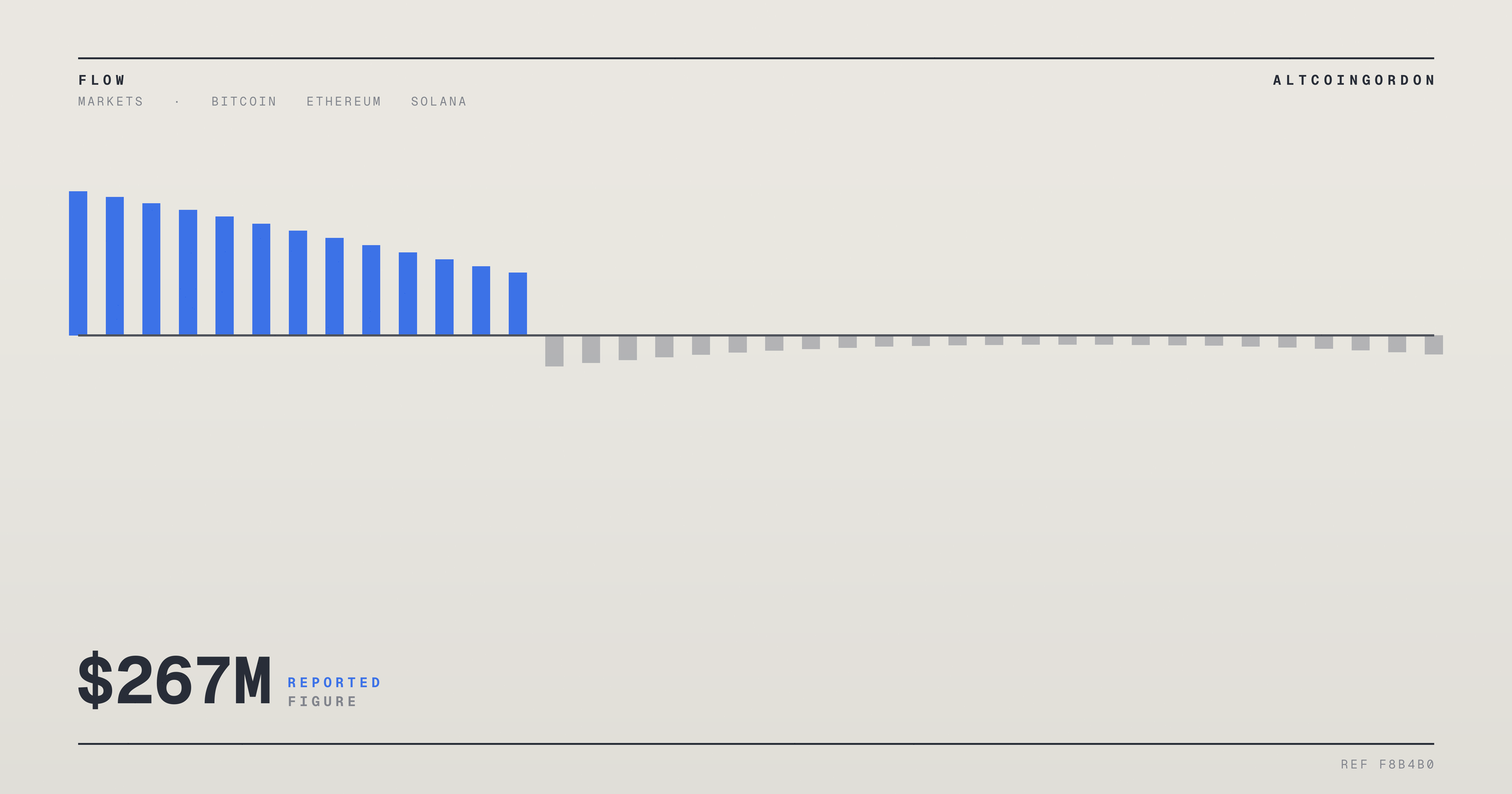
Bitwise's Solana exchange-traded fund pulled in $267 million from investors, CryptoSlate reported. The inflow figure signals real appetite for regulated exposure to Solana, one of the largest blockchain networks by market value.
That demand did not translate into gains for buyers. Market losses over the same period erased the value of the money that flowed in, according to the report. In practical terms, investors who bought into the fund ended up with holdings worth roughly what they put in, despite the scale of the capital committed.
The episode illustrates a basic feature of exchange-traded funds tied to volatile assets. An ETF wrapper can simplify access to an asset like Solana, letting investors buy and sell through a brokerage account rather than managing a crypto wallet or exchange account directly. It does not shield investors from price swings in the underlying asset.
Solana has traded with significant volatility over the past year, alongside other major cryptocurrencies. Investment products tracking such assets carry that volatility straight through to shareholders. A fund can see substantial inflows and still show little or no net gain if the underlying asset falls at the same time.
Bitwise has been among the more active issuers pushing into altcoin-linked investment products, building on the wave of crypto ETF approvals that followed the launch of spot Bitcoin funds. Solana-linked products have drawn interest from asset managers seeking to extend that model beyond Bitcoin and Ethereum.
The $267 million figure, as reported, represents a meaningful sum for a single-asset altcoin fund. It suggests institutional and retail investors are willing to allocate capital to Solana through regulated channels, even amid broader market uncertainty. Whether that appetite continues will likely depend on how Solana's price performs going forward, and on how investors weigh short-term losses against longer-term conviction in the network.
The report did not specify the exact time frame over which the losses occurred, nor the fund's current total assets under management. It also did not detail whether outflows accompanied the price declines or whether investors largely held their positions through the downturn.
Market Impact
The reported inflow-and-loss pattern highlights a risk that applies broadly to newer altcoin ETFs, not just Bitwise's Solana product. Funds tracking assets outside Bitcoin and Ethereum tend to carry higher volatility, which can quickly offset even substantial investor demand.
For issuers, the episode may test how investors respond when a well-subscribed fund shows flat or negative returns despite strong inflows. Continued volatility in Solana's price could influence future flows into this and similar altcoin-focused investment products across the sector.
The gap between strong inflows and flat returns underscores the volatility risk built into altcoin ETFs. Investors weighing similar products should consider that demand alone does not guarantee gains when the underlying asset moves sharply.
Frequently Asked Questions
What happened with Bitwise's Solana ETF?
The fund attracted $267 million in investor inflows, but market losses in Solana's price offset that capital, leaving the fund's value roughly unchanged for those who invested, according to CryptoSlate.
Why did the inflows not result in gains for investors?
The ETF's value is tied directly to Solana's price. Because Solana's price fell during the period in question, the fund's returns were reduced even as new money entered.
Does this mean the ETF failed?
Not necessarily. The report indicates strong investor demand, reflected in the $267 million inflow figure. The flat performance reflects broader market conditions rather than a structural issue with the fund itself.
How is a Solana ETF different from holding Solana directly?
An ETF lets investors gain exposure through a regulated brokerage account without managing crypto wallets or exchanges directly. It still carries the same price risk as holding the underlying asset.