

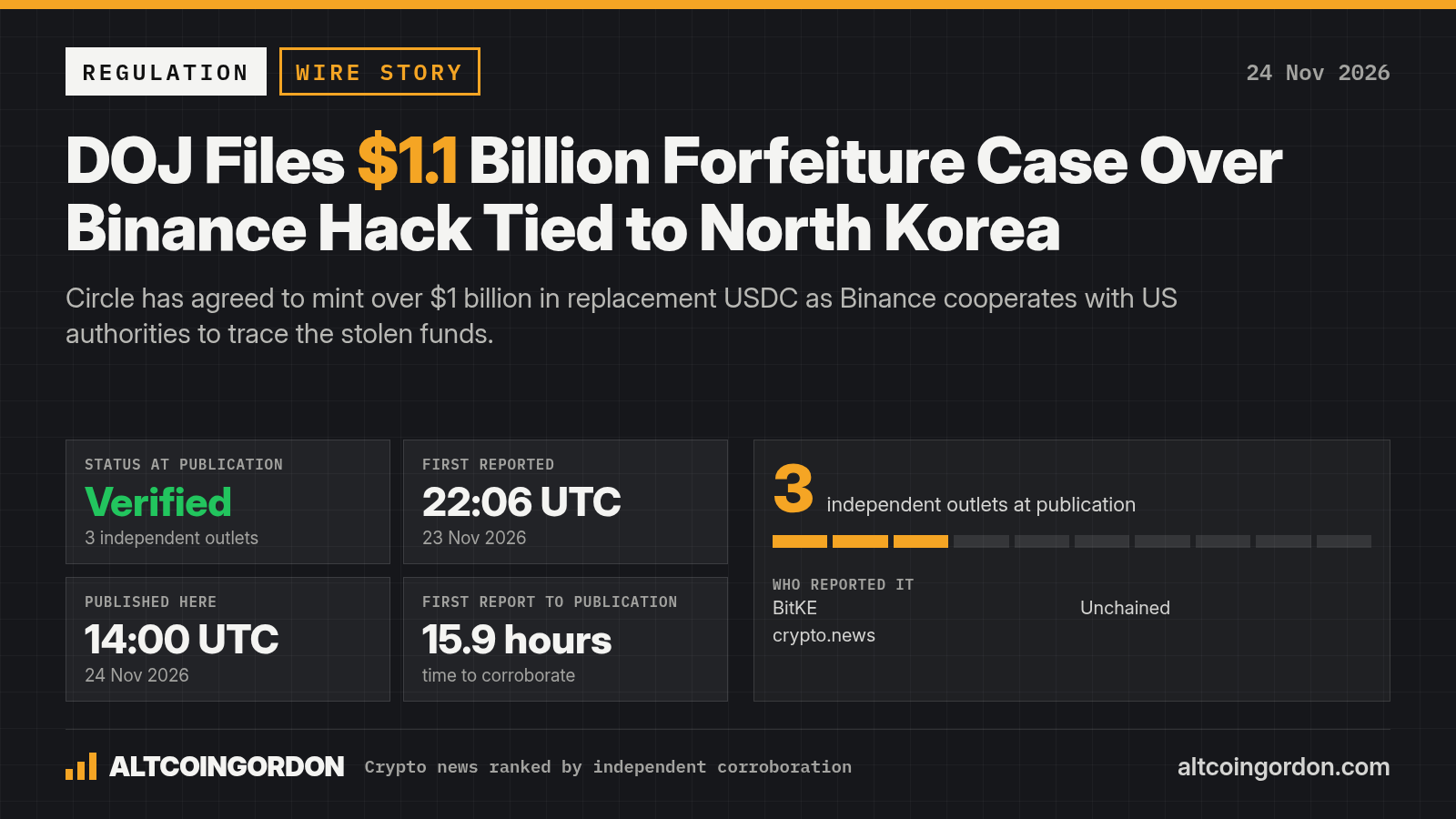
The US Department of Justice has moved to seize $1.1 billion in digital assets connected to a hack of Binance, according to filings reviewed by multiple outlets. Prosecutors allege the stolen funds trace back to a group linked to North Korea. The action takes the form of a civil forfeiture case, a legal mechanism that lets the government claim property tied to criminal activity even without a conviction against a specific individual.
Much of the targeted sum is denominated in USDC, the dollar-pegged stablecoin issued by Circle. Circle has agreed to mint more than $1 billion in replacement USDC connected to the case, according to reporting on the matter. Stablecoin issuers can freeze or blacklist tokens tied to illicit activity on the blockchain, and minting replacement tokens is one tool used to restore value to legitimate holders once stolen funds are isolated.
Binance has said it is working with US authorities as part of the broader effort to recover the stolen assets. The exchange's cooperation suggests coordination between the company, law enforcement, and Circle to track the funds across wallets and exchanges before the forfeiture filing was made public.
- Oct. 29Binance suffers the theft, later put at about $6.3 billion
- Nov. 6Circle voluntarily restricts access to the funds, the day prosecutors apply for a restraining order
- Nov. 12Court grants the temporary restraining order
- November 18Binance secures a $6.5 billion global freezing injunction from Abu Dhabi Global Market Courts
- Nov. 23DOJ files the verified forfeiture complaint and a motion to keep funds restrained
North Korea-linked hacking groups have targeted cryptocurrency platforms repeatedly in recent years. US officials have previously attributed large-scale thefts from exchanges and decentralized protocols to state-linked actors, often citing the proceeds as a funding source for the country's weapons programs. The $1.1 billion figure places this case among the larger crypto theft recovery efforts pursued by US authorities to date.
Civil forfeiture cases involving stablecoins depend heavily on the issuer's ability to freeze transfers at the smart contract level. Because USDC operates on public blockchains, transactions can be monitored, but the tokens themselves can also be blacklisted by Circle if addresses are flagged as connected to illicit activity. That capability appears central to how authorities and Circle have approached this case.
The filing does not necessarily mean the funds have already been recovered. Forfeiture actions establish a legal claim over specific assets, which can then proceed through further court action before any funds are returned to victims or the US government. The timeline for resolution, and the exact mechanism for compensating affected Binance users, has not been detailed in the available reporting.
Market Impact
A successful forfeiture action of this size would mark one of the largest publicized recoveries of crypto assets tied to a state-linked hacking group. It could reinforce confidence in the ability of stablecoin issuers and exchanges to cooperate with law enforcement after major breaches, a factor regulators have watched closely as stablecoin adoption grows.
The case also highlights the operational role Circle plays in enforcement actions, since its ability to mint and freeze USDC gives US authorities leverage not available with less centralized assets. For Binance, continued cooperation with US investigators may factor into its ongoing relationship with American regulators as the exchange navigates compliance expectations in the broader market.
The forfeiture filing signals an active, multi-party effort involving the DOJ, Circle, and Binance to claw back funds tied to one of the larger alleged state-linked crypto thefts. Further court proceedings will determine how and when the $1.1 billion is ultimately distributed.
Frequently Asked Questions
What is a civil forfeiture case in this context?
It is a legal process that allows the US government to claim ownership of assets tied to criminal activity, separate from any criminal charges against a specific person.
Why is Circle minting replacement USDC?
Circle can freeze USDC tokens linked to illicit activity and mint new tokens to restore value once the original tokens are isolated as part of the recovery effort described in the case.
Has Binance confirmed the hack or the amount stolen?
Binance has said it is cooperating with US authorities on recovering the funds, though full details of the original hack have not been disclosed in available reporting.
Is North Korea officially confirmed as responsible?
US authorities have linked the stolen funds to a North Korea-connected group in the forfeiture filing, though this attribution reflects the government's allegations in the case.