

Ethereum's price action has drawn fresh attention from market analysts after the token broke through a key resistance zone. The move has reopened discussion about whether ETH can reclaim the $3,000 level in the near term.
Analysis published by CryptoPotato framed the breakout as a potential turning point for Ethereum's short-term trajectory. The report examined whether current momentum is strong enough to carry the asset toward the psychologically significant $3,000 mark.
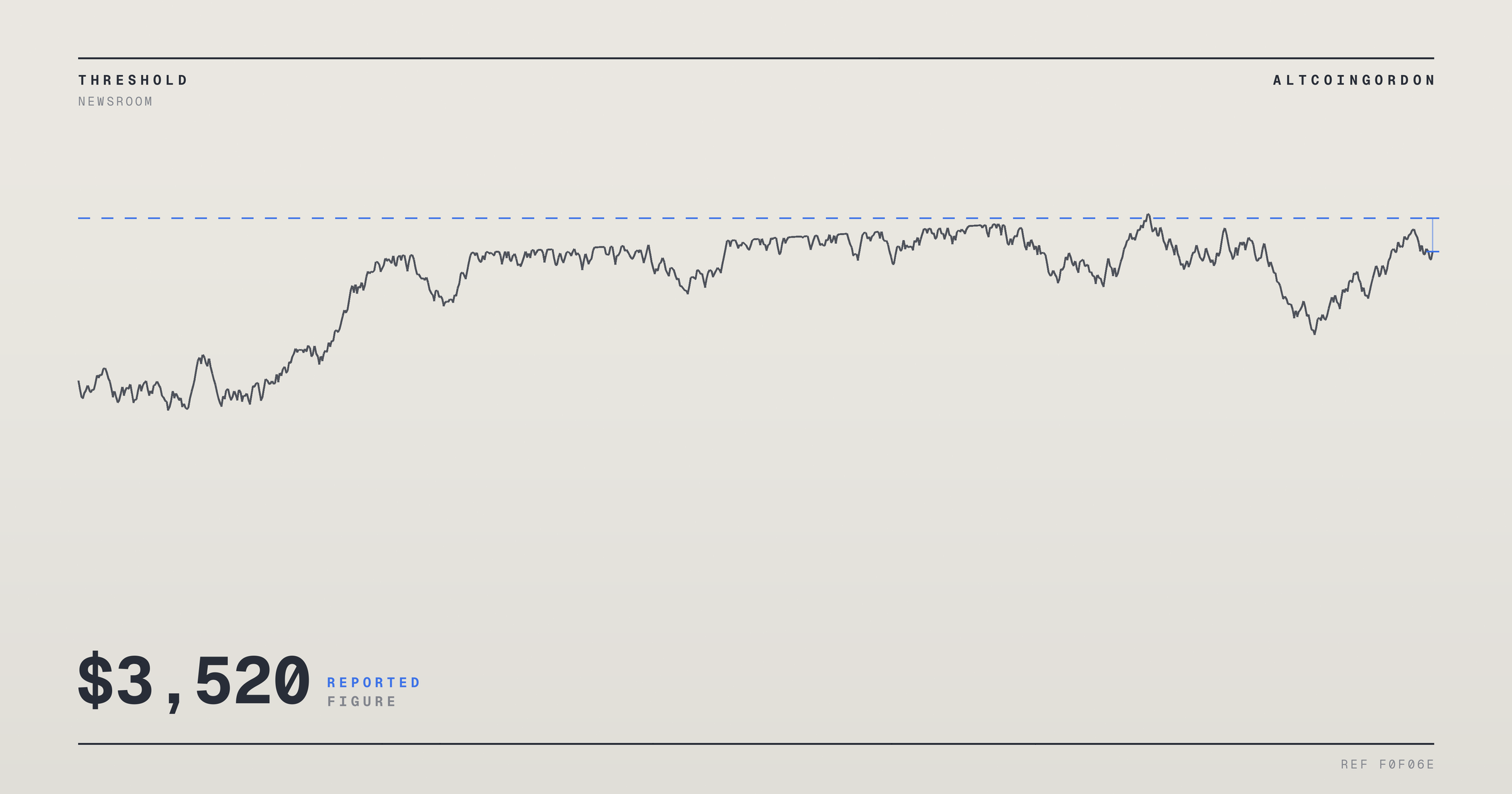
A separate analysis from Brave New Coin identified $2,631 as a key support level underpinning the recent advance. That outlet also flagged $3,520 as a longer-range target should ETH continue building on its current strength.
The two analyses differ somewhat in scope. CryptoPotato's coverage centers on the $3,000 threshold as an immediate marker of bullish continuation. Brave New Coin's assessment extends further, placing $3,520 as a technical objective beyond that initial milestone.
Support and resistance levels like these are drawn from chart patterns, trading volume, and prior price history. Analysts use them to gauge where buying or selling pressure has previously emerged. A break above resistance, followed by a successful retest of former resistance as new support, is often viewed by technical traders as a bullish signal.
Ethereum's price behavior matters beyond its own market. As the largest smart contract platform by market capitalization, ETH's trends often influence sentiment across decentralized finance, layer-2 networks, and the broader altcoin market. Sustained strength in Ethereum has historically coincided with increased activity in tokens built on its network.
The $2,631 support level cited by Brave New Coin represents a price floor that, if held, could allow further upside attempts. A failure to hold that level would likely raise questions about the durability of the recent breakout. Traders will be watching how price behaves around this zone in coming sessions.
Both reports emphasize that technical targets are not guarantees of future price movement. They reflect chart-based projections rather than certainties, and market conditions can shift quickly in either direction.
Market Impact
A confirmed break above resistance, if it holds, could encourage renewed buying interest in Ethereum and related tokens. Traders often treat round numbers like $3,000 as psychological benchmarks that can attract additional volume once breached. Should ETH approach the $3,520 level mentioned by Brave New Coin, it would mark a further extension of the current trend and could draw attention from a broader set of market participants.
Conversely, a drop below the $2,631 support level identified in the analysis could prompt a reassessment of the breakout's strength. Layer-2 tokens, DeFi platforms, and other assets tied to Ethereum's ecosystem often move in tandem with ETH's price direction, meaning continued momentum or a reversal could have ripple effects across the sector.
Ethereum's recent breakout has put fresh technical levels in focus, with analysts watching $2,631 as support and $3,000 to $3,520 as potential upside markers. Whether the move sustains will depend on how price behaves around these zones in the days ahead.
Frequently Asked Questions
What does the $2,631 support level mean for Ethereum?
It represents a price point where buying interest has previously emerged, according to Brave New Coin's analysis. Holding above this level is seen as supportive of continued upward momentum.
Why is $3,000 considered significant for ETH?
It is a round-number psychological threshold that traders often watch closely. CryptoPotato's analysis examined whether Ethereum's breakout has enough strength to push the price back above this mark.
What is the $3,520 target referenced in the reports?
Brave New Coin identified $3,520 as a longer-range technical target that could come into play if Ethereum's current breakout continues to build momentum.
Are these price levels guaranteed outcomes?
No. They are technical projections based on chart patterns and prior price behavior, not certainties. Market conditions can change, and analysts caution these are reference points rather than predictions.