

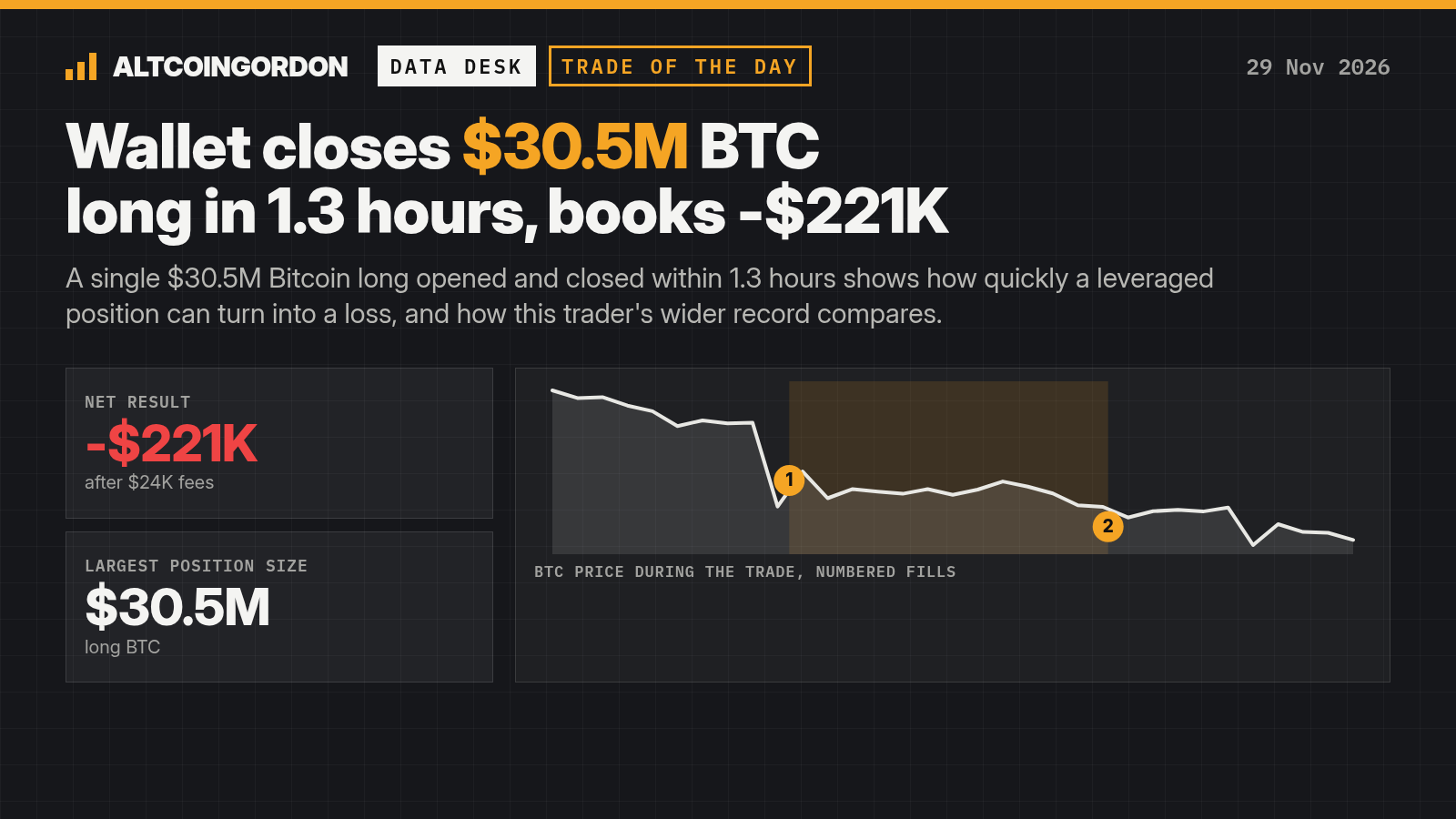
- Wallet 0xcefb…912b opened a $30.5M BTC long at $58,812 and closed it at $58,433 just 1.3 hours later, booking a net loss of $221K after $24K in fees.
- Across 66 closed trades we have recorded for this wallet, only 33% made money, for a combined net result of -$1.7M.
- The wallet has never been liquidated in those 66 trades, meaning this and other losses were taken by closing positions manually, not forced out by an exchange.
Wallet 0xcefb…912b opened a BTC long worth $30.5M at 08:28 UTC on 29 November, paying $58,812 per coin. By 09:45 UTC the same day, 1.3 hours later, the position was closed at $58,433. Over that stretch, price moved -0.6% against the trade. Before fees the trade showed a loss of $197K; after $24K in fees, the net result was -$221K.
The trade, step by step The record of this trade shows just two fills: the opening trade and the closing trade, with no adjustments in between. That makes it a clean read on how a single directional bet performed, rather than a position that was scaled in or out repeatedly.
- 1
Opened $30.5M at $58,81229 Nov 08:28 UTC
- 2
Closed $30.3M at $58,43329 Nov 09:45 UTC · realized -$197K
The size at entry was $30.5M; the size recorded at close was $30.3M. The position was shut by the trader rather than wound down by an exchange, and the outcome was a loss both before and after fees.
What the fees add on top of a loss Fees are a fixed cost of trading size, not of outcome: this trader paid $24K to open and close $30.5M of exposure regardless of which way price moved. On a losing trade, fees stack directly onto the trading loss, turning a -$197K result before fees into -$221K net. On a position of this size, that fee is a small fraction of the total loss, but it is a cost paid on every trade, win or lose.
A directional trader’s wider record Our classification marks wallet 0xcefb…912b as a directional trader, meaning it tends to take outright long or short bets on price rather than running offsetting positions. Its scorecard puts this single trade in context.
Of 66 closed trades we have recorded since 16 November 2026, only 33% made money, and the net result across all of them is -$1.7M. That -$1.7M also matches the wallet’s Hyperliquid all-time P&L figure. A low win share does not by itself mean a trader loses money overall — a trader can win small and lose big, or the reverse — but here the win share and the net result point the same way. Over the past day the wallet’s P&L is -$83K, over the past 7 days -$704K, and over the past 30 days -$1.7M, a stretch our chart traces from $0 down to a low of -$1.7M.
The wallet’s best recorded trade was a long BTC position opened 21 Nov 11:32 UTC, running from $58,205 to $58,860, closed for a net profit of $251K. Its worst was a short BTC position opened 23 Nov 13:57 UTC, running from $62,258 to $64,539, closed for a net loss of $765K. The gap between those two outcomes is wider than the loss on today’s trade, and it shows the range of results a single directional position can produce once size and leverage are applied.
What to watch The wallet still holds its largest open position: a long BTC position worth $28.8M, entered at $58,464, using 40x leverage, with a liquidation price of $57,688 and an unrealized profit of +$184K at last check. Typical holding time across this wallet’s 66 recorded trades is 2.1 hours, close to the 1.3 hours this trade ran, and in 66 recorded trades the account has never been liquidated.
Beginner’s guide: the terms in this report
How much do fees matter?
Every fill on Hyperliquid pays a fee, and active traders pay it many times over. A strategy built on many small trades needs a real edge just to break even, which is why we show fees separately from the gross result.
What do long and short mean?
A long position makes money when the price rises; a short position makes money when it falls. On a futures exchange such as Hyperliquid you can open either with borrowed buying power, which is what leverage means.
How does leverage change the risk?
Leverage multiplies gains and losses alike. At 10x, a 1% move against a position costs about 10% of the margin behind it; at 25x, a move of roughly 4% against it can wipe that margin out. That is why the liquidation price sits closer to the entry the higher the leverage.
What is the difference between realized and unrealized P&L?
Unrealized P&L is the profit or loss on a position that is still open, valued at the current price. It only becomes realized when the position is closed, so it can grow or disappear quickly with the market.
More from the data desk
- AguilaTrades Flips $149.4M BTC Position to Long, Books -$938K on the Reversal
- Top 50 Hyperliquid Traders Shift $45.0M Toward Long BTC in an Hour, Still Net Short $52.3M
- BTC Falls to $58,598 in an Hour as Tracked Short Leverage Runs at 5.5x
Follow it live
- Wallet 0xcefb…912b’s live positions and full record
- Hyperliquid Whale Tracker
- Beginner’s guide: how leverage trading works
- How our data desk works
How this was made: every figure above comes from AltcoinGordon’s own tracking of BTC positions on Hyperliquid, captured at 14:05 UTC. It covers the accounts we track, not the whole market. The text was written by our automated data desk and checked by software against the captured data before publishing (how our data desk works). Not investment advice.