

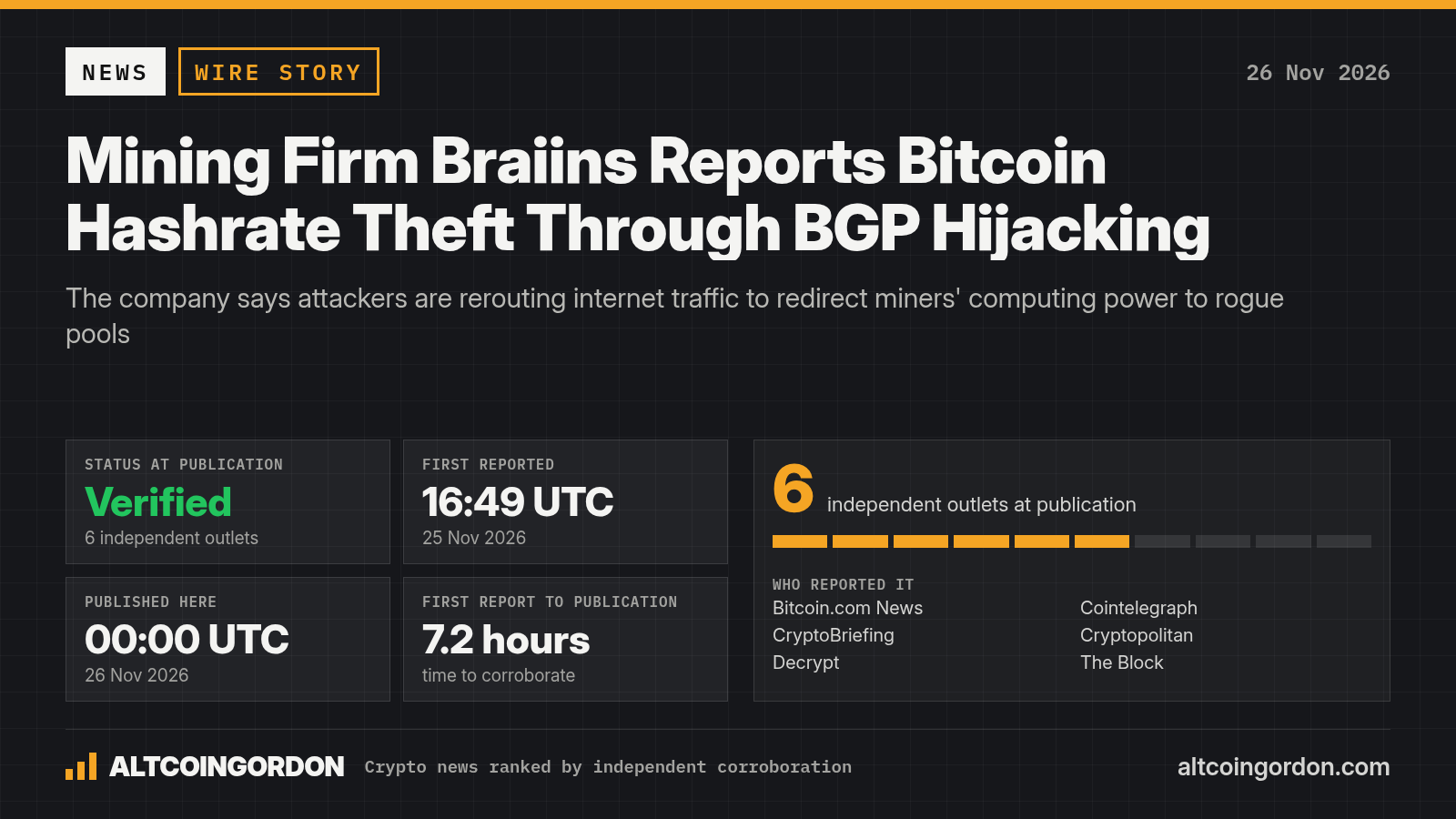
Braiins, known for its mining pool and firmware products, says it has identified a pattern of Bitcoin hashrate theft carried out through Border Gateway Protocol hijacking. BGP is the routing system that underpins how data moves across the global internet, directing traffic between networks. When that system is manipulated, attackers can intercept or redirect traffic that was never meant for them.
In this case, Braiins says the technique is being used to hijack the connection between mining hardware and the pools miners intend to support. Instead of hashrate flowing to a chosen pool, it can be silently rerouted to an attacker-controlled destination. The miner's equipment keeps running as normal, masking the theft from the operator.
Braiins has characterized the issue as widespread rather than an isolated incident. That framing suggests the company believes multiple mining operations, not a single target, have been affected. The firm has not disclosed exact figures on how much hashrate or revenue may have been diverted.
- Nov. 7-12Earliest incidents hit Brazil and Argentina mining sites
- Nov. 23Braiins reviewed major pools and found most still unsecured
- Nov. 25Braiins issued its public security alert on the attacks
BGP hijacking is not new to the broader internet security world. It has been used in the past to reroute traffic for data interception, service disruption, and financial fraud across different industries. Applying the same technique to Bitcoin mining represents a network-layer threat that sits outside the usual attack surface miners worry about, such as malware on mining rigs or compromised pool credentials.
Because Bitcoin's security model depends on honest, verifiable hashrate distribution, this kind of attack carries implications beyond the individual miners who lose revenue. Diverted hashrate still secures the network in a technical sense, since the proof-of-work is still being produced. But it also means miners are being defrauded of the rewards they believed they were earning, while an unknown third party may be collecting them instead.
Braiins' warning places responsibility partly on the infrastructure layer of mining operations, rather than solely on hardware or software choices made by individual operators. Network routing has traditionally been treated as a background utility, not a security-critical component. This disclosure pushes mining operators to reconsider how their internet connections to pools are secured and monitored.
- 1
Attacker announces a fake, more specific routeTargets the pool's Stratum connection address block
- 2
Networks funnel traffic to the attackerHappens when routes aren't validated
- 3
Attacker impersonates the real poolFeeds miners jobs that look legitimate
- 4
Rewards are claimed elsewhereShares credited to the attacker's own account at another pool
- 5
Miners see nothing wrong on-siteMachines keep running while dashboards show no output
Bitcoin around this story
What the futures data on our own BTC terminal showed between the first report and our publication. It shows timing, not cause: prices move for many reasons at once.
Market Impact
The immediate market effect of this disclosure is limited, since it concerns operational security rather than Bitcoin's price or trading activity. The bigger consequence falls on mining pool operators and hosting companies, who may now face pressure to adopt stronger network protections, such as route authentication or monitoring for unexpected BGP announcements.
If hashrate theft through this method proves widespread, as Braiins suggests, it could affect how mining pools calculate payouts and verify where submitted work actually originates. Larger, well-resourced mining operations may be better positioned to detect and respond to these intrusions than smaller or less technically staffed operators.
Braiins' disclosure highlights a network-level vulnerability that had received little attention within Bitcoin mining security discussions. Further details on the scale of the theft, and any response from affected pools, are likely to follow as the industry assesses the risk.
Frequently Asked Questions
What is BGP hijacking?
BGP hijacking exploits the Border Gateway Protocol, the system that routes internet traffic between networks, to redirect data to unintended destinations.
How does BGP hijacking lead to Bitcoin hashrate theft?
Attackers reroute the connection between mining hardware and a chosen pool, diverting computing power and its associated rewards to a different, attacker-controlled pool.
Does this attack affect Bitcoin's overall network security?
The proof-of-work is still produced and secures the blockchain, but affected miners may lose the rewards they expected to receive.
Who is Braiins?
Braiins is a Bitcoin mining technology company that operates mining pool and firmware products used by miners worldwide.
What can miners do to protect themselves?
Operators are being urged to monitor their network routing and connections to mining pools more closely to detect unauthorized rerouting.