

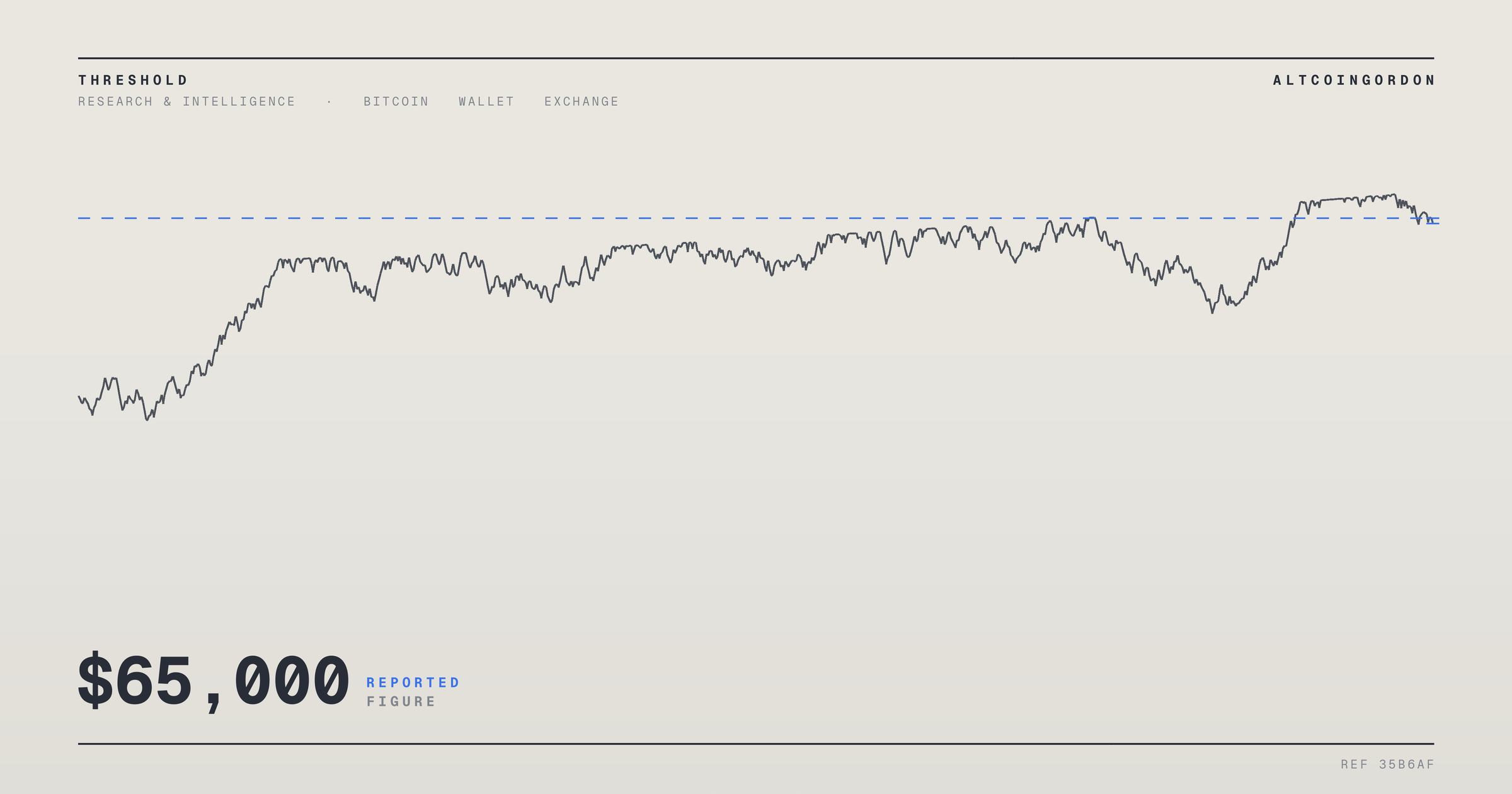
CryptoSlate reported on August 13 that approximately 1.79 million Bitcoin is clustered around the $65,000 price level. The outlet described this concentration as a factor quietly limiting the cryptocurrency's ability to sustain moves above that threshold.
In on-chain analysis, large clusters of coins acquired at similar prices often behave differently than the broader market. Holders who bought near a given level tend to sell as price approaches their entry point, especially after extended periods without significant gains. This creates a supply overhang that buyers must absorb before price can move decisively higher.
The scale described in the CryptoSlate report is notable. At current supply levels, Bitcoin's total circulating amount sits near 19.7 million coins. A cluster of 1.79 million would represent roughly nine percent of that supply, concentrated at a single price band. Such concentration, if accurate, would represent a meaningful portion of tradable coins sitting at breakeven or near-breakeven levels.
Market participants have long used cost-basis distribution data to identify potential resistance and support zones. When a large volume of coins sits at a loss, sellers may be reluctant to exit, creating support. When coins sit at breakeven, holders often use price recoveries to reduce risk, creating resistance. The CryptoSlate report frames the $65,000 level as falling into the latter category.
This type of on-chain signal has become a standard tool for analysts tracking Bitcoin's price behavior. It supplements traditional technical analysis, which relies on historical price action rather than the underlying distribution of holder cost basis. Together, these approaches can offer a fuller picture of why certain price levels prove difficult to clear.
The report does not specify the timeframe over which this 1.79 million Bitcoin cluster formed, nor does it identify the wallet types or entities involved. Whether the coins are held by long-term investors, short-term traders, institutional custodians, or exchange wallets was not detailed in the available reporting. That distinction matters, because different holder types tend to react differently to price recoveries near their entry points.
Bitcoin's price has repeatedly approached and retreated from levels near $65,000 in recent trading sessions, according to broader market observation. Whether the specific cluster described by CryptoSlate is the primary driver of that pattern, or one of several contributing factors, remains an open question pending further on-chain data disclosure.
Market Impact
If the described concentration proves durable, traders may treat $65,000 as a key level to watch for sustained breakout attempts. Analysts often flag such clusters as zones where selling pressure could resurface each time price approaches, even amid otherwise bullish conditions elsewhere in the market.
For now, the claim rests on a single reported analysis. Traders should treat the specific figure of 1.79 million Bitcoin as a data point requiring further confirmation from additional on-chain research providers before drawing firm conclusions about near-term price behavior.
The reported cluster adds a data point to ongoing debate over Bitcoin's resistance near $65,000, though its precise composition and durability remain unclear pending additional analysis.
Frequently Asked Questions
What does it mean for Bitcoin to have a 'wall' of coins at a price level?
It generally refers to a large volume of coins acquired near that price. Holders may sell as price returns to their entry point, creating resistance to further gains.
How large is 1.79 million Bitcoin relative to total supply?
It represents roughly nine percent of Bitcoin's circulating supply, which currently sits near 19.7 million coins.
Does this mean Bitcoin cannot rise above $65,000?
No. It suggests that level may face recurring selling pressure, not that a breakout is impossible. Broader demand and market conditions still play a role.
Who is likely holding these coins near $65,000?
The available reporting does not specify holder types, such as long-term investors, traders, or exchanges. That detail was not included in the source report.