

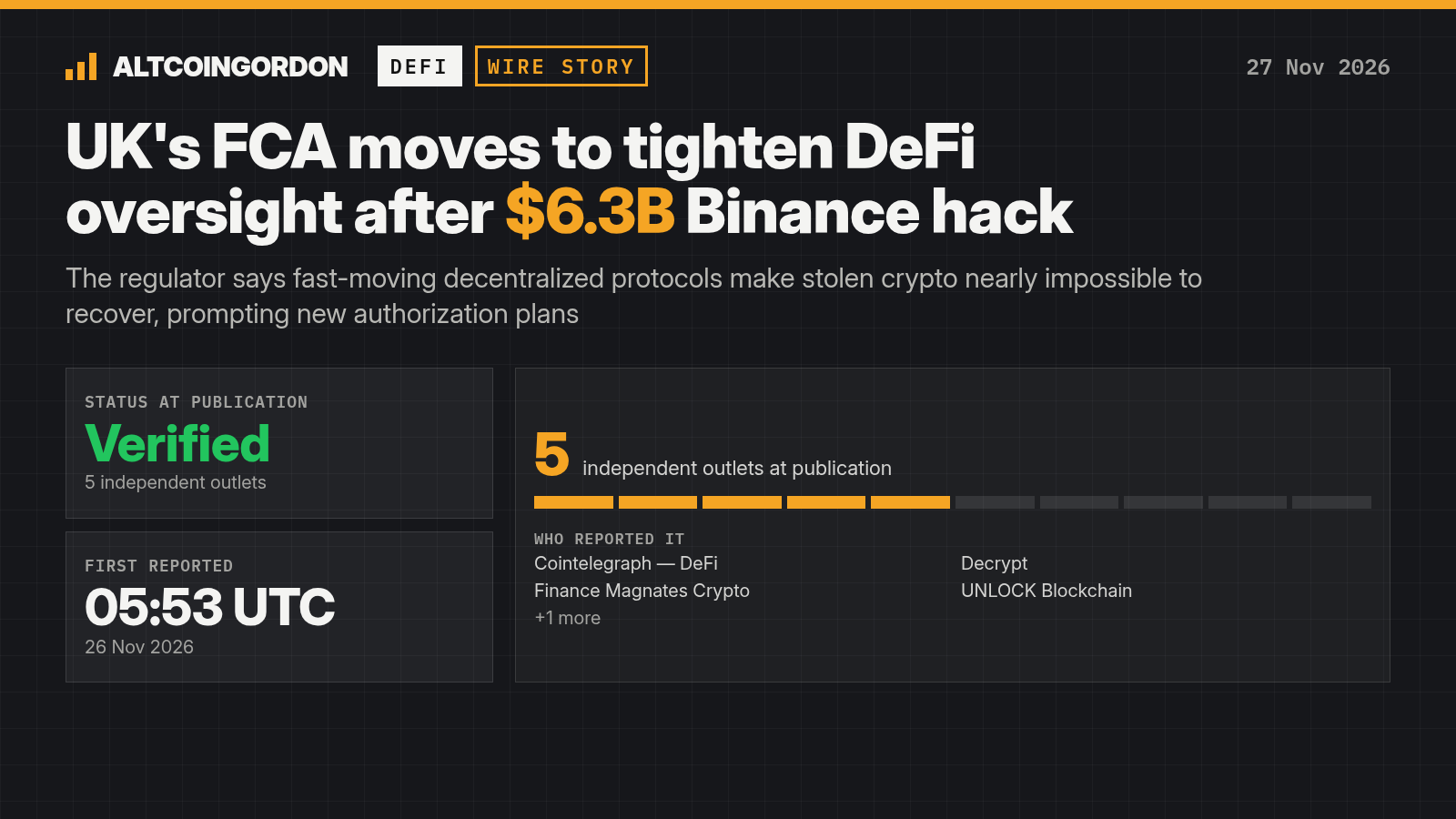
Britain's financial watchdog is preparing to tighten its grip on decentralized finance, pointing directly to the fallout from October's $6.3 billion Binance hack as justification. The Financial Conduct Authority plans to move forward with authorization requirements for DeFi platforms operating in or serving the UK market, according to a Financial Times report published Thursday.
The regulator's reasoning centers on how quickly criminals can move stolen funds once they enter decentralized systems. Jane Moore, who heads payments and digital assets at the FCA, told the Financial Times that the pace and volume of transfers across DeFi protocols makes it far harder for authorities to freeze assets or stop laundering before funds disappear.
The October 29 Binance breach sits at the center of that argument. Hackers with suspected ties to North Korea funneled stolen assets through decentralized protocols, including THORChain, complicating efforts to trace and recover the money. Blockchain analytics firm Elliptic found that by November 6, the attackers had converted stolen holdings into roughly 1,650 Bitcoin, worth close to $124 million at the time, with much of that activity routed through decentralized platforms. Separate reporting has noted wallets tied to the hack moving close to $600 million worth of Ethereum across bridges between blockchains, underscoring how deeply the stolen funds penetrated DeFi infrastructure after leaving a centralized exchange.
- Nov. 6Elliptic finds attackers converted stolen funds into about 1,650 Bitcoin
- November 16UK government confirms it is working with the FCA to assess the hack's implications
- January 2027FCA to release final regulatory guidance
- October 25, 2027New UK regulatory regime for DeFi and tokenized equities takes effect
US prosecutors have since filed action seeking to recover more than $1.1 billion in cryptocurrency connected to the theft. British lawmakers have also pressed the government on the incident, and officials confirmed in a parliamentary response that they are coordinating with the FCA and other agencies to gauge what the hack means for UK markets and consumers.
Beyond DeFi specifically, the FCA's plan extends to equity trading. The regulator wants all retail equity orders placed by UK investors, including trades in tokenized stock products, funneled through authorized and regulated platforms rather than offshore or unlicensed venues. The goal appears to be closing a gap where retail investors could unknowingly route tokenized share trades through platforms outside the regulator's reach.
The FCA opened public consultations on DeFi guidance and the broader scope of its crypto regulatory framework on October 21, with both closing on November 18. Final guidance is expected in January 2027, with the full regime set to take effect on October 25, 2027. That timeline gives the industry roughly a year to adjust before the rules formally bind platforms serving UK customers.
Industry reaction has been sharp. Executives tied to Coinbase and the Aave protocol have challenged the FCA's framing, arguing that a centralized exchange's security failure is being used to justify restrictions on a fundamentally different type of infrastructure. Their core objection is that DeFi platforms, which rely on self-executing smart contracts and leave custody with users rather than an operator, cannot be held to the same standard as a centralized exchange that controls customer accounts directly.
- 22 OctUK's FCA Opens Consultation on DeFi Rules Ahead of 2027 Crypto Regime
- 23 NovUK's FCA to Bar Crypto Exchanges From Market-Making on Their Own Platforms
- 26 Nov 05:53Cointelegraph — DeFi · first report
- 26 Nov 06:14Bitcoinist
- 26 Nov 06:21crypto.news
- 26 Nov 07:13CoinTurk News EN
- 26 Nov 07:24UNLOCK Blockchain
- 26 Nov 10:43Finance Magnates Crypto
- 26 Nov 11:50Decrypt
Market Impact
If the FCA's approach holds, DeFi platforms serving UK users could face licensing costs and compliance burdens previously reserved for centralized exchanges and brokers. That could push some decentralized protocols to geofence UK users or partner with regulated intermediaries rather than operate directly in the market. The tokenized equity rule adds another layer, potentially cutting off retail access to offshore platforms offering tokenized shares outside FCA oversight.
The debate also feeds into a broader split among regulators. European authorities are reportedly exploring ways to let regulated entities offer supervised access to DeFi rather than restrict it outright, a contrast to the FCA's tougher stance. How that divergence plays out could shape where DeFi liquidity and development concentrate over the next several years, particularly as the UK's full regime nears its October 2027 start date.
The FCA's final guidance, due in January 2027, will determine how directly decentralized platforms are pulled into the same licensing structure as centralized exchanges before the new regime takes effect in October 2027.
Frequently Asked Questions
Why is the FCA citing the Binance hack to justify DeFi rules?
The FCA says stolen funds from the $6.3 billion Binance hack moved through decentralized protocols like THORChain so quickly that authorities struggled to freeze or trace them, exposing gaps in existing oversight.
What would the new FCA rules require of DeFi platforms?
The FCA plans to introduce authorization requirements for DeFi platforms operating in the UK, alongside rules forcing retail equity orders, including tokenized stock trades, onto regulated venues rather than offshore or unlicensed platforms.
When will the new UK crypto regulatory regime take effect?
The FCA expects to issue final guidance in January 2027, with the broader regulatory regime set to come into force on October 25, 2027.
How has the crypto industry responded to the proposal?
Executives linked to Coinbase and Aave have criticized the approach, arguing it unfairly applies lessons from a centralized exchange's security failure to decentralized platforms built around self-custody and smart contracts.