

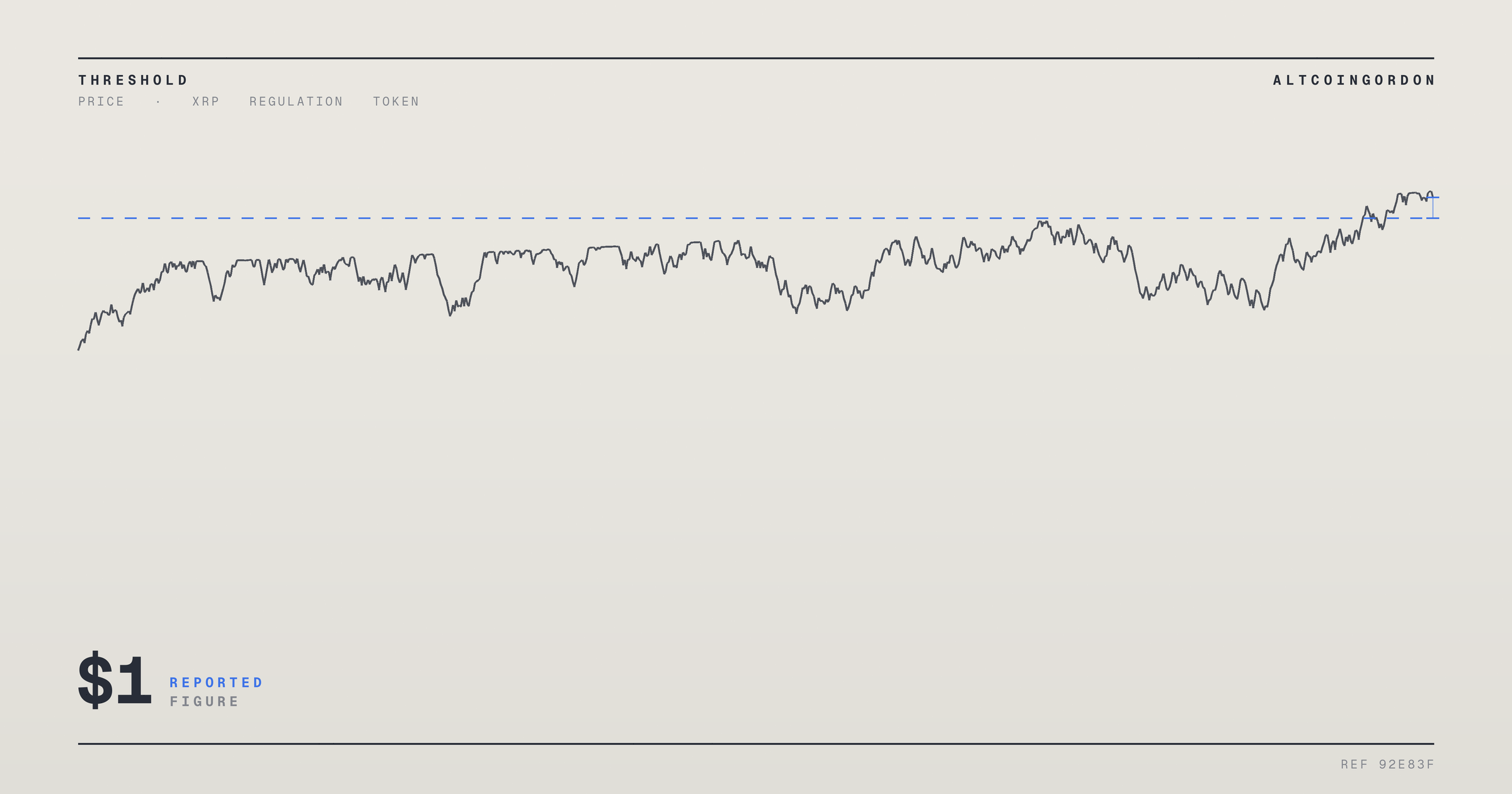
XRP has fallen to trade just above $1 after losing a support level that traders had treated as a near-term floor. The decline has pushed the token's relative strength index, a common momentum gauge, close to oversold conditions. That reading suggests selling pressure has been persistent in recent sessions.
Analysts tracking XRP's chart pattern have pointed to a descending channel as the dominant structure shaping price action. In technical analysis, a descending channel forms when price moves lower within two parallel downward-sloping lines. Traders often watch such channels for signs of either a breakout to the upside or continued downside follow-through.
The $1 mark has taken on added significance as a psychological and technical reference point. Round-number price levels frequently attract concentrated buying or selling interest, since many traders set orders around them. A sustained break below $1 could open the door to further declines, while a bounce from current levels would offer some relief to holders.
The RSI reading nearing oversold territory is worth context. An RSI below 30 is typically interpreted as a sign that an asset has been sold aggressively, potentially setting up conditions for a short-term rebound. However, oversold readings do not guarantee a reversal, and assets can remain in that zone during extended downtrends.
XRP's price action arrives amid broader uncertainty across crypto markets, where large-cap tokens have shown mixed performance in recent weeks. Traders and analysts continue to weigh macroeconomic signals alongside token-specific technical patterns when assessing near-term direction. For XRP specifically, the combination of a broken support level and a descending channel structure has added to caution among short-term traders.
Market participants will likely watch whether XRP can stabilize above $1 in coming sessions. A failure to hold that level could reinforce the bearish channel pattern identified by chart analysts. Conversely, a recovery back above the recently lost support zone would be seen as a signal that buyers are stepping back in.
The episode underscores how technical levels continue to shape trader psychology even for a widely held token like XRP. Support and resistance zones, momentum indicators, and chart patterns remain core tools used across the industry to frame short-term expectations, even as fundamentals around adoption and regulation evolve separately.
Market Impact
A sustained move below $1 could weigh on short-term sentiment toward XRP, particularly among traders who rely on technical levels to size positions. Given XRP's status as one of the more widely traded large-cap tokens, price weakness here can also feed into broader altcoin market sentiment during periods of risk-off trading.
At the same time, an RSI reading near oversold levels has historically drawn attention from traders looking for potential entry points. Whether that translates into actual buying support remains uncertain, and the descending channel pattern identified by analysts suggests the path of least resistance may still be lower unless a clear break of the channel occurs.
XRP's test of the $1 level will likely remain a focal point for traders in the near term, as technical signals point to elevated caution rather than a clear directional resolution.
Frequently Asked Questions
What does it mean that XRP lost a key support level?
It means a price level that had previously held as a floor for buying interest was broken, often signaling weaker near-term demand.
What does an RSI near oversold mean for XRP?
A relative strength index approaching oversold territory suggests selling has been intense recently, though it does not guarantee a price reversal.
What is a descending channel in technical analysis?
It is a chart pattern where price moves lower between two parallel downward-sloping trendlines, often used to gauge trend direction and pressure.
Why is the $1 level significant for XRP?
Round-number price levels like $1 often act as psychological reference points where trading activity and order placement tend to concentrate.