

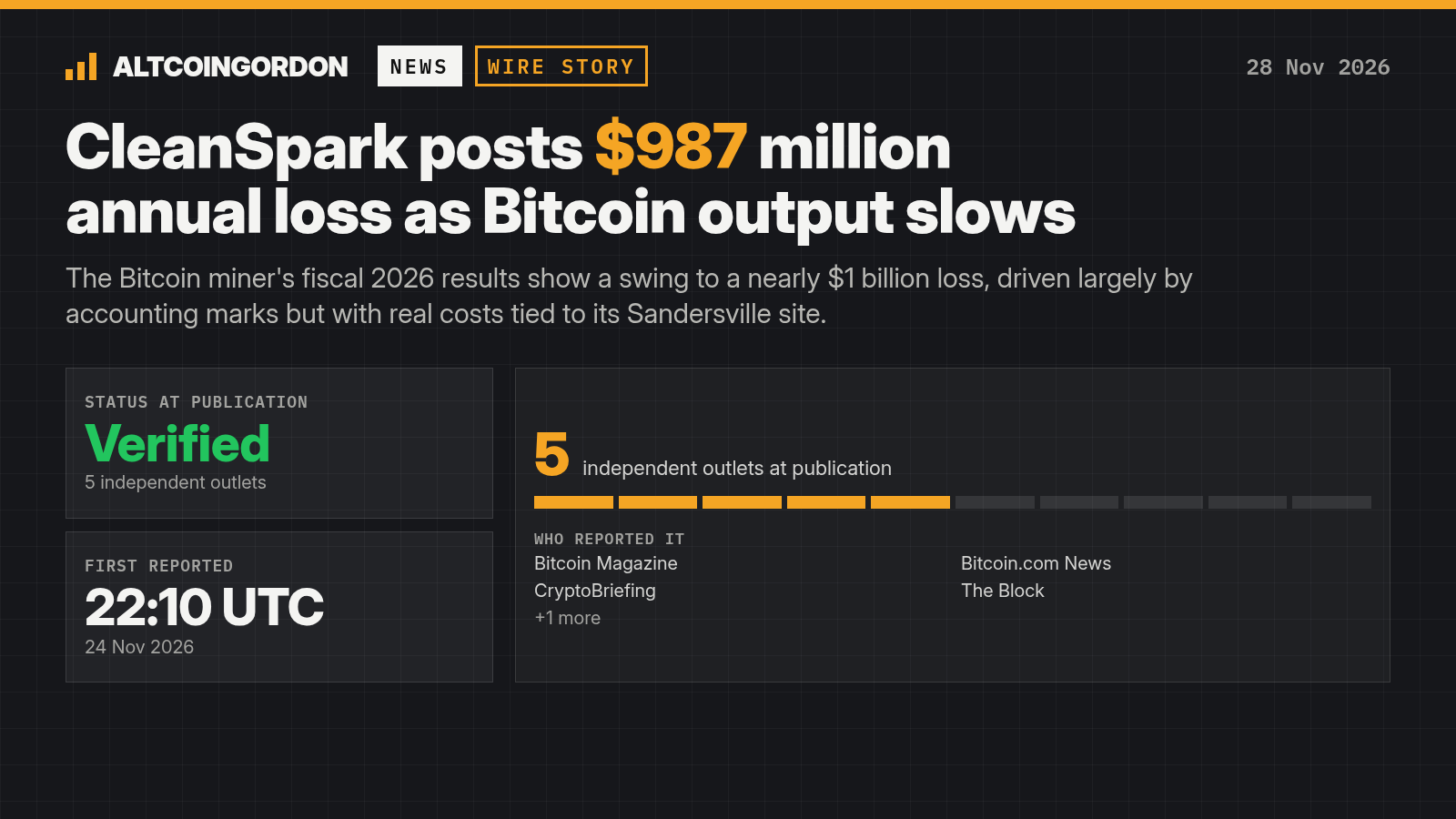
CleanSpark, one of the largest publicly traded Bitcoin mining companies in the United States, reported a net loss of $987 million for its fiscal 2026. The result marks a swing from prior profitability and comes alongside a decline in the amount of Bitcoin the company mined during the year.
The loss reflects both operational pressures and accounting dynamics common across the mining sector. CleanSpark closed the fiscal year holding 11,720 Bitcoin, a stockpile that remains central to the company's financial profile.
BlockchainReporter's analysis framed much of the loss as the product of non-cash marks rather than cash operating losses. Under current accounting standards, miners must record their Bitcoin holdings at fair value each reporting period. When Bitcoin's price falls, those holdings can generate large unrealized losses on paper, even if the company has not sold any coins. That dynamic can produce headline losses that look far more severe than a company's underlying cash position.
Holdings excluding collateral were 11,720 BTC
Holdings including pledged collateral totalled 13,530 BTC
Holdings including pledged collateral were 13,530 BTC, worth about $1.1 billion
BlockchainReporter also pointed to CleanSpark's Sandersville, Georgia operations as a more concrete driver of the loss. Unlike paper marks tied to Bitcoin's price, costs or impairments connected to a physical mining site represent real operational expense. That distinction matters for investors trying to separate temporary valuation swings from structural problems in the business.
Declining Bitcoin production adds another layer of pressure. Miners generate revenue primarily by earning newly minted Bitcoin and transaction fees, so any drop in output directly reduces top-line income. Production can fall for several reasons, including rising network difficulty, equipment downtime, or a strategic shift away from mining toward other activities.
CleanSpark is reportedly considering selling more Bitcoin than it currently mines. That would represent a departure from the accumulation strategy many public miners have followed in recent years, where companies held onto coins as a long-term treasury asset rather than selling them for operating cash. A move toward net selling could signal liquidity needs, a change in corporate strategy, or both.
The combination of a large reported loss, a sizable Bitcoin treasury, and a potential shift in selling behavior places CleanSpark at a notable juncture. How the company balances its mining operations against its Bitcoin holdings will likely shape investor perception of its financial health heading into the next fiscal year.
Bitcoin around this story
What Bitcoin futures prices on Hyperliquid showed between the first report and our publication. It shows timing, not cause: prices move for many reasons at once.
Market Impact
CleanSpark's results highlight how fair-value accounting for Bitcoin holdings can amplify reported losses during periods of price weakness, independent of a miner's operational performance. Investors and analysts following the sector will likely look past the headline loss figure to separate non-cash marks from real cash costs, such as those tied to specific facilities like Sandersville.
The prospect of CleanSpark selling more Bitcoin than it mines could also draw attention from market participants who track miner treasury behavior as a signal of broader supply dynamics. A shift away from accumulation by a major public miner, if confirmed in future filings, may be watched closely for signs of similar moves among peers.
CleanSpark's fiscal 2026 results underscore the gap between accounting losses and operational reality in Bitcoin mining. Attention now turns to whether the company follows through on selling more Bitcoin than it mines, and how its Sandersville operations perform going forward.
Frequently Asked Questions
Why did CleanSpark report a $987 million loss?
The loss stems from a combination of declining Bitcoin production and accounting marks that reduce the reported value of CleanSpark's Bitcoin holdings when prices fall, alongside costs tied to its Sandersville, Georgia operations.
How much Bitcoin does CleanSpark currently hold?
CleanSpark held 11,720 Bitcoin as of its fiscal 2026 report.
Is CleanSpark planning to sell its Bitcoin holdings?
CleanSpark is considering selling more Bitcoin than it mines, which would mark a shift from its prior accumulation strategy.
Does the loss mean CleanSpark's mining operations are unprofitable?
Not necessarily. Much of the loss reflects non-cash accounting marks on Bitcoin holdings, though there are also real operational costs connected to the Sandersville facility.