

Nvidia has directed its hardware partners to withhold orders bound for Malaysia, Singapore, Thailand and Indonesia, according to the Financial Times. Dell and Supermicro, which build servers around Nvidia's chips, told customers in those markets that Nvidia would not clear their shipments for release, the newspaper reported, citing people familiar with the matter.
The freeze follows export rules the US Commerce Department put into force last week. Those rules require licenses before advanced AI chips and the servers built around them can be sent to several Southeast Asian destinations. Washington's goal, according to the FT's reporting, is to cut off pathways that Chinese firms have used to obtain high-end computing power indirectly, by routing purchases through buyers in the region.
The four countries named have grown into hubs where Chinese AI developers have sought indirect access to Nvidia's most capable chips, which Washington already restricts from direct sale to China. By requiring licenses for this corridor too, regulators are aiming at a channel that had let restricted hardware reach Chinese buyers once it landed in Southeast Asia.
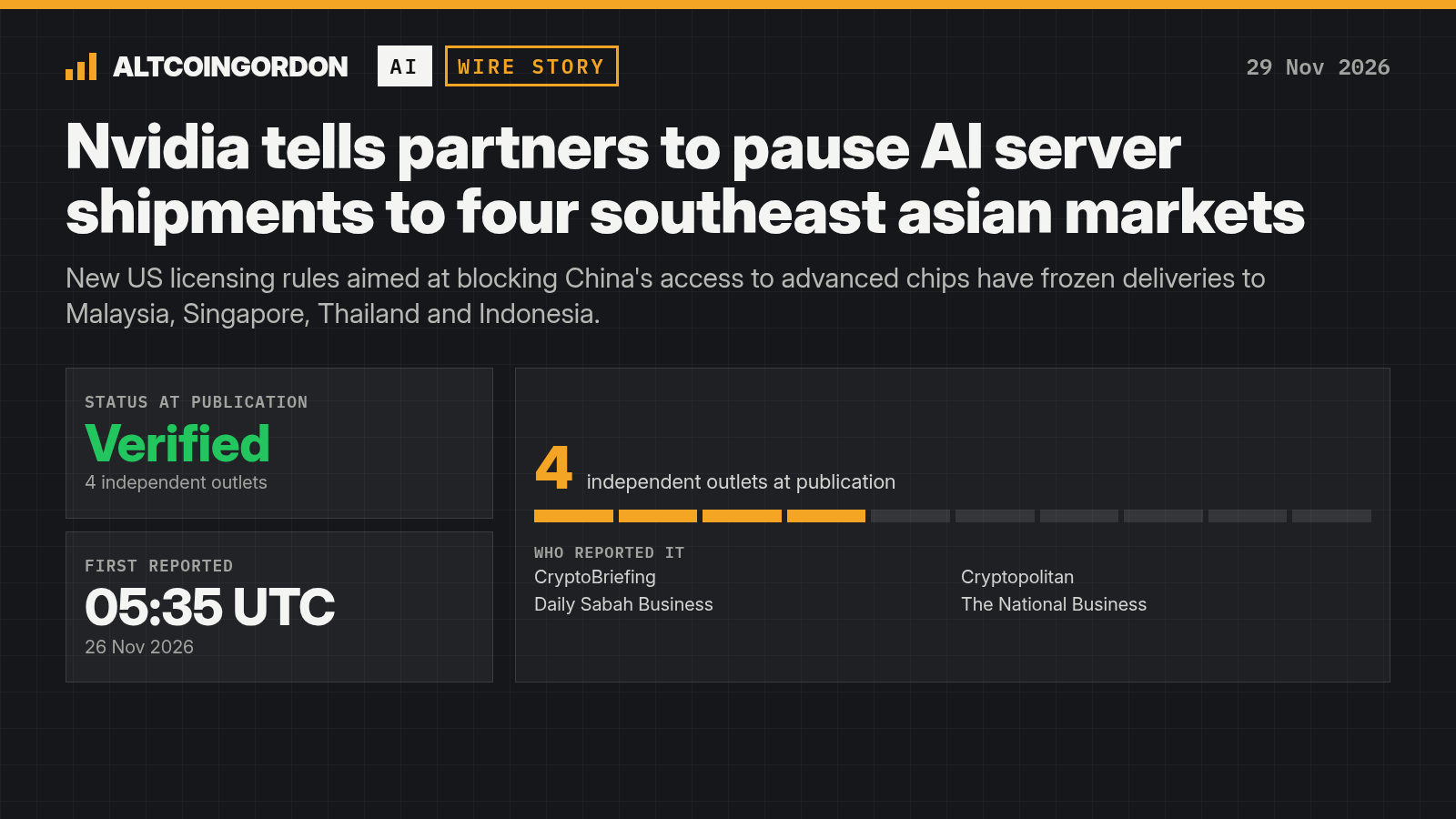
- 26 Nov 05:35CryptoBriefing · first report
- 26 Nov 06:01The National Business
- 26 Nov 08:50Daily Sabah Business
- 27 Nov 01:04Cryptopolitan
Sources told the FT that neither Nvidia nor its partners yet know whether the halt is temporary or how long compliance with the new licensing framework will take. One cloud-industry executive described a rule that arrived without a clear application process, leaving companies racing against a 90-day compliance window without settled guidance on how to secure the required licenses.
The timing adds another layer to a turbulent stretch for Nvidia's leadership. The Commerce Department issued its new rule just days after chief executive Jensen Huang stepped down amid reports tying him to a Chinese intelligence contact connected to Megaspeed, a Singapore-based cloud computing firm that is also an Nvidia partner. Nvidia's board reinstated Huang as CEO on November 23. Megaspeed itself has faced scrutiny over whether it helped route advanced AI chips to China in violation of export controls.
Southeast Asia has become a significant revenue engine for Nvidia as data center buildouts have expanded across the region. Nvidia's Singapore subsidiary recorded $104 billion in revenue in 2025, up 72% from the prior year, according to company accounts cited by the FT. Some of Nvidia's Taiwan and China sales are also booked through that Singapore entity, the newspaper reported, underscoring how central the hub has become to the company's accounting as well as its logistics.
Market Impact
Trading desks reacted to the uncertainty rather than to a confirmed permanent cutoff. Pricing in prediction markets shifted against Nvidia closing November above $140, with odds in one sub-market dropping 21 percentage points following the report. The move signals investors see near-term revenue risk from the pause, even as most observers treat it as a compliance response to fresh licensing rules rather than an outright ban.
A sustained halt would pressure a region that has become an important growth market for Nvidia's data center business, particularly given the scale of revenue the company already books through Singapore. Any clarification from Nvidia or Commerce Department officials on the scope and duration of the restrictions, along with signs of progress on licensing applications, would likely shape how markets price the stock through year-end.
Nvidia, Dell and Supermicro had not issued public comment on the shipment halt as of the FT's report. Attention now turns to whether Washington provides clearer licensing guidance before the compliance window closes.
Frequently Asked Questions
Which countries are affected by Nvidia's shipment halt?
Malaysia, Singapore, Thailand and Indonesia are the four countries where Nvidia has told manufacturing partners to stop sending AI-chip-equipped servers, per the Financial Times report.
Why did Nvidia halt these shipments?
New US Commerce Department rules that took effect last week require licenses for exporting advanced AI chips and servers to parts of Southeast Asia, aimed at blocking indirect Chinese access to restricted computing power.
Is the halt permanent?
Sources told the Financial Times it is unclear whether the pause is temporary, as Nvidia and its partners work to understand how to comply with the new licensing requirements.
How much revenue does Nvidia generate from the region?
Nvidia's Singapore subsidiary recorded $104 billion in revenue in 2025, a 72% increase from the prior year, according to company accounts cited by the Financial Times.
What role did Jensen Huang's leadership situation play?
The Commerce Department issued its new export rule shortly after CEO Jensen Huang briefly stepped down over reports linking him to a Chinese intelligence contact tied to the firm Megaspeed; Nvidia's board reinstated him on November 23.