

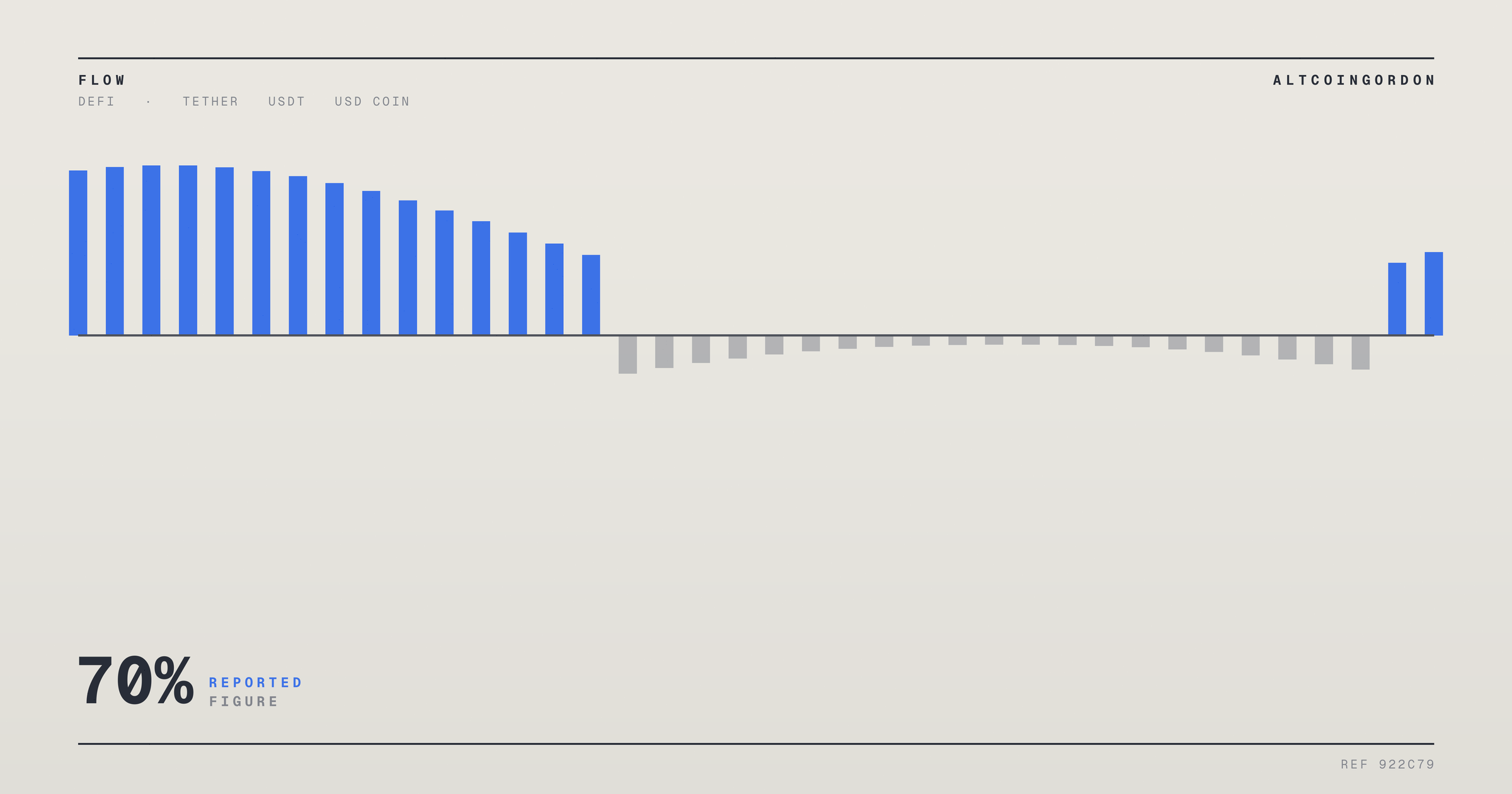
A report from Bankless, published in early July, states that USD Coin (USDC) has extended its lead over Tether's USDT to command roughly 70% of stablecoin transaction volume in 2026. If accurate, this would represent a significant reordering of the stablecoin landscape, where USDT has historically held the largest share of on-chain activity and market capitalization for much of the past decade.
Stablecoins have become foundational infrastructure for the broader crypto economy, serving as settlement rails for exchanges, decentralized finance protocols, cross-border payments, and increasingly, institutional treasury operations. Volume share among stablecoins is often used as a proxy for which assets are being actively used in trading, lending, and payment flows, as distinct from simple market capitalization, which measures the total value of tokens outstanding rather than how actively they circulate.
USDC, issued by Circle, has positioned itself over recent years as a more regulation-forward alternative to USDT, emphasizing regular attestations of reserves, U.S. banking relationships, and compliance with emerging stablecoin frameworks in jurisdictions such as the European Union and, more recently, the United States. Tether's USDT, by contrast, has maintained a larger global footprint, particularly in emerging markets and on certain blockchain networks where liquidity and exchange listings have favored it for years.
It is important to note that this report currently rests on a single corroborating source, and the fact-check confidence associated with the claim is low. No cross-referencing data from independent on-chain analytics platforms, exchange volume trackers, or other financial news outlets has been presented alongside this figure. Readers should treat the specific 70% volume-share figure as a claim.
Still, the broader narrative it points to — a potential shift in stablecoin usage patterns toward more compliance-oriented issuers — aligns with a trend that has been discussed across the industry as regulators in major markets tighten oversight of stablecoin issuers. Legislative and regulatory developments around stablecoin reserve requirements, licensing, and disclosure obligations have increasingly favored issuers perceived as more transparent, which could plausibly influence where trading volume concentrates over time.
Without additional independent verification, the precise mechanics behind the reported shift — whether it reflects sustained changes in exchange listings, DeFi protocol preferences, network-level usage, or a temporary spike in activity — remain unclear. Market participants and analysts will likely look for confirmation from established data providers before treating this figure as a settled fact about the current stablecoin market structure.
Market Impact
If confirmed by additional data sources, a sustained shift of stablecoin volume toward USDC could have implications for liquidity distribution across exchanges and DeFi protocols, potentially affecting trading spreads, arbitrage flows, and the competitive positioning of stablecoin issuers. It could also reinforce Circle's standing in ongoing conversations about regulatory compliance as a differentiator among stablecoin providers.
However, given the limited corroboration behind this specific report, market participants should be cautious about drawing firm conclusions. A change in reported volume share does not necessarily indicate a proportional change in total market capitalization, reserve backing, or long-term adoption, and further verification from multiple analytics providers would be needed to assess the durability of any such shift.
The claim that USDC has expanded its stablecoin volume share to around 70% in 2026 is notable but currently unverified beyond a single report, and readers should watch for corroborating data before treating it as an established market fact.
Frequently Asked Questions
What does 'stablecoin volume share' actually measure?
Volume share typically refers to the proportion of total on-chain or exchange transaction activity attributable to a specific stablecoin over a given period, which differs from market capitalization, a measure of total tokens outstanding rather than how actively they are used.
Has this 70% figure been confirmed by other sources?
As of this report, the figure comes from a single source (Bankless) and has not been independently corroborated by other news outlets or on-chain data platforms, so it should be treated as a preliminary claim rather than a verified industry-wide statistic.
Why might USDC be gaining ground on USDT?
Analysts have pointed to USDC's emphasis on regulatory compliance, regular reserve attestations, and U.S. banking relationships as factors that could make it more attractive amid tightening global stablecoin regulation, though the specific drivers behind any reported volume shift have not been detailed in available sources.
Does a shift in volume share mean USDT is losing market dominance overall?
Not necessarily. Volume share reflects transactional activity over a specific period and can fluctuate, whereas USDT has historically maintained a large total market capitalization; a change in volume share does not automatically translate into a change in overall market size or reserve backing.