

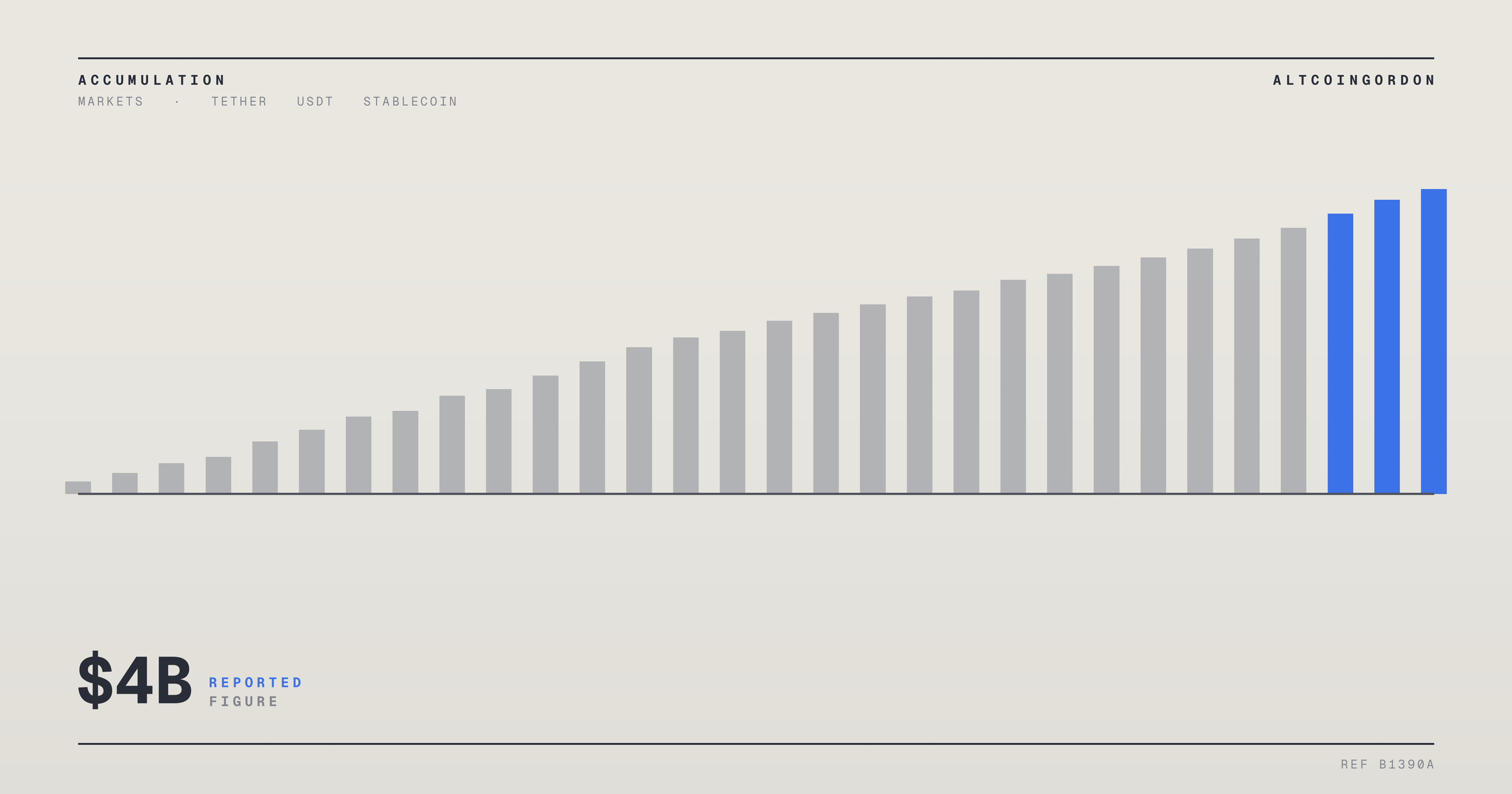
Tether's USDT, the largest stablecoin by market capitalization, has recorded a supply decline of approximately $4 billion. Two separate reports confirm the drop but differ slightly on its underlying cause.
Coinfomania described the move as investors shifting funds into fiat currency. BlockchainReporter characterized the same decline as a broader exit from the crypto market. Both accounts agree on the scale of the contraction, even as they diverge on where the money has gone next.
Stablecoin supply figures are widely watched as a proxy for liquidity available to crypto markets. USDT is used across exchanges as a base trading pair, a settlement tool, and a parking spot for capital during periods of volatility. When its supply contracts, it often signals that traders are redeeming tokens for dollars rather than rotating into other digital assets.
A reduction in USDT supply does not necessarily indicate a single cause. Redemptions can reflect profit-taking, risk aversion, or simple portfolio rebalancing ahead of anticipated market moves. The distinction between money moving to fiat and money leaving the crypto ecosystem entirely matters for how analysts interpret the trend, but both outcomes reduce the stablecoin liquidity available on-chain in the near term.
Tether has not issued a public statement addressing the specific figures cited in these reports. The company routinely mints and redeems USDT in response to market demand, and supply figures can fluctuate as institutional clients and exchanges adjust their holdings. A $4 billion swing, while notable, represents a fraction of Tether's total circulating supply, which has stood in the tens of billions of dollars in recent periods.
Market participants often track these supply changes through on-chain data providers and blockchain explorers. Discrepancies in interpretation, such as the difference between the two reports here, are common when public data does not specify the destination of redeemed funds. Analysts typically need additional data, including exchange inflows and outflows, to determine whether redeemed USDT has converted to fiat, moved into other cryptocurrencies, or simply been held off-exchange.
Market Impact
A contraction in USDT supply can tighten available liquidity for trading pairs across major exchanges, particularly for tokens that rely heavily on Tether as a settlement currency. If the decline reflects genuine capital exit from crypto, it could weigh on near-term trading volumes and price stability for smaller-cap assets that depend on stablecoin liquidity.
Conversely, if funds have simply rotated into fiat holdings pending redeployment, the effect may prove temporary. Traders and market observers will likely watch subsequent supply data and exchange flow figures to determine whether the trend continues or reverses in the coming weeks.
The reported $4 billion drop in USDT supply underscores ongoing questions about liquidity trends in crypto markets. Further data will be needed to clarify whether the shift represents a temporary pause or a more sustained pullback from digital assets.
Frequently Asked Questions
What caused the drop in USDT supply?
Reports differ on the exact cause. One account attributes it to investors converting holdings into fiat currency, while another describes it as capital leaving the crypto market broadly.
How much did USDT's supply decline?
Both reports cite a decline of roughly $4 billion in Tether's circulating USDT supply.
Does a drop in USDT supply affect the crypto market?
It can reduce liquidity available for trading, since USDT is widely used as a settlement currency and trading pair on exchanges.
Has Tether commented on the supply change?
No public statement from Tether addressing these specific figures has been reported at this time.