

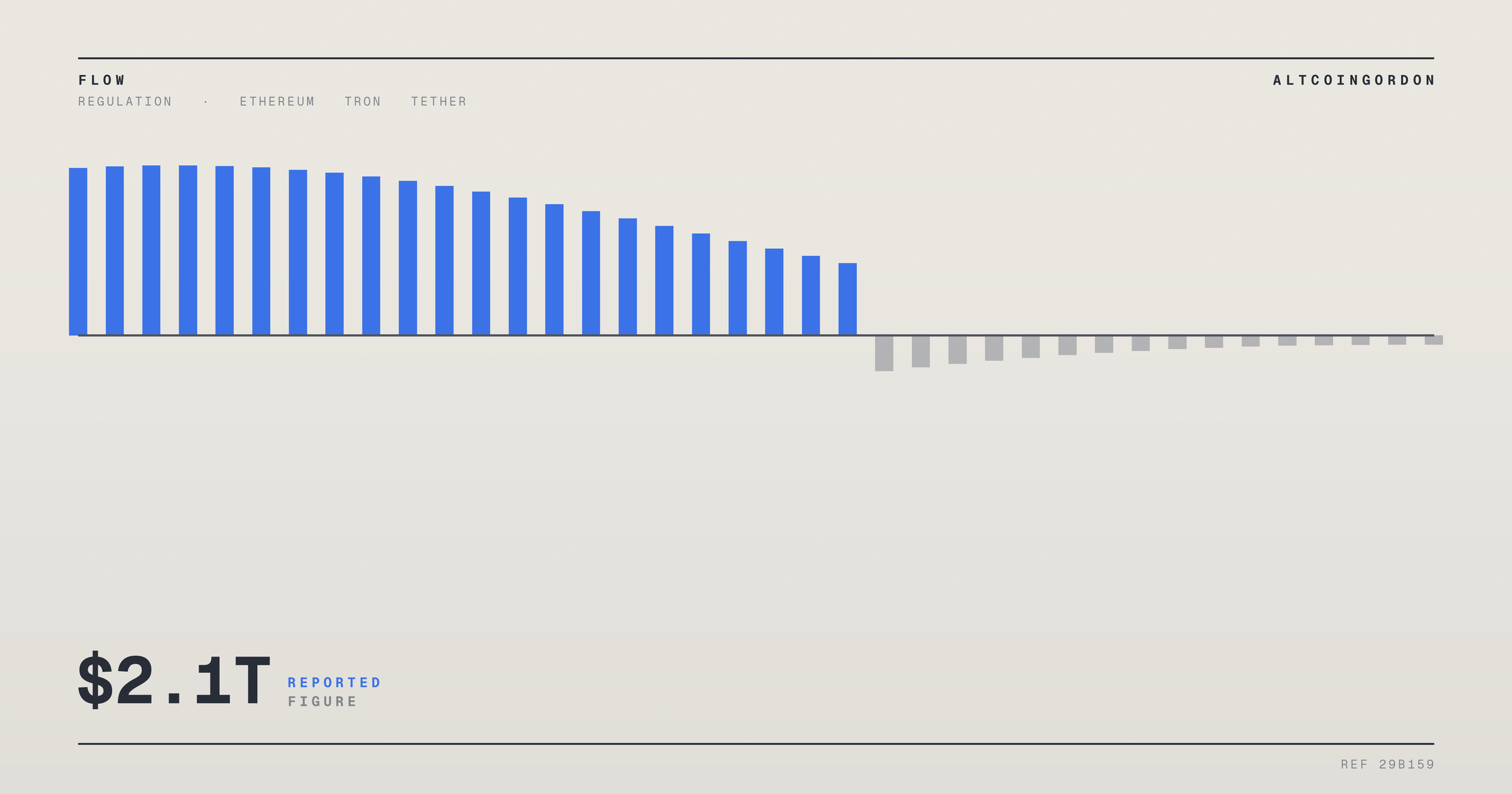
TRON's cumulative USDT transfer volume has reached $2.1 trillion, according to crypto.news. The figure underscores the blockchain's position as a primary settlement layer for Tether's stablecoin. Reporting from BitKE, citing second-quarter 2026 data, adds that TRON's total stablecoin supply hit a record high over the same period, with USDT making up the dominant share.
TRON has built its reputation on offering low transaction fees and fast settlement for stablecoin transfers. Those characteristics have made it a preferred network for moving USDT, particularly in regions where transaction costs on other chains can be prohibitive. The $2.1 trillion figure reflects cumulative transfer activity rather than a single snapshot, illustrating the scale of repeated usage over time.
The reported expansion of U.S. access adds a new dimension to TRON's growth story. Stablecoin activity in the United States has historically been concentrated on Ethereum and a handful of other networks favored by regulated exchanges and institutional custodians. Broader access for U.S. users to TRON-based USDT could shift some of that balance, though the specifics of how that access is expanding were not detailed in available reporting.
The record stablecoin supply on TRON during the second quarter points to sustained demand for dollar-pegged tokens on the network, independent of price swings in the broader crypto market. Stablecoin supply figures are often used as a proxy for on-chain liquidity, since tokens like USDT are frequently held for trading, remittances, and payments rather than speculation alone.
USDT's dominance within TRON's stablecoin ecosystem is consistent with its broader market position. Tether's token remains the most widely used stablecoin globally, and TRON has long been one of its most active issuance and circulation venues. The combination of high transfer volume and record supply suggests that dominance has held steady or strengthened into the current quarter.
Neither source detailed the precise mechanisms behind the reported expansion of U.S. access, nor did they specify whether the change stems from exchange listings, regulatory clarity, or infrastructure upgrades. Readers should treat the access-related claim as a reported development pending further detail from additional coverage.
Market Impact
A rising stablecoin supply and sustained transfer volume on TRON typically signal continued liquidity for USDT holders and traders who rely on the network for cost-efficient settlement. If U.S. access is genuinely expanding, it could bring TRON further into the mainstream of regulated crypto activity, a space it has historically occupied less prominently than Ethereum-based rails.
For stablecoin issuers and exchanges, TRON's growing footprint reinforces the importance of multi-chain support for USDT and other dollar-pegged tokens. Market participants tracking stablecoin flows as an indicator of liquidity conditions will likely watch whether TRON's supply and transfer figures continue climbing in subsequent quarters.
The reported $2.1 trillion in cumulative USDT transfers and record stablecoin supply mark a notable point in TRON's development as a settlement network. Further detail on the scope of expanded U.S. access will help clarify how significant this shift proves to be for the broader stablecoin market.
Frequently Asked Questions
What does the $2.1 trillion figure represent?
It reflects the cumulative volume of USDT transfers processed on the TRON network, as reported by crypto.news, rather than a single-period snapshot.
Why is TRON's stablecoin supply significant?
A record stablecoin supply suggests sustained demand for dollar-pegged tokens on the network, which analysts often use as an indicator of on-chain liquidity.
What does expanded U.S. access mean for TRON?
Reporting indicates that access for U.S.-based users is widening, though the specific mechanisms behind this change were not detailed in available coverage.
Why does USDT dominate TRON's stablecoin activity?
USDT has long been the most widely used stablecoin globally, and TRON has served as one of its major circulation and settlement networks due to low fees and fast transactions.