

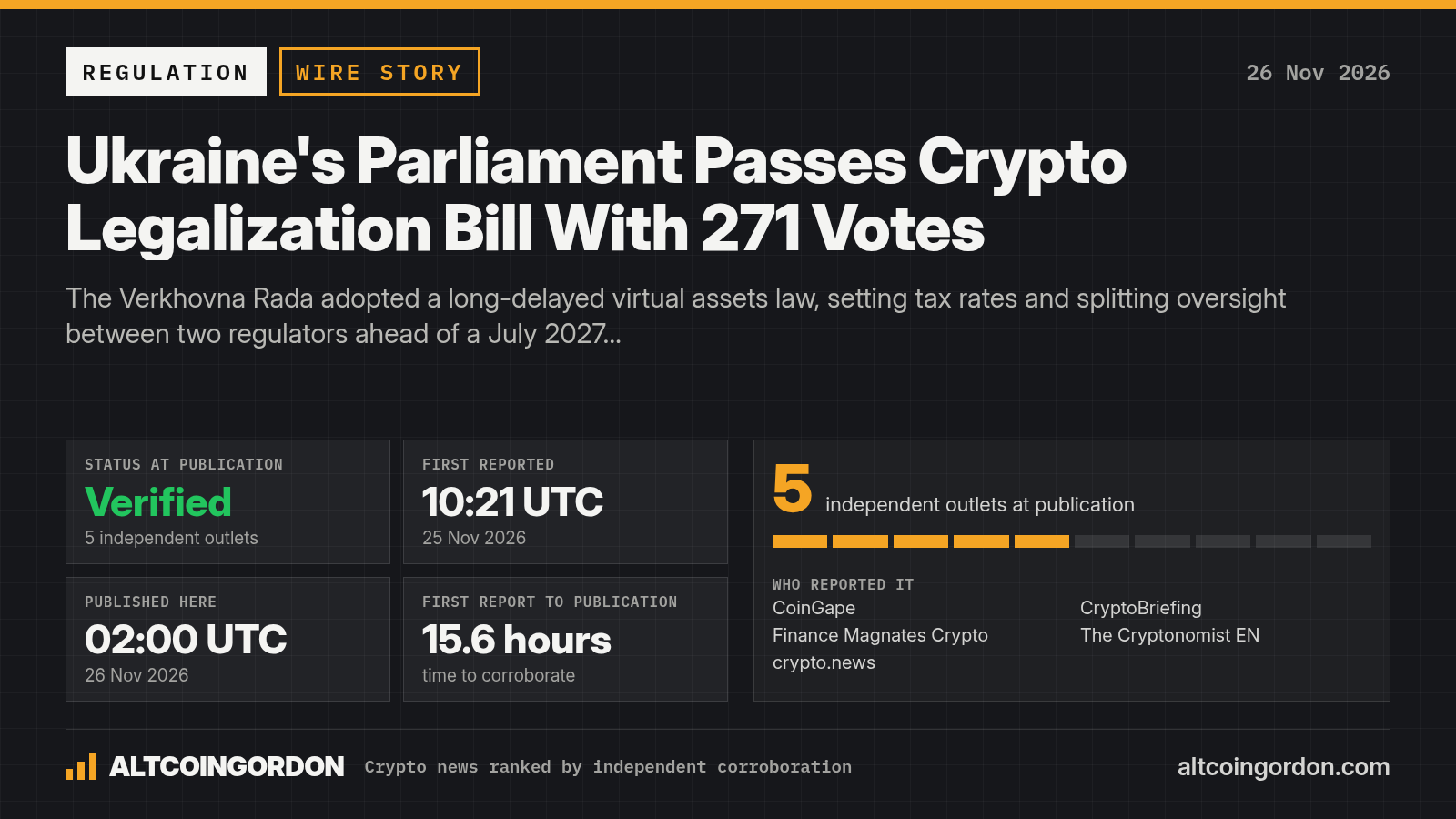
Ukraine's Verkhovna Rada passed Bill No. 10225-d, titled "On Virtual Assets," on November 25, 2026. Lawmakers approved the measure in its second reading and in full, with 271 votes in favor, the Rada's official bill card shows. Eight members voted against the bill. Four legislators abstained and 32 did not cast a vote.
The legislation amends Ukraine's Tax Code and other laws to establish rules covering virtual asset trading, custody, provider licensing and taxation. Lawmakers reviewed more than 2,500 amendments before settling on the final text. Parliament first approved the bill in an earlier reading on September 3, 2025, meaning the process took more than a year to conclude.
Oversight will be divided between two institutions. The National Securities and Stock Market Commission will license and supervise crypto exchanges, custodians and other service providers, and will have authority to seek court orders against unauthorized operators. The National Bank of Ukraine will handle electronic money, currency controls and stablecoin supervision. The law's approval followed disagreements between the two regulators over their respective responsibilities, Finance Magnates reported.
5% income tax plus 5% military levy through end of 2028
Forbes Ukraine says the 5%+5% rate applies to the entire sale amount, not just profit
On taxation, individuals will owe an 18% personal income tax plus a 5% military levy on annual profits from selling virtual assets, a combined rate of 23%. Profit will be calculated as sale proceeds minus documented acquisition cost. Swapping one virtual asset for another, such as bitcoin for USDT, will not trigger a taxable event. Annual profits within one minimum monthly wage are exempt, and virtual asset transactions will not carry VAT.
Holders of assets acquired before the law takes effect will get preferential treatment, though accounts of the terms differ. One version holds that a reduced rate of 5% personal income tax plus a 5% military levy will apply through the end of 2028, with the rate applied to the entire sale amount rather than just profit, as Forbes Ukraine has characterized it. The Cryptonomist, however, reported a 10% transitional tax on qualifying sales between July 1, 2027 and the end of 2028, also applied to the full sale amount rather than the gain.
The NSSMC confirmed the law is scheduled to take effect July 1, 2027, with the commission's next task being the drafting of implementing rules. The framework was built with reference to the European Union's Markets in Crypto-Assets regulation, fulfilling a commitment under the EU's Ukraine Facility that required crypto regulation by the third quarter of 2026. The law does not make cryptocurrency legal tender.
Lawmaker Yaroslav Zheleznyak said the law establishes the 18% tax and 5% levy and projected it would generate an additional 15 billion hryvnias in state revenue. Crypto Economy put the expected revenue at $332 million. Companies holding crypto on behalf of clients will be required to keep customer funds separate from corporate assets, a measure parliament said is meant to build trust in licensed providers. The parliamentary press service said the law's purpose is to allow new technology to develop without undermining financial stability or national security.
- 25 Nov 10:21CryptoBriefing · first report
- 25 Nov 10:40Coindoo
- 25 Nov 10:45crypto.news
- 25 Nov 11:20CoinGape
- 25 Nov 13:39The Cryptonomist EN
- 25 Nov 15:45CoinTurk News EN
- 25 Nov 16:43Finance Magnates Crypto
Market Impact
A clear legal framework could encourage Ukrainian exchanges, custodians and other service providers to seek formal licensing rather than operate informally, potentially bringing more trading activity onshore. The split between the securities regulator and the central bank mirrors structures used elsewhere, which may ease compliance for firms already navigating EU rules under MiCA.
The tax treatment, particularly the transitional rates for pre-existing holdings, will likely shape how quickly individual holders disclose and sell assets once the law takes effect in July 2027. Uncertainty over whether the discounted rate applies to gross proceeds or net profit could affect how investors plan asset sales during the transition window through 2028.
With the bill now awaiting the president's signature, Ukraine joins a small group of countries moving toward comprehensive crypto regulation aligned with EU standards. Implementation details, including the final shape of transitional tax rates, are expected to become clearer as the NSSMC drafts its supporting rules ahead of the July 2027 start date.
Frequently Asked Questions
When does Ukraine's new crypto law take effect?
The law is scheduled to take effect on July 1, 2027, according to CryptoBriefing and the National Securities and Stock Market Commission, as reported by Coindoo and CoinTurk News.
What tax rate will apply to crypto profits in Ukraine?
Individuals will owe an 18% personal income tax plus a 5% military levy on annual profits from selling virtual assets, a combination CoinGape described as a 23% combined rate.
Who will regulate crypto businesses in Ukraine?
The National Securities and Stock Market Commission will license and supervise exchanges, custodians and other providers, while the National Bank of Ukraine will oversee e-money, currency controls and stablecoins, according to crypto.news, CoinTurk News and the Cryptonomist.
Will crypto-to-crypto trades be taxed under the new law?
No. Exchanging one virtual asset for another, such as bitcoin for USDT, will not trigger a taxable event, according to the Cryptonomist.
How many lawmakers voted for and against the bill?
271 lawmakers voted in favor, according to CryptoBriefing, Coindoo, crypto.news, CoinGape and the Cryptonomist, with eight voting against, per CryptoBriefing, Coindoo, the Cryptonomist and CoinTurk News. CoinGape added that four abstained and 32 did not vote.