

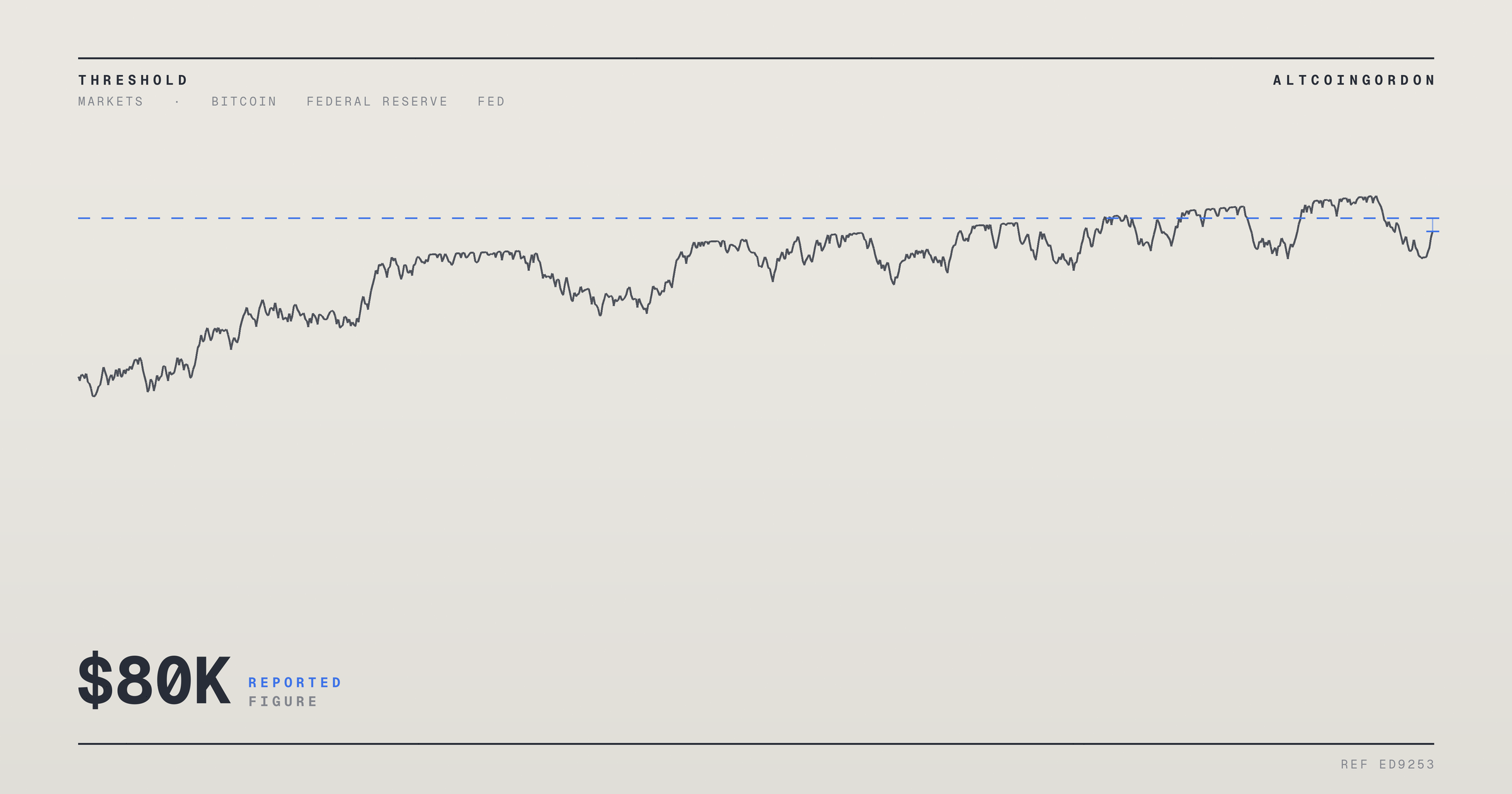
Bitcoin's price action has come under renewed scrutiny after Federal Reserve Bank of Cleveland President Beth Hammack signaled the central bank may need to act more forcefully against inflation. Her comments arrived as bitcoin hovered near the $80,000 mark, a level traders have treated as a key line in the sand for the asset's broader trend.
Hammack's remarks reinforce a cautious tone from parts of the Federal Reserve even as markets have priced in expectations for monetary easing. When Fed officials suggest inflation risks remain elevated, it typically dampens appetite for rate cuts, which can weigh on risk assets including cryptocurrencies.
Bitcoin and other digital assets tend to react to shifts in the interest rate outlook because lower rates generally support demand for non-yielding or speculative assets. A more hawkish Fed stance can have the opposite effect, pressuring valuations across equities and crypto markets alike.
Adding to the uncertainty, CryptoSlate reported that bitcoin has been confined to roughly an $8,000 trading range as the US approaches its midterm elections. This kind of range-bound behavior often reflects a market waiting for clarity on both monetary policy and political outcomes before committing to a new directional move.
Midterm elections historically introduce short-term volatility into financial markets, as investors weigh potential shifts in fiscal policy, regulation, and government spending priorities. For crypto markets specifically, political outcomes can influence the regulatory environment, including how agencies approach digital asset oversight and enforcement.
The combination of a hawkish Fed signal and election-related uncertainty has left bitcoin traders watching the $80,000 level closely. A decisive break below that threshold could open the door to further downside testing, while holding above it may reinforce the level as a durable support zone.
Market participants are also parsing Hammack's comments within the broader context of the Fed's dual mandate, balancing inflation control against employment and growth considerations. Any divergence among Fed officials on the appropriate pace of action tends to inject additional volatility into rate-sensitive markets, including crypto.
Market Impact
A more hawkish Federal Reserve stance generally reduces expectations for near-term rate cuts, which can pressure risk assets including bitcoin. If inflation concerns intensify, traders may reassess positioning across both crypto and traditional markets, potentially increasing volatility around key technical levels like $80,000.
The reported $8,000 trading range suggests bitcoin may continue to consolidate rather than trend strongly in either direction until there is more clarity on both Fed policy and the outcome of US midterm elections. Traders should expect choppy conditions as these two macro catalysts play out in parallel.
Bitcoin's ability to hold $80,000 will likely hinge on how the Federal Reserve's inflation stance evolves alongside political developments tied to the midterm elections.
Frequently Asked Questions
Who is Beth Hammack and why do her comments matter for bitcoin?
Beth Hammack is president of the Federal Reserve Bank of Cleveland. Her comments on inflation policy can influence market expectations for interest rates, which in turn affect demand for risk assets like bitcoin.
Why is $80,000 considered an important level for bitcoin?
Traders view $80,000 as a key support zone. Holding above it could reinforce confidence in the current price structure, while a break below may signal further downside risk.
What does the reported $8,000 trading range mean for bitcoin?
It suggests bitcoin has been moving within a relatively narrow band rather than establishing a clear trend, reflecting market uncertainty ahead of the US midterm elections.
How could US midterm elections affect bitcoin's price?
Midterm elections can introduce volatility by shifting expectations around fiscal policy and regulation, including how future lawmakers and agencies may approach cryptocurrency oversight.