

Bitcoin is above $65,000 and the reason has almost nothing to do with crypto. The stories that cleared independent corroboration over the past day point at a market taking its instructions from the US inflation calendar, while the one structural catalyst American crypto policy has been waiting on quietly got downgraded.
The price is trading the macro calendar
Bitcoin climbed past $65,000 with traders positioning ahead of the US inflation report, and separately the inflation outlook was reported as clouding the path to September’s rate decision. Both reached two independent publishers.
Read together they describe a market that is not pricing a crypto thesis at all. It is pricing the probability of a September cut, and buying ahead of a print that could move that probability either way. That matters for how much weight to put on the level itself: a move driven by rate expectations can be given back by a single data release, and $65,000 reached this way is a weaker floor than the same number reached on crypto-native demand.
The legislative catalyst just got longer odds
Against that, Grayscale’s Zach Pandl said the CLARITY Act is unlikely to pass in 2026 — carried by three independent publishers, which puts it among the better-corroborated claims of the period.
This is the assessment worth sitting with. US market-structure legislation has been the standing answer to why institutional allocation should accelerate, and the timeline for it has now slipped from “this year” in the spring to a senior figure at a major asset manager saying it probably will not happen at all in 2026. Nothing about that changes what Bitcoin does this week. It changes what the second half of the year is allowed to assume.
The build-out continues regardless, which is the actual signal
The infrastructure stories did not pause for any of the above:
- Michael Saylor signalled a possible new Bitcoin purchase by Strategy — three publishers.
- Canary’s XRP ETF drew $82 million of inflows while the price drop wiped out far more — two publishers, and the more instructive of the two numbers is the second one.
- The UK’s FCA is reported to be planning rules for tokenized gold — two publishers.
- EURe’s share of crypto card spending fell to 2% as USDC dominates — three publishers.
The XRP ETF line is the one to hold onto. Inflows and price are being treated as the same signal across a lot of coverage, and here they pointed in opposite directions within a single product on a single day. A fund can take money in while its underlying falls, and reporting the inflow without the drawdown produces a story that is true and misleading at once.
The EURe figure is a small number carrying a large point: dollar stablecoins are winning the payment rail in a European context too, and a 2% share is not a competitive position. Anyone modelling euro-denominated stablecoin adoption from regulatory intent rather than spending data is modelling the wrong thing.
The best-corroborated story of the day was not the price
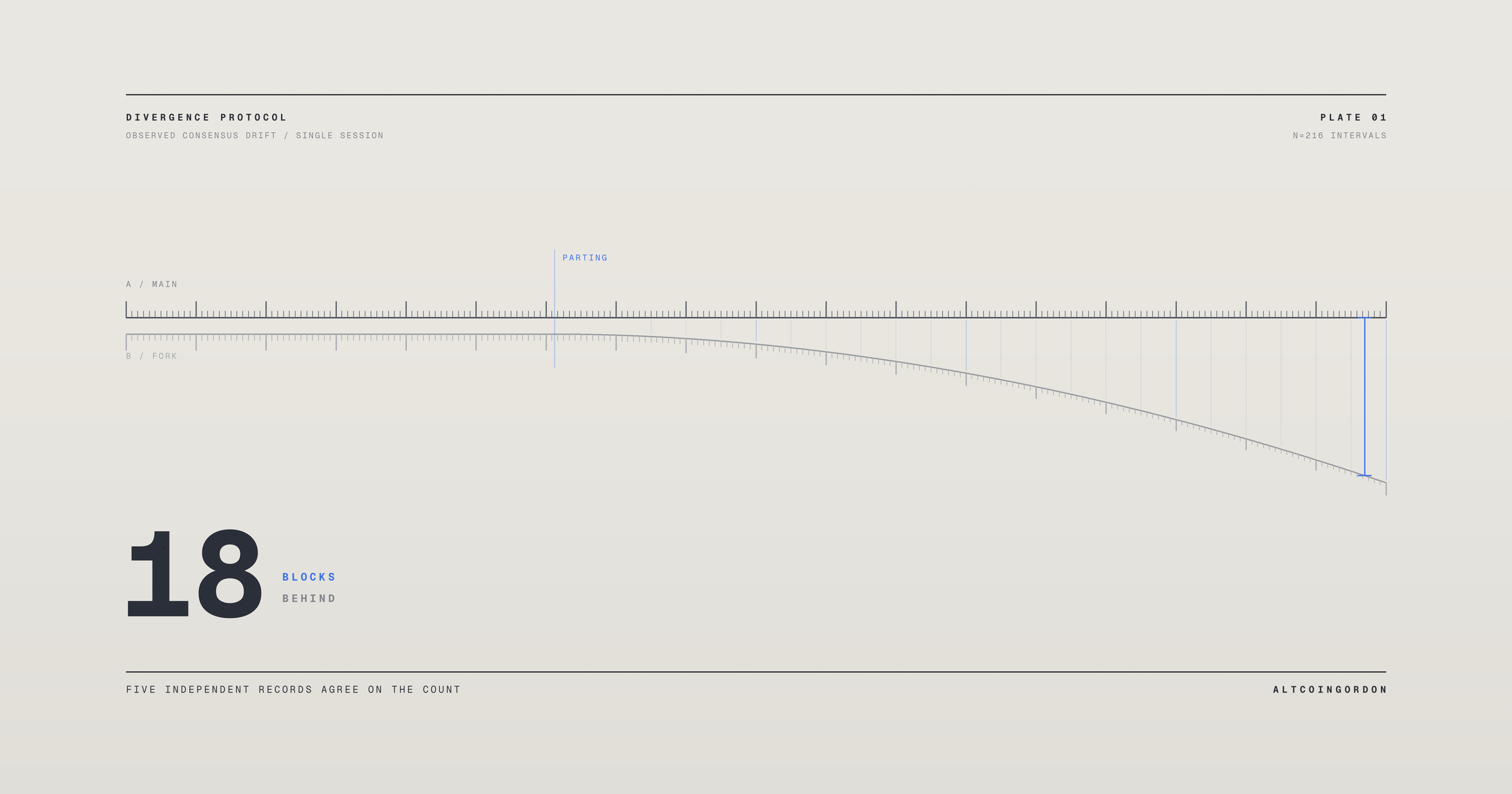
Five independent publishers — the highest count on this desk over the period — reported that a Bitcoin fork linked to the BIP-110 proposal has fallen 18 blocks behind the main chain.
It is worth noticing when the corroboration count and the attention economy disagree this sharply. A protocol dispute that produces a measurable, verifiable divergence gets five newsrooms independently at the keyboard; a price level gets two. That is usually a sign the technical story is the one with a checkable fact at its centre, and the price story is the one everybody can write from the same chart.
Also confirmed
Australia’s AUSTRAC suspended Cryptolink’s Bitcoin ATMs for three months (three publishers) — the crypto ATM channel continues to be where anti-money-laundering enforcement lands first, because it is the point where cash meets chain.
Grayscale withdrew three altcoin ETF filings, and publishers disagreed on what ADA, HBAR and DOT prices actually did afterwards — four publishers, and a genuine contradiction between them. That story is worth reading for the disagreement rather than through it.
What this adds up to
A market taking direction from the Federal Reserve rather than from itself, a US legislative catalyst being priced further out, and institutional plumbing continuing to get built on a timeline that appears indifferent to both. The plumbing is the part that compounds. The other two are this week’s weather.
Every claim above traces to a story on this site that reached at least two independent publishers before it was written; each is linked, and each carries its own publisher list and timestamps. Nothing here should have to be taken on our word.